Icaricia icarioides moroensis
Morro Bay Blue Butterfly
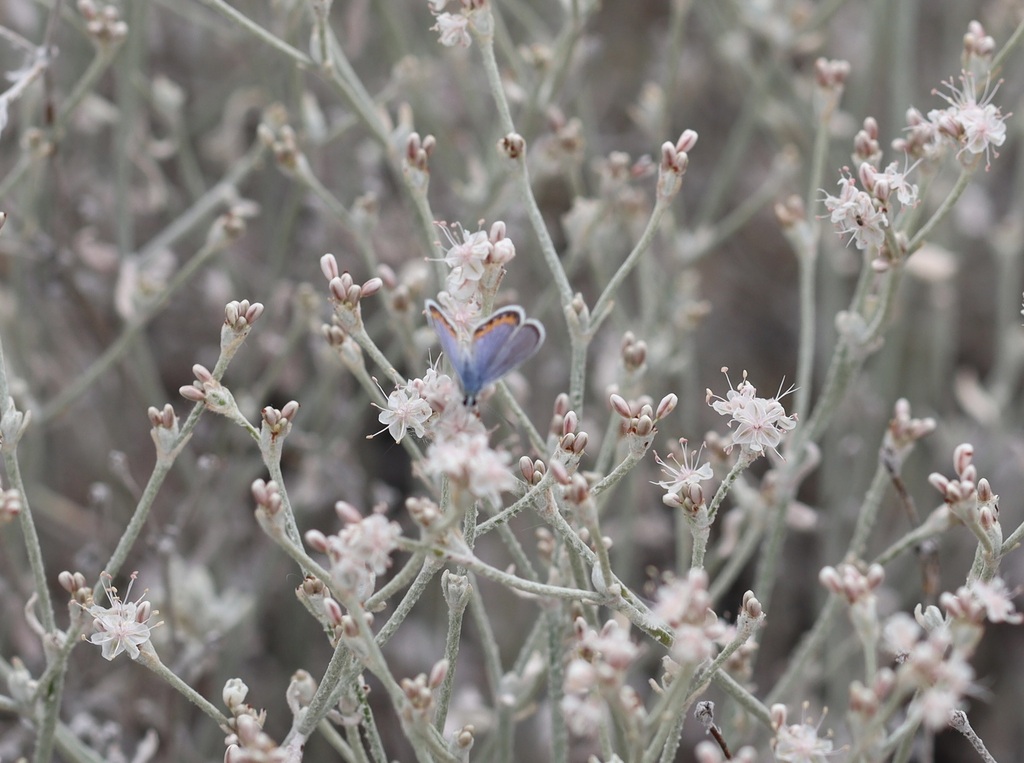
no rights reserved · CC0
Family: Lycaenidae · Class: Insecta · Order: Lepidoptera
Conservation status: G5T2 S2
Icaricia icarioides moroensis (Morro Bay Blue Butterfly) is a California animal in the Lycaenidae family.
The Morro Bay blue butterfly (Icaricia icarioides moroensis) is a subspecies of the Boisduval's blue butterfly endemic to a highly restricted range along the central California coast. This small lycaenid butterfly exhibits sexual dimorphism typical of blues, with males displaying iridescent blue dorsal wing surfaces and females showing brown wings with varying degrees of blue suffusion. The ventral wing surfaces are pale with distinctive black spots arranged in rows, with the inner row being round, black, and encircled with white. The subspecies moroensis is distinguished from related subspecies by having larger black spots on the underside of the hindwings compared to other coastal forms. The Morro Bay blue butterfly has an extremely limited distribution, historically and currently restricted to coastal areas around Morro Bay in San Luis Obispo County, California. This narrow endemic occupies one of the most restricted ranges of any North American butterfly subspecies. The species' range represents a small fraction of the broader distribution of Icaricia icarioides, which extends throughout western North America with over 1,900 documented occurrences using a 2-kilometer separation distance. The subspecies inhabits coastal scrub and dune communities in the immediate vicinity of Morro Bay. These habitats are characterized by sandy soils and maritime influence, supporting specialized plant communities adapted to salt spray and coastal conditions. The butterfly's habitat requirements appear closely tied to the presence of its host plants and specific microclimate conditions found in this coastal environment. Like other members of the Lycaenidae family, the Morro Bay blue butterfly undergoes complete metamorphosis. Adults are active during the flight season, which typically occurs in spring and early summer months when host plants are available and weather conditions are favorable. The species likely has a single generation per year, as is common among coastal California blues. Males establish territories and engage in mate-seeking behavior, while females focus on locating suitable host plants for egg laying. Larvae develop on native legumes, following the typical lycaenid pattern of close association with specific plant species. The conservation status of the Morro Bay blue butterfly reflects its extremely restricted range and small population size. NatureServe assigns it a global rank of G5T2, indicating the subspecies is imperiled with a very high risk of extinction due to restricted range and few populations. The subspecies faces ongoing threats typical of coastal California endemics, including habitat loss and fragmentation from development, invasive plant species, and potential impacts from climate change affecting coastal ecosystems. The butterfly's survival depends entirely on the protection and management of its limited coastal habitat around Morro Bay. Given its narrow endemic status and restricted range, any significant habitat disturbance could threaten the subspecies' continued existence. Conservation efforts must focus on habitat protection and management within its small geographic range to ensure long-term population viability.
Classification
Class: Insecta · Order: Lepidoptera · Family: Lycaenidae
Conservation status
G5T2 S2
Frequently asked questions
How is Icaricia icarioides moroensis classified?
Icaricia icarioides moroensis belongs to class Insecta, order Lepidoptera, family Lycaenidae.
What family does Icaricia icarioides moroensis belong to?
Icaricia icarioides moroensis is in the Lycaenidae family.
Is Icaricia icarioides moroensis protected or of conservation concern?
Icaricia icarioides moroensis carries the following status: G5T2 S2.
What is Icaricia icarioides moroensis?
The Morro Bay blue butterfly (Icaricia icarioides moroensis) is a subspecies of the Boisduval's blue butterfly endemic to a highly restricted range along the central California coast.
Is Icaricia icarioides moroensis found in California?
Yes. Icaricia icarioides moroensis is recorded in California in The California Species Project's catalogue.
Related species
Other California species in the same genus, family, or bioregion.
Data from The California Species Project — 14,000+ California species with verified data from CNPS, CDFW, USFWS, and more.