Icaricia icarioides parapheres
Point Reyes Blue Butterfly
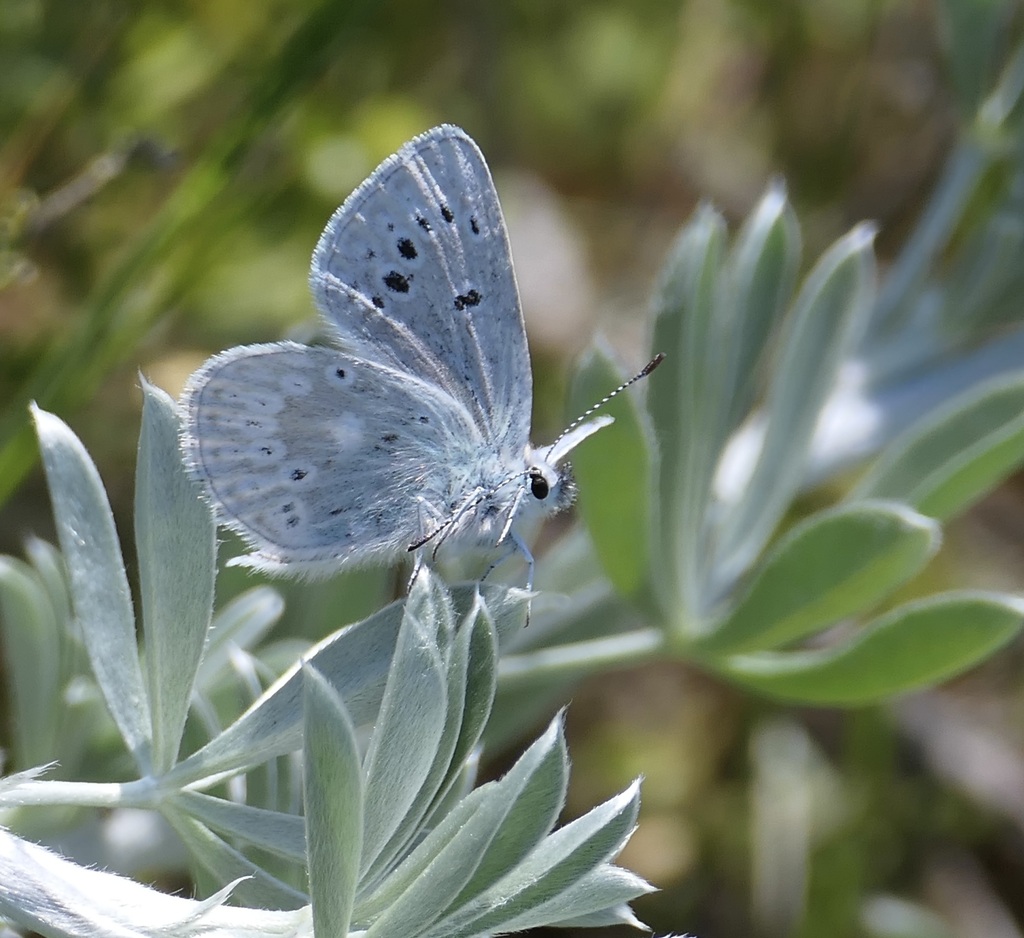
(c) John Hibbard, some rights reserved (CC BY) · licence
Family: Lycaenidae · Class: Insecta · Order: Lepidoptera
Conservation status: G5T1T2 S1
Icaricia icarioides parapheres (Point Reyes Blue Butterfly) is a California animal in the Lycaenidae family.
The Point Reyes Blue Butterfly (Icaricia icarioides parapheres) is a subspecies of Boisduval's Blue, a small lycaenid butterfly endemic to the Point Reyes peninsula in Marin County, California. This subspecies belongs to a complex of 25 recognized subspecies of Icaricia icarioides distributed across North America, but is distinguished by its extremely limited geographic range and specialized habitat requirements. Males typically display bright blue dorsal wing surfaces with narrow dark borders, while females are generally brown or brownish-gray with varying amounts of blue scaling near the wing bases. The ventral wing surfaces of both sexes are pale gray to whitish with distinctive black spots circled in white, characteristic of the lycaenid family. The wingspan measures approximately 25-30 millimeters (1.0-1.2 inches). This subspecies occurs exclusively in coastal dune habitats within the Point Reyes National Seashore area of Marin County, California. The range is extremely restricted to fore and rear dune systems along the Pacific Coast, making it one of the most geographically limited butterfly subspecies in North America. Historical records suggest the population may have been more widespread within the Point Reyes peninsula, but current distribution appears confined to specific dune complexes. The Point Reyes Blue inhabits coastal prairie and dune grassland communities, typically in areas with a mosaic of native vegetation and sandy soils. These habitats are characterized by exposure to marine influences including salt spray, fog, and strong coastal winds. The subspecies requires the presence of specific host plants within the legume family (Fabaceae), though detailed host plant relationships for this particular subspecies have not been comprehensively documented in available literature. Like other Icaricia icarioides subspecies, adults are active during late spring and early summer months, typically from May through July. Males engage in patrolling behavior to locate females, often flying close to the ground in areas where host plants are present. Females deposit eggs singly on or near host plant foliage. The species likely has a single generation per year, with larvae developing through summer and fall months before pupating and overwintering. The Point Reyes Blue Butterfly carries a global rank of G5T1T2, indicating the full species is secure globally but this subspecies is critically imperiled to imperiled, with a state rank of S1 in California, designating it as critically imperiled at the state level. The extremely restricted range makes this subspecies highly vulnerable to habitat loss, degradation, and environmental changes. Coastal development pressures, altered fire regimes, invasive plant species, and climate change impacts including sea level rise pose significant threats to the limited dune habitat. The subspecies' occurrence within Point Reyes National Seashore provides some protection, but the small population size and restricted range make it particularly susceptible to local extinctions. Conservation efforts require careful habitat management to maintain the specialized dune ecosystem conditions necessary for the subspecies' survival.
Classification
Class: Insecta · Order: Lepidoptera · Family: Lycaenidae
Conservation status
G5T1T2 S1
Frequently asked questions
How is Icaricia icarioides parapheres classified?
Icaricia icarioides parapheres belongs to class Insecta, order Lepidoptera, family Lycaenidae.
What family does Icaricia icarioides parapheres belong to?
Icaricia icarioides parapheres is in the Lycaenidae family.
Is Icaricia icarioides parapheres protected or of conservation concern?
Icaricia icarioides parapheres carries the following status: G5T1T2 S1.
What is Icaricia icarioides parapheres?
The Point Reyes Blue Butterfly (Icaricia icarioides parapheres) is a subspecies of Boisduval's Blue, a small lycaenid butterfly endemic to the Point Reyes peninsula in Marin County, California.
Is Icaricia icarioides parapheres found in California?
Yes. Icaricia icarioides parapheres is recorded in California in The California Species Project's catalogue.
Related species
Other California species in the same genus, family, or bioregion.
Data from The California Species Project — 14,000+ California species with verified data from CNPS, CDFW, USFWS, and more.