Ictalurus furcatus
Blue catfish
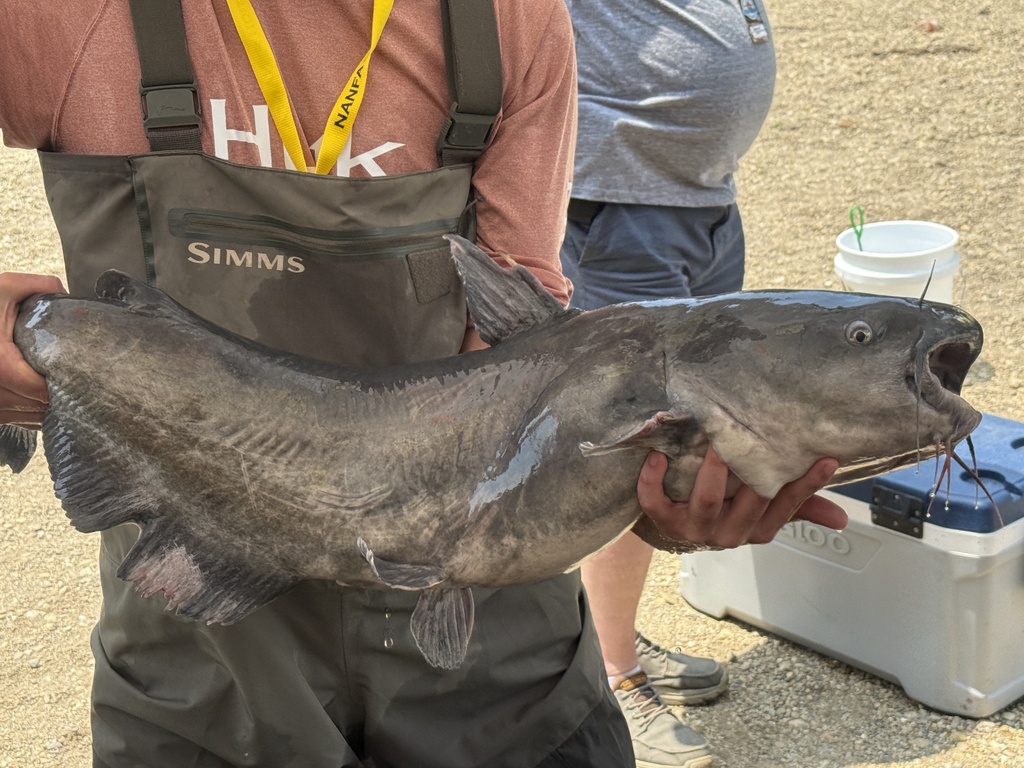
(c) Nick Tobler (Cowturtle), some rights reserved (CC BY) · licence
Family: Ictaluridae · Class: Actinopterygii · Order: Siluriformes
Ictalurus furcatus (Blue catfish) is a California animal in the Ictaluridae family.
The blue catfish is a large freshwater fish native to major river systems of the south-central and southeastern United States. As North America's largest catfish species, blue catfish can exceed 1.5 meters (5 feet) in length and weigh over 45 kilograms (100 pounds). The species exhibits a slate blue to gray coloration on the dorsal surface, transitioning to white or pale blue on the ventral side. Blue catfish are distinguished from channel catfish by their straight-edged anal fin with 30 to 36 rays, compared to the curved anal fin of channel catfish. The barbels around the mouth are shorter relative to body size than those of other catfish species, and the forked tail gives rise to the scientific name furcatus. Historically, blue catfish inhabited the Mississippi River basin from Minnesota south to the Gulf of Mexico, and major tributaries including the Missouri, Ohio, Arkansas, and Tennessee rivers. The species has been widely introduced outside its native range for recreational fishing and aquaculture purposes. In California, blue catfish have been introduced to various reservoirs and river systems, though they are not native to the state. Established populations exist in several California water bodies, where they are managed as a recreational fishery. Blue catfish prefer large rivers, reservoirs, and lakes with moderate to swift current. They typically inhabit deeper waters during daylight hours and move to shallower areas to feed at night. The species tolerates a wide range of water temperatures and can survive in waters with low dissolved oxygen levels. Blue catfish demonstrate a preference for areas with sandy or rocky bottoms and are often found near submerged structures such as fallen trees or rock formations. As opportunistic omnivores, blue catfish consume fish, crustaceans, mollusks, aquatic insects, and plant matter. Larger individuals prey heavily on other fish species, including gizzard shad, skipjack herring, and smaller catfish. Blue catfish are long-lived, with some individuals reaching ages exceeding 30 years. Spawning occurs from April through June when water temperatures reach 21 to 24 degrees Celsius (70 to 75 degrees Fahrenheit). Males construct nests in cavities along riverbanks or under submerged objects, where females deposit 4,000 to 100,000 eggs depending on body size. Males guard the eggs and fry for several weeks after hatching. Blue catfish are not federally listed and are considered a species of recreational and commercial importance throughout much of their range. In some introduced areas, populations have grown rapidly and raised concerns about impacts on native fish communities. The species' adaptability and long lifespan contribute to successful establishment in non-native waters. Management strategies vary by location, with some jurisdictions promoting blue catfish as a recreational fishery while others implement control measures to protect native species.
Classification
Class: Actinopterygii · Order: Siluriformes · Family: Ictaluridae
Frequently asked questions
How is Ictalurus furcatus classified?
Ictalurus furcatus belongs to class Actinopterygii, order Siluriformes, family Ictaluridae.
What family does Ictalurus furcatus belong to?
Ictalurus furcatus is in the Ictaluridae family.
What is Ictalurus furcatus?
The blue catfish is a large freshwater fish native to major river systems of the south-central and southeastern United States.
Is Ictalurus furcatus found in California?
Yes. Ictalurus furcatus is recorded in California in The California Species Project's catalogue.
Related species
Other California species in the same genus, family, or bioregion.
Data from The California Species Project — 14,000+ California species with verified data from CNPS, CDFW, USFWS, and more.