Ictalurus punctatus
Channel catfish
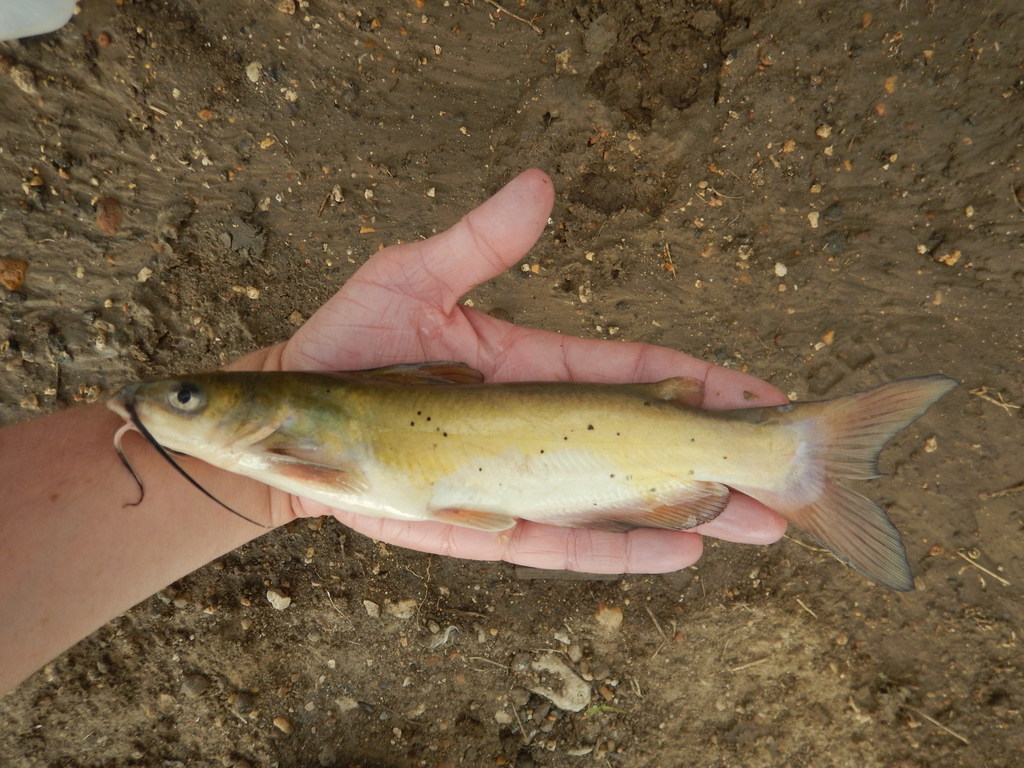
(c) Fishes of Texas team, some rights reserved (CC BY-SA) · licence
Family: Ictaluridae · Class: Actinopterygii · Order: Siluriformes
Ictalurus punctatus (Channel catfish) is a California animal in the Ictaluridae family.
The channel catfish is a large freshwater fish species native to central North America but widely introduced throughout California and much of the United States. Adults typically reach 40 to 60 centimeters (16 to 24 inches) in length and weigh 1 to 3 kilograms (2 to 7 pounds), though specimens can exceed 90 centimeters (35 inches) and 20 kilograms (45 pounds). The body is elongated and laterally compressed with a forked tail fin. The skin lacks scales and appears smooth, ranging from blue-gray to olive-brown dorsally with pale yellow to white undersides. Eight barbels surround the mouth, with four under the chin and two on each side of the upper jaw. Adults display scattered dark spots along the sides, which may fade with age. Originally native to the Mississippi River basin and Great Lakes region, channel catfish have been extensively introduced to water bodies throughout California since the early 1900s. The species now occurs in the Sacramento-San Joaquin Delta, Colorado River system, and numerous reservoirs, ponds, and slow-moving rivers throughout the Central Valley and southern California. Populations are established in major water bodies including Clear Lake, Folsom Lake, and the Salton Sea. Channel catfish inhabit warm, slow-moving waters including rivers, lakes, reservoirs, and ponds. They prefer areas with soft bottoms of mud, sand, or gravel and tolerate a wide range of water conditions. The species thrives in temperatures between 24 to 29 degrees Celsius (75 to 84 degrees Fahrenheit) but can survive in waters from near freezing to 38 degrees Celsius (100 degrees Fahrenheit). They are highly tolerant of low oxygen conditions and turbid water. Channel catfish are opportunistic omnivores with a diet consisting of aquatic insects, crustaceans, mollusks, small fish, plant matter, and organic debris. They use their sensitive barbels and taste buds distributed across their body to locate food in murky water. Spawning occurs from late spring through early summer when water temperatures reach 21 to 27 degrees Celsius (70 to 80 degrees Fahrenheit). Males construct nests in cavities under logs, rocks, or banks, where females deposit 2,000 to 70,000 adhesive eggs depending on body size. Males guard the nest and young for several weeks after hatching. Channel catfish are not listed under federal or California endangered species legislation and maintain stable populations throughout their introduced range in California. As a non-native species, they may compete with native fish for food and habitat resources. The California Department of Fish and Wildlife manages channel catfish as a sport fish, with established populations supporting recreational angling throughout the state. Their adaptability and tolerance to varied environmental conditions have enabled successful establishment in diverse California water systems.
Classification
Class: Actinopterygii · Order: Siluriformes · Family: Ictaluridae
Frequently asked questions
How is Ictalurus punctatus classified?
Ictalurus punctatus belongs to class Actinopterygii, order Siluriformes, family Ictaluridae.
What family does Ictalurus punctatus belong to?
Ictalurus punctatus is in the Ictaluridae family.
What is Ictalurus punctatus?
The channel catfish is a large freshwater fish species native to central North America but widely introduced throughout California and much of the United States.
Is Ictalurus punctatus found in California?
Yes. Ictalurus punctatus is recorded in California in The California Species Project's catalogue.
Related species
Other California species in the same genus, family, or bioregion.
Data from The California Species Project — 14,000+ California species with verified data from CNPS, CDFW, USFWS, and more.