Icteria virens
Yellow-breasted Chat
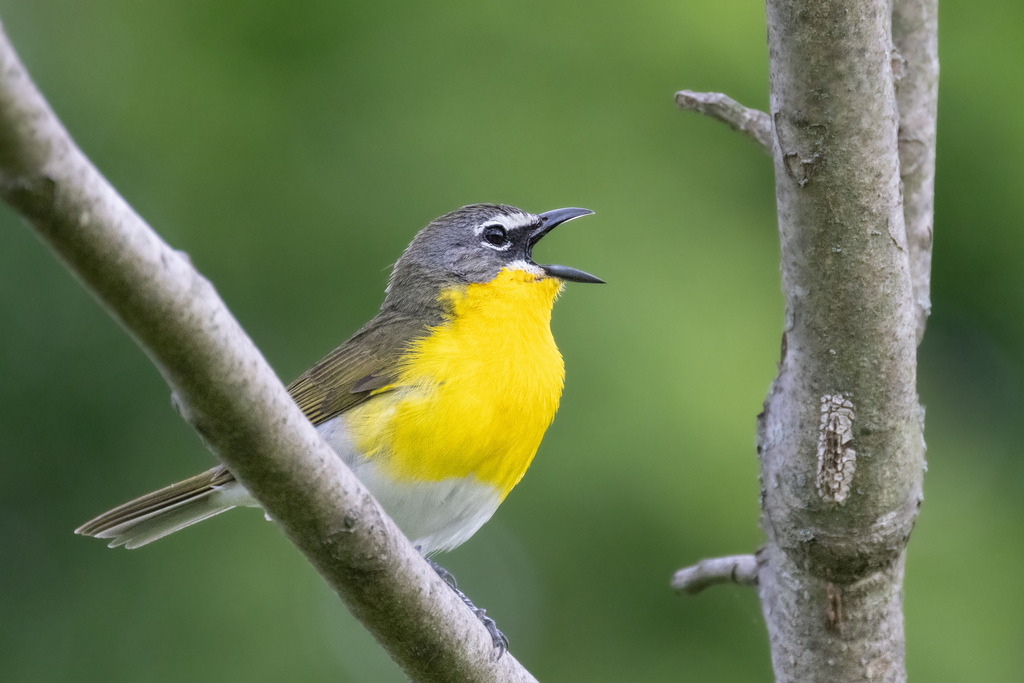
no rights reserved · CC0
Family: Icteriidae · Class: Aves · Order: Passeriformes
Conservation status: G5 S4
Icteria virens (Yellow-breasted Chat) is a California animal in the Icteriidae family.
The Yellow-breasted Chat is North America's largest warbler-like songbird, measuring 17-19 cm (6.7-7.5 inches) in length with a wingspan of 23-27 cm (9-10.5 inches). Adult males display bright yellow throat and breast plumage contrasting with olive-green upperparts and white underparts below the breast. The head features distinctive white spectacles formed by white eye-rings and superciliary stripes, with a dark lore creating a masked appearance. Females show similar but slightly duller coloration. The species has a thick, slightly decurved bill adapted for gleaning insects and berries, and relatively long legs for a passerine. Yellow-breasted Chats breed throughout much of the continental United States and extend into southern Canada, with their range reaching from British Columbia east to New Hampshire and south to northern Mexico. In California, the species occurs primarily in the Central Valley, coastal ranges, and foothills of the Sierra Nevada, generally below 1,500 meters (4,900 feet) elevation. According to eBird data, breeding populations are most consistent in riparian corridors of the Sacramento and San Joaquin valleys, with scattered populations in suitable habitat throughout the state's lower elevations. The species inhabits dense riparian thickets, brushy areas along streams, and early successional habitats with thick understory vegetation. Preferred breeding habitat includes willow and cottonwood riparian forests, blackberry tangles, and shrubland edges. Yellow-breasted Chats require areas with canopy cover between 25-75% and dense understory vegetation 1-4 meters high for nesting. They are typically found near water sources but may occur in dry brushlands with sufficient cover during migration. Yellow-breasted Chats are secretive birds that remain hidden in dense vegetation while foraging. Their diet consists primarily of insects including beetles, caterpillars, moths, and ants, supplemented by berries and small fruits during late summer and migration. Males are known for their varied repertoire of calls, whistles, and chattering sounds, often delivered from concealed perches or during brief display flights. Breeding occurs from May through July, with females constructing cup-shaped nests 0.6-2.4 meters above ground in dense shrubs. Clutch size ranges from 3-5 eggs, with an incubation period of 11-12 days. The Yellow-breasted Chat is not federally or state listed but faces population declines in many regions due to habitat loss. According to the North American Breeding Bird Survey, populations have declined by approximately 1.1% annually since 1966. In California, riparian habitat destruction and fragmentation represent primary threats, along with cowbird parasitism and pesticide use in agricultural areas. The species benefits from riparian restoration projects and maintenance of dense shrubland habitats. Climate change may affect breeding ranges as suitable riparian habitats shift with changing precipitation patterns and water availability.
Classification
Class: Aves · Order: Passeriformes · Family: Icteriidae
Conservation status
G5 S4
Frequently asked questions
How is Icteria virens classified?
Icteria virens belongs to class Aves, order Passeriformes, family Icteriidae.
What family does Icteria virens belong to?
Icteria virens is in the Icteriidae family.
Is Icteria virens protected or of conservation concern?
Icteria virens carries the following status: G5 S4.
What is Icteria virens?
The Yellow-breasted Chat is North America's largest warbler-like songbird, measuring 17-19 cm (6.7-7.5 inches) in length with a wingspan of 23-27 cm (9-10.5 inches).
Is Icteria virens found in California?
Yes. Icteria virens is recorded in California in The California Species Project's catalogue.
More California species
This species has no close relatives in our California data — here are other species to explore.
Data from The California Species Project — 14,000+ California species with verified data from CNPS, CDFW, USFWS, and more.