Icterus bullockii
Bullock's Oriole
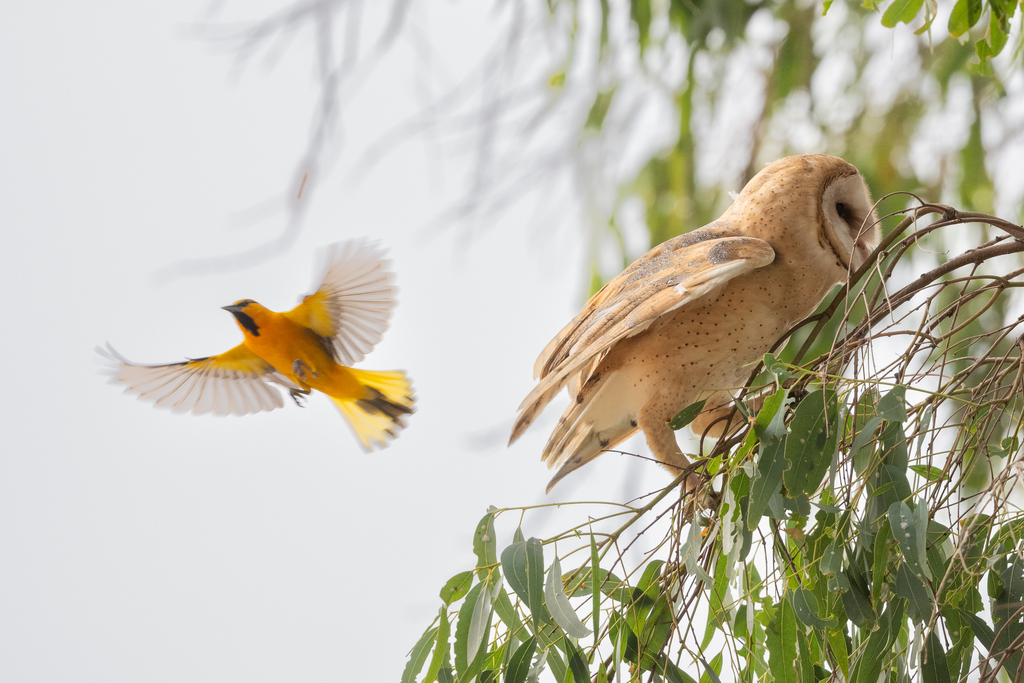
(c) Michael Eisen, some rights reserved (CC BY) · licence
Family: Icteridae · Class: Aves · Order: Passeriformes
Icterus bullockii (Bullock's Oriole) is a California animal in the Icteridae family.
Bullock's Oriole is a medium-sized songbird measuring 17 to 19 cm (6.7 to 7.5 inches) in length with a wingspan of 30 cm (12 inches). Adult males display bright orange plumage on the head, neck, rump, and underparts, contrasting sharply with black wings, back, throat, and eye line. The wings feature prominent white wing bars and white edging on flight feathers. Adult females and juveniles are pale yellow to whitish below with grayish-olive upperparts and two distinct white wing bars. Males develop their full breeding plumage by their second year. Bullock's Oriole breeds across western North America from southern British Columbia through the western United States to northern Mexico. In California, the species occurs throughout most of the state except for high elevations of the Sierra Nevada and Cascade ranges, and portions of the southeastern deserts. During winter, most populations migrate to western Mexico, though some individuals remain in coastal California and the Central Valley. The species shows strong site fidelity to breeding territories. This oriole inhabits open woodlands, riparian forests, parks, and suburban areas with mature trees. Preferred habitat includes cottonwood and willow groves along streams, oak woodlands, and areas with scattered large trees. The species typically occurs from sea level to 2,100 meters (6,900 feet) elevation, favoring areas with a mix of open ground for foraging and tall trees for nesting. Urban and suburban environments with ornamental trees and water sources also support breeding populations. Bullock's Oriole feeds primarily on insects during the breeding season, including caterpillars, beetles, ants, and grasshoppers. The species also consumes nectar from flowers, particularly those of agave and other tubular blooms, and fruits such as berries and oranges. Foraging occurs in tree canopies and shrubs, with birds using their pointed bills to probe bark crevices and extract insects. The breeding season extends from April through July. Females construct distinctive pendant nests woven from plant fibers, hair, and string, suspended from the tips of drooping branches. Clutch size ranges from 3 to 6 eggs, with an incubation period of 12 to 14 days. Young fledge after 12 to 14 days in the nest. Bullock's Oriole is not federally or state listed and maintains stable populations across most of its range. The species has adapted well to human-modified landscapes and may benefit from ornamental plantings in urban areas. However, localized declines occur in areas where riparian habitat has been removed or degraded. Brown-headed Cowbird parasitism affects some populations, with cowbird eggs occasionally replacing oriole eggs in nests. Climate change may alter the timing of insect emergence and flowering, potentially affecting breeding success and migration timing. Conservation efforts focus on maintaining riparian corridors and native tree plantings in developed areas.
Classification
Class: Aves · Order: Passeriformes · Family: Icteridae
Frequently asked questions
How is Icterus bullockii classified?
Icterus bullockii belongs to class Aves, order Passeriformes, family Icteridae.
What family does Icterus bullockii belong to?
Icterus bullockii is in the Icteridae family.
What is Icterus bullockii?
Bullock's Oriole is a medium-sized songbird measuring 17 to 19 cm (6.7 to 7.5 inches) in length with a wingspan of 30 cm (12 inches).
Is Icterus bullockii found in California?
Yes. Icterus bullockii is recorded in California in The California Species Project's catalogue.
Related species
Other California species in the same genus, family, or bioregion.
Data from The California Species Project — 14,000+ California species with verified data from CNPS, CDFW, USFWS, and more.