Icterus galbula
Baltimore Oriole
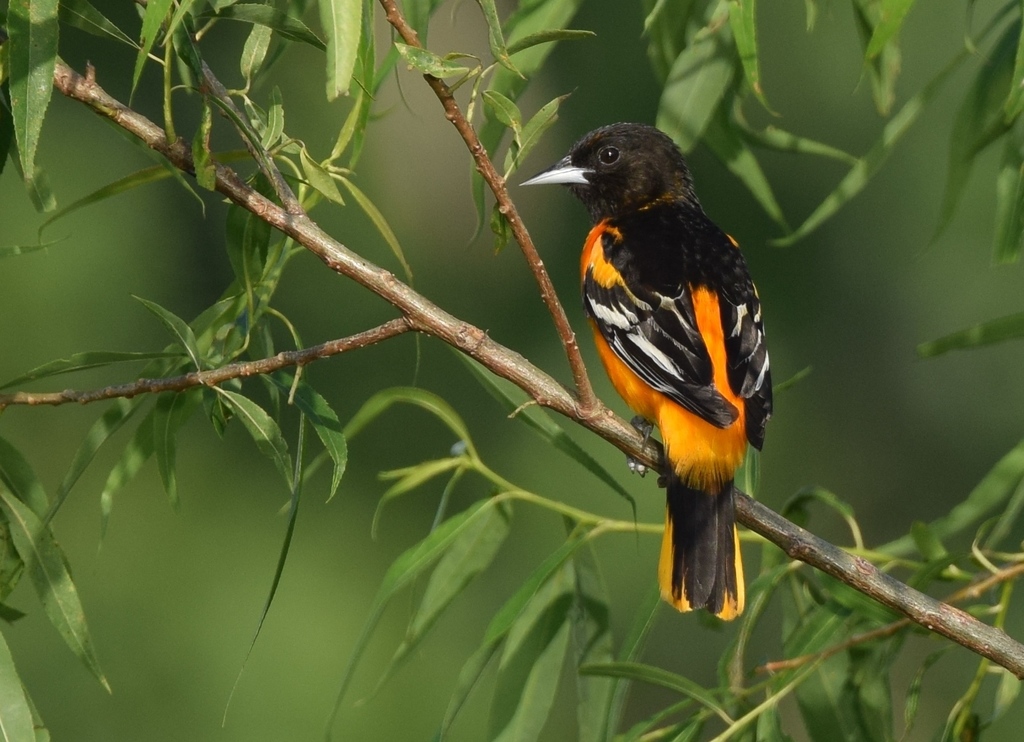
no rights reserved · CC0
Family: Icteridae · Class: Aves · Order: Passeriformes
Icterus galbula (Baltimore Oriole) is a California animal in the Icteridae family.
The Baltimore Oriole is a medium-sized songbird measuring 17 to 22 cm (6.7 to 8.7 inches) in length with a wingspan of 23 to 32 cm (9.1 to 12.6 inches). Adult males display distinctive bright orange plumage on the head, breast, belly, and rump, contrasting sharply with black wings, tail, back, and head. Females and immature birds show more subdued coloration with olive-yellow to orange underparts and brownish-olive upperparts. Both sexes possess a straight, pointed bill adapted for their varied diet. The Baltimore Oriole breeds across eastern North America from southern Canada to the Gulf Coast states. In California, the species occurs primarily as a vagrant or uncommon migrant, with scattered records throughout the state but most frequently documented along the coast and in desert regions during spring and fall migration periods. Historical records exist from locations including the Salton Sea, Point Reyes, and various coastal counties. The species does not maintain breeding populations in California. During the breeding season, Baltimore Orioles inhabit deciduous woodlands, particularly areas with mature trees such as elm, cottonwood, and maple. They show preference for open woodland edges, parks, and suburban areas with large shade trees. In their eastern range, they construct distinctive hanging nest structures suspended from branch tips, typically 6 to 30 feet above ground. The species demonstrates adaptability to human-modified landscapes when suitable nesting trees remain available. Baltimore Orioles consume a diverse diet consisting of insects, fruits, and nectar. During breeding season, they primarily feed on caterpillars, beetles, and other insects, providing high-protein food sources for developing young. Adults also consume ripe fruits including cherries, mulberries, and oranges, and regularly visit nectar feeders. Their foraging behavior involves gleaning insects from foliage and bark crevices. Breeding occurs from May through July, with females constructing elaborate pouch-shaped nests woven from plant fibers, hair, and string. Clutch size ranges from 3 to 6 eggs, with an incubation period of 12 to 14 days. The Baltimore Oriole maintains stable populations across most of its range and lacks federal or state conservation listing status. According to the North American Breeding Bird Survey, continental populations have remained relatively stable since 1970, though some regional declines have occurred in portions of the breeding range. The species faces threats from habitat loss due to removal of mature shade trees in urban and suburban environments, pesticide use that reduces insect prey availability, and collisions with communication towers during migration. Climate change may affect food availability and migration timing. In California, the species remains a rare but regular vagrant with no significant conservation concerns due to its transient status in the state.
Classification
Class: Aves · Order: Passeriformes · Family: Icteridae
Frequently asked questions
How is Icterus galbula classified?
Icterus galbula belongs to class Aves, order Passeriformes, family Icteridae.
What family does Icterus galbula belong to?
Icterus galbula is in the Icteridae family.
What is Icterus galbula?
The Baltimore Oriole is a medium-sized songbird measuring 17 to 22 cm (6.7 to 8.7 inches) in length with a wingspan of 23 to 32 cm (9.1 to 12.6 inches).
Is Icterus galbula found in California?
Yes. Icterus galbula is recorded in California in The California Species Project's catalogue.
Related species
Other California species in the same genus, family, or bioregion.
Data from The California Species Project — 14,000+ California species with verified data from CNPS, CDFW, USFWS, and more.