Icterus parisorum
Scott's Oriole
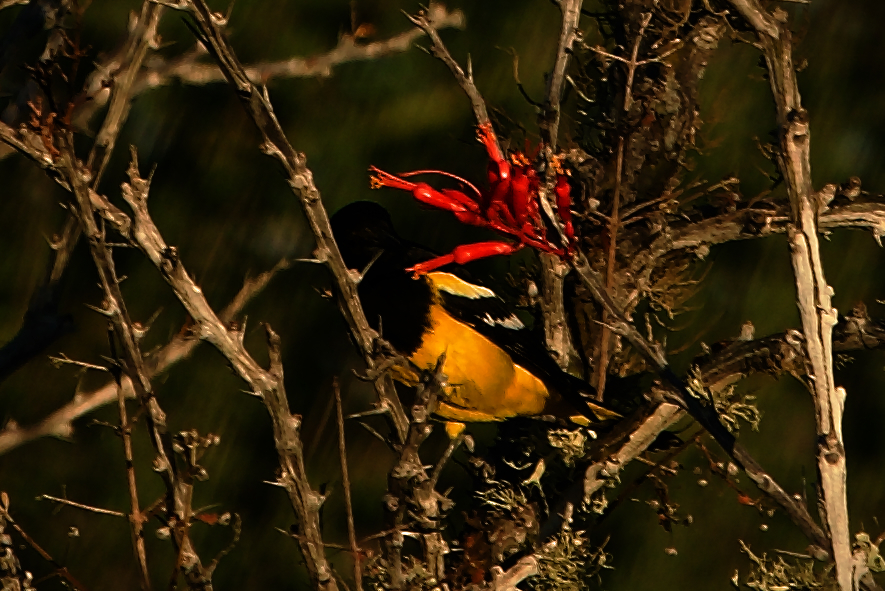
(c) Bill Levine, some rights reserved (CC BY) · licence
Family: Icteridae · Class: Aves · Order: Passeriformes
Icterus parisorum (Scott's Oriole) is a California animal in the Icteridae family.
Scott's Oriole is a medium-sized songbird measuring 19-21 cm (7.5-8.3 inches) in length with a wingspan of 32 cm (12.6 inches). Adult males display striking black and yellow plumage, with a black head, throat, back, wings, and tail contrasting sharply with bright yellow underparts, rump, and shoulder patches. The wings show white wingbars and white edges on the flight feathers. Females and juveniles are more subdued, with olive-yellow upperparts, dull yellow underparts, and grayish wings with white wingbars. The bill is straight, pointed, and dark gray to black, adapted for their varied diet. Scott's Oriole ranges across the southwestern United States and northwestern Mexico. In California, the species occurs primarily in desert regions of the southeastern counties, including the Mojave Desert, parts of the Sonoran Desert, and desert mountain ranges. The breeding range extends from southeastern California through southern Nevada, Arizona, New Mexico, and western Texas, south into Baja California and mainland Mexico. Northern populations are migratory, wintering primarily in Mexico. The species inhabits arid and semi-arid environments, particularly areas with yucca plants, desert scrub, and pinyon-juniper woodlands. Scott's Orioles show a strong association with Joshua trees (Yucca brevifolia) and other yucca species in the Mojave Desert, as well as agaves in more southern portions of their range. They occur from sea level to approximately 2,400 meters (7,900 feet) elevation, typically in areas with scattered trees or large shrubs that provide nesting sites and foraging opportunities. Scott's Orioles are omnivorous, feeding on insects, spiders, nectar, and fruit. They frequently probe yucca and agave flowers for nectar and small insects, and also consume berries and other fruits when available. During breeding season, they increase their intake of protein-rich insects to feed growing nestlings. The species breeds from April through July, with peak activity in May and June. Females construct hanging basket nests woven from plant fibers, typically suspended from yucca flower stalks or tree branches 1-6 meters above ground. Clutches consist of 2-4 pale blue eggs marked with dark spots and lines. Incubation lasts 12-14 days, performed solely by the female, while both parents feed the nestlings for 14-16 days until fledging. Scott's Oriole is not federally or state listed and is considered a species of least concern globally. However, populations face potential threats from habitat loss due to urban development, renewable energy projects in desert areas, and climate change effects on desert ecosystems. The species may benefit from conservation efforts focused on protecting Joshua tree and other yucca habitats, which are increasingly threatened by development and changing climate conditions in the southwestern deserts.
Classification
Class: Aves · Order: Passeriformes · Family: Icteridae
Frequently asked questions
How is Icterus parisorum classified?
Icterus parisorum belongs to class Aves, order Passeriformes, family Icteridae.
What family does Icterus parisorum belong to?
Icterus parisorum is in the Icteridae family.
What is Icterus parisorum?
Scott's Oriole is a medium-sized songbird measuring 19-21 cm (7.5-8.3 inches) in length with a wingspan of 32 cm (12.6 inches).
Is Icterus parisorum found in California?
Yes. Icterus parisorum is recorded in California in The California Species Project's catalogue.
Related species
Other California species in the same genus, family, or bioregion.
Data from The California Species Project — 14,000+ California species with verified data from CNPS, CDFW, USFWS, and more.