Icterus pustulatus
Streak-backed Oriole
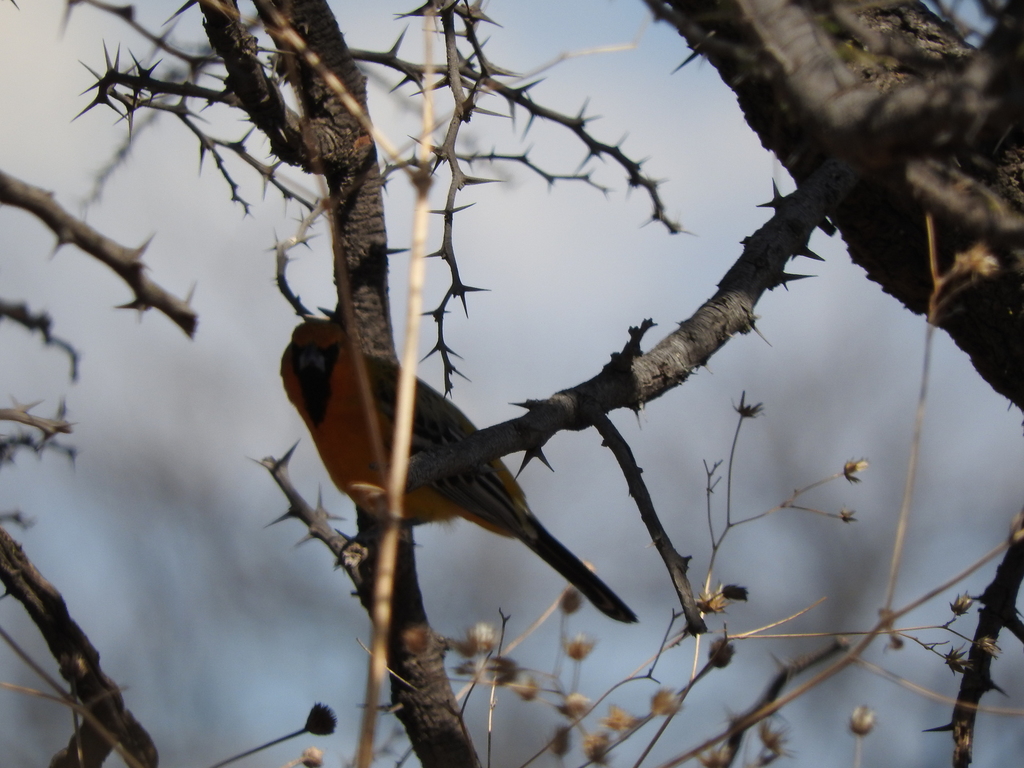
(c) Oscar Alejandro Morales Juárez, some rights reserved (CC BY-SA) · licence
Family: Icteridae · Class: Aves · Order: Passeriformes
Icterus pustulatus (Streak-backed Oriole) is a California animal in the Icteridae family.
The Streak-backed Oriole is a medium-sized songbird measuring 19-21 cm (7.5-8.3 inches) in length with a wingspan of approximately 28-30 cm (11-12 inches). Adult males display bright orange plumage on the head, breast, and underparts, contrasting sharply with a black back marked by distinctive orange or yellow streaks that give the species its common name. The wings and tail are black with white wing bars and white outer tail feathers. Females are more subdued, showing yellowish-orange underparts with a grayish-brown back that retains the characteristic streaking pattern. Both sexes have a straight, pointed black bill and dark legs. The Streak-backed Oriole ranges from western Mexico through Central America to northwestern Costa Rica. In North America, the species is primarily found along Mexico's Pacific coast from Sonora south to Oaxaca, and along the Gulf coast from Tamaulipas to the Yucatan Peninsula. In California, this species occurs as a rare vagrant, with documented records primarily from southern California counties including San Diego, Orange, Los Angeles, and Ventura. Most California observations occur during fall and winter months, typically between October and March. This species inhabits a variety of semi-open environments including thorn forest, deciduous woodland, gallery forests along streams, parks, and gardens. In its native range, it occurs from sea level to approximately 1,500 meters (4,900 feet) elevation. The species shows a preference for areas with scattered trees and open spaces, avoiding dense forest interiors. In California, vagrant individuals are most often detected in residential areas with mature trees, parks, and riparian corridors. Streak-backed Orioles are primarily insectivorous, foraging for beetles, caterpillars, ants, and other arthropods by gleaning from foliage and bark surfaces. They also consume nectar from flowers and feed on fruits, particularly figs, berries, and other soft fruits. The species constructs hanging, pouch-like nests woven from plant fibers and suspended from branch tips, typically 3-12 meters (10-40 feet) above ground. Breeding occurs from April through August in their native range, with females laying 3-4 pale blue eggs marked with dark spots and streaks. The Streak-backed Oriole is not federally listed in the United States and holds no special conservation status in California, as it is not a regular breeding resident. According to the International Union for Conservation of Nature, the species is classified as Least Concern globally, with stable populations throughout most of its range. In Mexico, populations appear secure in suitable habitat, though some local declines may occur due to habitat conversion for agriculture and urban development. Climate change may be influencing the species' northward dispersal patterns, potentially increasing vagrant occurrences in California and other southwestern states.
Classification
Class: Aves · Order: Passeriformes · Family: Icteridae
Frequently asked questions
How is Icterus pustulatus classified?
Icterus pustulatus belongs to class Aves, order Passeriformes, family Icteridae.
What family does Icterus pustulatus belong to?
Icterus pustulatus is in the Icteridae family.
What is Icterus pustulatus?
The Streak-backed Oriole is a medium-sized songbird measuring 19-21 cm (7.5-8.3 inches) in length with a wingspan of approximately 28-30 cm (11-12 inches).
Is Icterus pustulatus found in California?
Yes. Icterus pustulatus is recorded in California in The California Species Project's catalogue.
Related species
Other California species in the same genus, family, or bioregion.
Data from The California Species Project — 14,000+ California species with verified data from CNPS, CDFW, USFWS, and more.