Idaea demissaria
Red-Bordered Wave
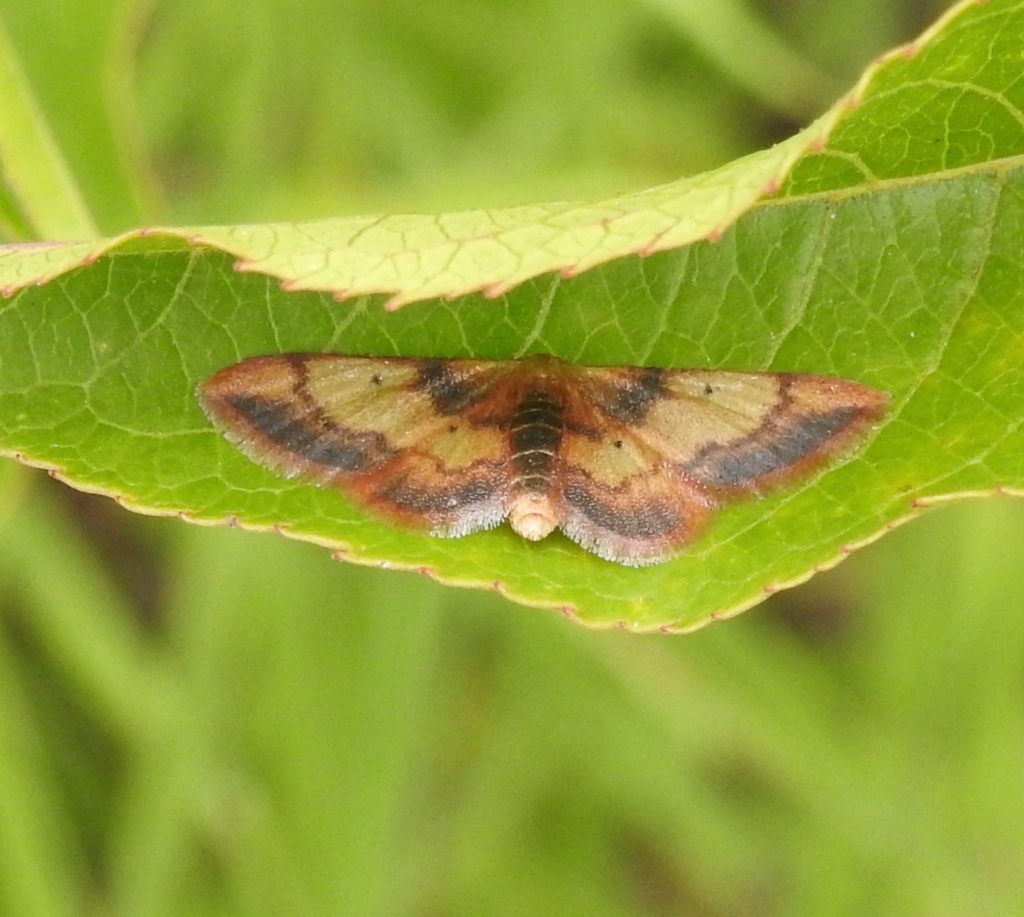
(c) Laura Gaudette, some rights reserved (CC BY) · licence
Family: Geometridae · Class: Insecta · Order: Lepidoptera
Idaea demissaria (Red-Bordered Wave) is a California animal in the Geometridae family.
The Red-bordered Wave (Idaea demissaria) is a small geometrid moth in the family Geometridae. Adults display straw-colored wings with distinctive reddish shading in the basal area and beyond the postmedian line (BugGuide). The forewings and hindwings are relatively broad and rounded, typical of wave moths in the subfamily Sterrhinae. Wing patterns may show subtle variations across the species' range, with some populations displaying more pronounced reddish borders than others. This species occurs throughout North America, with a distribution extending from coast to coast, except in higher elevations and extreme northern regions (BugGuide). According to NatureServe, Idaea demissaria has a global conservation rank of G5, indicating the species is secure globally with no immediate conservation concerns. The species includes at least two recognized subspecies: I. d. demissaria and I. d. columbia, suggesting some geographic variation in morphology or genetics across its range. Red-bordered Wave moths inhabit diverse terrestrial environments where their larval host plants occur. Adults are attracted to artificial lights and can be found in urban, suburban, and natural areas. The species appears to be adaptable to various habitat types across its broad North American range, from deciduous and mixed forests to more open landscapes with scattered vegetation. Like most geometrid moths, Red-bordered Wave larvae are caterpillars that move in a distinctive looping motion, earning geometrids the common name "inchworms" or "loopers." The larvae likely feed on herbaceous plants and low-growing vegetation, though specific host plant relationships have not been well documented in available literature. Adult flight periods and voltinism (number of generations per year) may vary geographically due to the species' extensive range across different climate zones. Adults are presumably nocturnal, as typical for most geometrid species, and are attracted to ultraviolet light sources during evening hours. Conservation status for Red-bordered Wave appears stable. NatureServe's global ranking of G5 indicates secure populations with no significant conservation concerns identified. The species' broad distribution across North America suggests ecological adaptability and resilience to habitat modifications. However, like many moth species, populations may face localized pressures from habitat loss, pesticide use, and light pollution, which can disrupt natural behavior patterns and reproduction. Scientific documentation for this species remains limited beyond basic taxonomic and distribution information. The information presented here is based on available sources including BugGuide and NatureServe. If you have additional verified information about this species' biology, larval host plants, or detailed ecology, please contact us to help improve this species account.
Classification
Class: Insecta · Order: Lepidoptera · Family: Geometridae
Frequently asked questions
How is Idaea demissaria classified?
Idaea demissaria belongs to class Insecta, order Lepidoptera, family Geometridae.
What family does Idaea demissaria belong to?
Idaea demissaria is in the Geometridae family.
What is Idaea demissaria?
The Red-bordered Wave (Idaea demissaria) is a small geometrid moth in the family Geometridae.
Is Idaea demissaria found in California?
Yes. Idaea demissaria is recorded in California in The California Species Project's catalogue.
Related species
Other California species in the same genus, family, or bioregion.
Data from The California Species Project — 14,000+ California species with verified data from CNPS, CDFW, USFWS, and more.