Idotea urotoma
Blunt-tailed Isopod
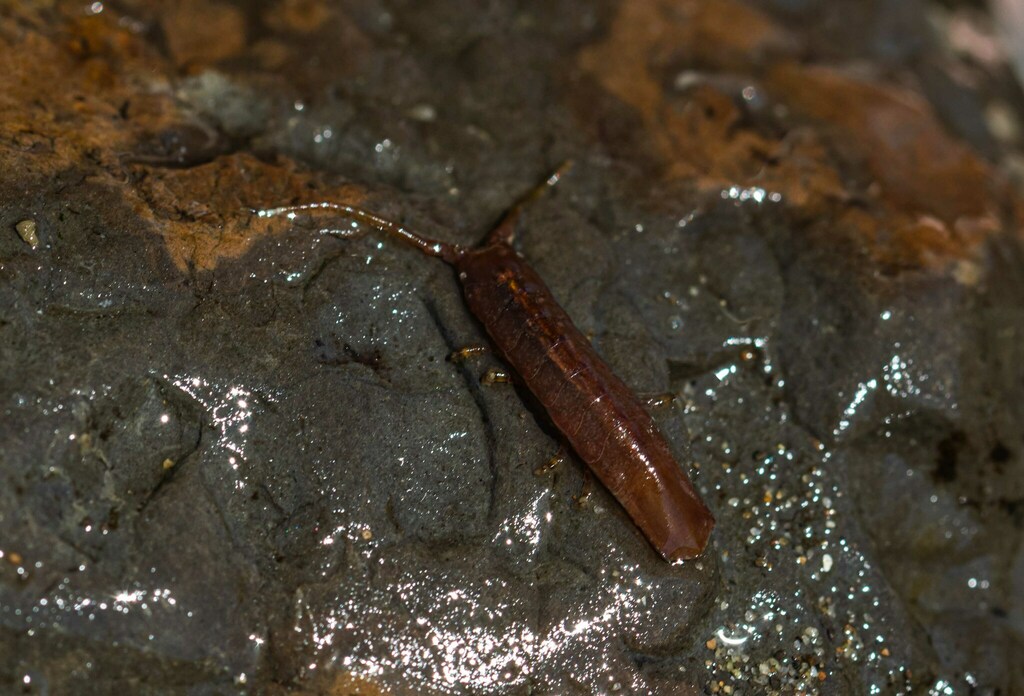
(c) Jeremiah Degenhardt, some rights reserved (CC BY) · licence
Family: Idoteidae · Class: Malacostraca · Order: Isopoda
Idotea urotoma (Blunt-tailed Isopod) is a California animal in the Idoteidae family.
The Blunt-tailed Isopod (Idotea urotoma) is a marine crustacean belonging to the order Isopoda, family Idoteidae. This species represents one of numerous isopod taxa found in marine environments, though detailed morphological descriptions in the scientific literature remain limited. Like other members of the genus Idotea, this species likely exhibits the characteristic elongated, flattened body plan typical of marine isopods, with seven pairs of walking legs and a segmented body structure. The distribution and range of Idotea urotoma have not been comprehensively documented in readily accessible scientific literature. As a marine isopod, the species likely occurs in coastal waters, potentially along the Pacific Coast given its inclusion in California species databases. However, specific geographic boundaries, depth ranges, and regional population distributions require further scientific investigation to establish accurate range maps. Habitat requirements for this species have not been well characterized in available scientific documentation. Marine isopods of the genus Idotea typically inhabit various marine and estuarine environments, including rocky intertidal zones, kelp forests, eelgrass beds, and subtidal areas. These crustaceans often associate with algae, seagrass, and other marine vegetation that provide both habitat structure and food resources. Without species-specific studies, the precise microhabitat preferences, substrate requirements, and depth distributions of I. urotoma remain unclear. Ecological information for Idotea urotoma is notably scarce in current scientific literature. Members of the genus Idotea are generally omnivorous, feeding on algae, detritus, and small organic particles. They play important roles in marine food webs as both primary consumers of plant material and prey items for fish, crabs, and other marine predators. Reproductive biology, life cycle duration, seasonal activity patterns, and specific dietary preferences for this species have not been adequately studied or published in accessible scientific sources. The conservation status of Idotea urotoma appears to be unassigned at both federal and state levels, with no current listings under the Endangered Species Act or California Endangered Species Act as of December 2025. The species does not appear on IUCN Red List assessments, suggesting either stable populations or insufficient data for conservation evaluation. The lack of comprehensive biological and ecological studies limits the ability to assess population trends, potential threats, or conservation needs. Marine isopods can be vulnerable to habitat degradation, pollution, climate change effects on ocean chemistry, and coastal development impacts, but specific threat assessments for I. urotoma have not been conducted. Scientific documentation for this species remains extremely limited despite thorough literature searches. The information presented here represents the current state of available knowledge, which highlights significant data gaps in taxonomy, distribution, ecology, and conservation status. Enhanced field studies, taxonomic research, and ecological investigations are needed to develop comprehensive species accounts. If you have additional verified information about this species' biology, distribution, or ecology, please contact us to help improve this species account.
Classification
Class: Malacostraca · Order: Isopoda · Family: Idoteidae
Frequently asked questions
How is Idotea urotoma classified?
Idotea urotoma belongs to class Malacostraca, order Isopoda, family Idoteidae.
What family does Idotea urotoma belong to?
Idotea urotoma is in the Idoteidae family.
What is Idotea urotoma?
The Blunt-tailed Isopod (Idotea urotoma) is a marine crustacean belonging to the order Isopoda, family Idoteidae.
Is Idotea urotoma found in California?
Yes. Idotea urotoma is recorded in California in The California Species Project's catalogue.
Related species
Other California species in the same genus, family, or bioregion.
Data from The California Species Project — 14,000+ California species with verified data from CNPS, CDFW, USFWS, and more.