Indotyphlops braminus
Brahminy Blindsnake
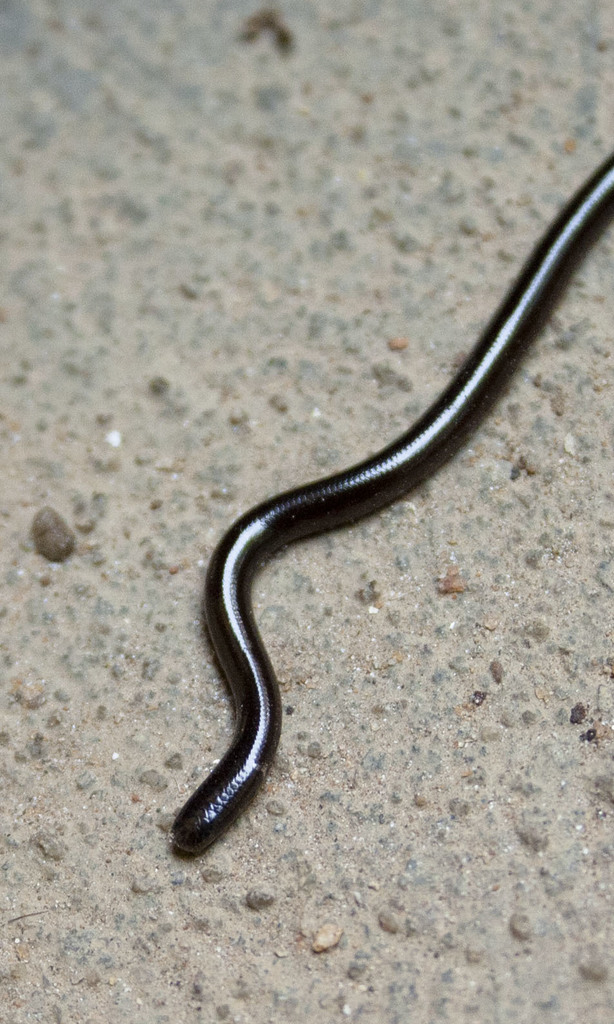
(c) Siddarth Machado, some rights reserved (CC BY) · licence
Family: Typhlopidae · Class: Reptilia · Order: Squamata
Indotyphlops braminus (Brahminy Blindsnake) is a California animal in the Typhlopidae family.
The Brahminy blindsnake is a small, fossorial reptile that represents one of the world's most successful invasive snake species. Adults typically measure 50 to 170 mm (2 to 6.7 inches) in total length, with a uniform diameter of 2 to 4 mm throughout the body. The species exhibits a cylindrical, worm-like appearance with a blunt head that is indistinguishable from the tail, earning it the common name "two-headed snake" in some regions. The body is covered in smooth, overlapping scales arranged in 20 rows around the circumference. Coloration ranges from dark brown to black dorsally, with lighter brown or pinkish ventral surfaces. The eyes are vestigial and appear as small dark spots beneath translucent scales. Native to Southeast Asia, the Brahminy blindsnake has established populations across tropical and subtropical regions worldwide through human-mediated dispersal. In California, the species has been documented in urban and suburban areas throughout the southern counties, including Los Angeles, Orange, Riverside, San Bernardino, and San Diego counties. Populations extend northward along the coast to Santa Barbara County and inland to the Central Valley. The species' distribution continues to expand as ornamental plant trade facilitates introduction to new areas. Brahminy blindsnakes inhabit loose, moist soil in gardens, nurseries, and landscaped areas. They show strong association with disturbed habitats and human-modified environments, particularly areas with regular irrigation and organic mulch. The species occurs from sea level to approximately 1,200 meters elevation in California. Optimal habitat includes well-drained soils with abundant organic matter, often beneath potted plants, compost piles, and landscape rock features. They avoid clay soils and areas subject to flooding. This species exhibits unique reproductive behavior as an all-female, parthenogenetic population. Reproduction occurs without fertilization, with females producing genetically identical offspring. Clutch sizes range from 1 to 8 eggs, with an average of 2 to 4 per reproductive event. Eggs measure approximately 4 by 8 mm and require 5 to 7 weeks to hatch under optimal conditions. Brahminy blindsnakes are primarily fossorial, spending most time underground in the upper 30 cm of soil. They feed exclusively on ant and termite larvae, pupae, and eggs, using their reduced dentition to puncture prey items. Activity occurs primarily during warm, humid conditions, with individuals emerging at night or following precipitation. The Brahminy blindsnake has no federal or state conservation listing in California, as it is not native to North America. Instead, the species is considered an established non-native species with potential ecological impacts on native soil fauna. Current populations appear stable and expanding, with no management actions directed toward conservation. Research focuses on understanding ecological interactions with native species and potential impacts on ant and termite communities. The species' parthenogenetic reproduction and association with human activities suggest continued range expansion throughout suitable habitat in California.
Classification
Class: Reptilia · Order: Squamata · Family: Typhlopidae
Frequently asked questions
How is Indotyphlops braminus classified?
Indotyphlops braminus belongs to class Reptilia, order Squamata, family Typhlopidae.
What family does Indotyphlops braminus belong to?
Indotyphlops braminus is in the Typhlopidae family.
What is Indotyphlops braminus?
The Brahminy blindsnake is a small, fossorial reptile that represents one of the world's most successful invasive snake species.
Is Indotyphlops braminus found in California?
Yes. Indotyphlops braminus is recorded in California in The California Species Project's catalogue.
More California species
This species has no close relatives in our California data — here are other species to explore.
Data from The California Species Project — 14,000+ California species with verified data from CNPS, CDFW, USFWS, and more.