Ischnura cervula
Pacific Forktail
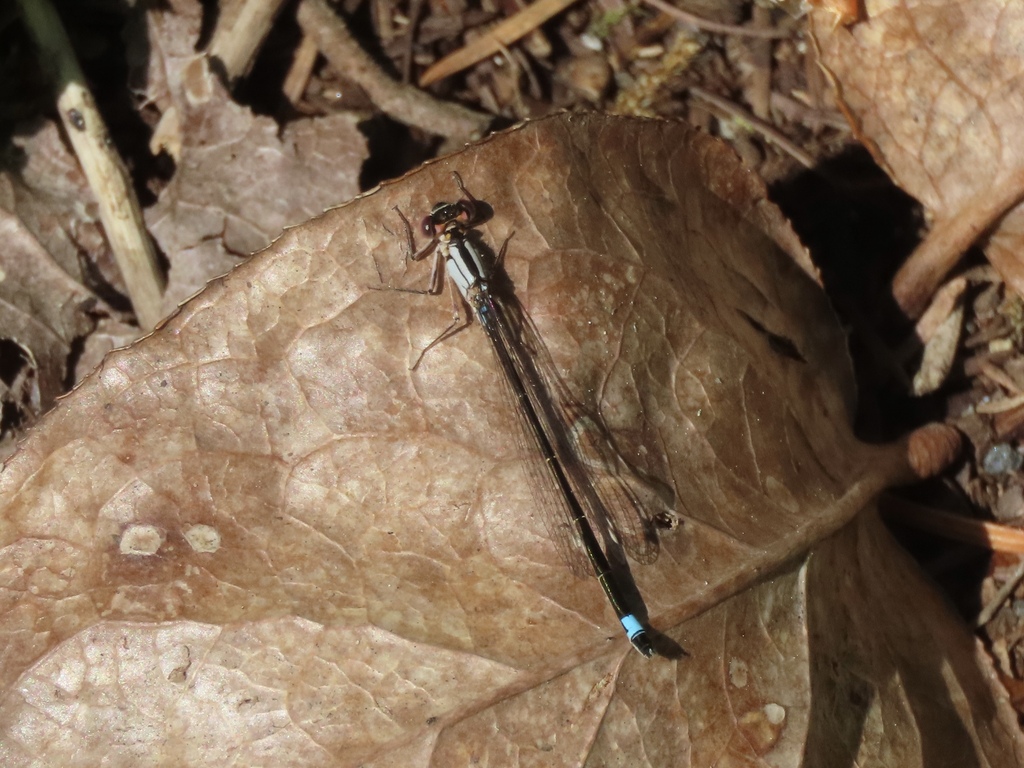
no rights reserved · CC0
Family: Coenagrionidae · Class: Insecta · Order: Odonata
Ischnura cervula (Pacific Forktail) is a California animal in the Coenagrionidae family.
The Pacific Forktail is a small damselfly in the family Coenagrionidae, distinguished by its slender build and characteristic forked tail appendages. Adults typically measure 25 to 35 mm (1.0 to 1.4 inches) in length with a wingspan of approximately 40 to 50 mm. Males display bright blue coloration on the thorax and abdomen with black markings, while females exhibit more variable coloration ranging from blue-green to brown or tan. The species is characterized by relatively short cerci (tail appendages) that give it the "forktail" common name, and pale postocular spots behind the compound eyes. The Pacific Forktail has a broad distribution across western North America, ranging from British Columbia south through California, and extending east into parts of the Rocky Mountain region. According to NatureServe, the species maintains a Global Status of G5, indicating it is secure across its range (NatureServe 2016). In California, populations occur throughout much of the state, from coastal areas to interior valleys and mountain regions. The species has been documented at elevations from sea level to approximately 2,400 meters (7,900 feet). This damselfly inhabits a wide variety of freshwater environments including ponds, lakes, slow-moving streams, marshes, and constructed water features. Adults are commonly found around vegetation-rich aquatic habitats with emergent and submerged plants that provide oviposition sites and larval development areas. The species demonstrates considerable tolerance for different water quality conditions and can persist in moderately disturbed habitats, including urban and suburban ponds. Pacific Forktails are active fliers during daylight hours, with peak activity typically occurring during warm, sunny conditions. Adults are generalist predators, capturing small flying insects including midges, mosquitoes, aphids, and other soft-bodied prey. Mating occurs through the characteristic damselfly tandem position, with males grasping females behind the head using specialized claspers. Females deposit eggs in plant tissues below the water surface, often while still in tandem with males. The aquatic nymphs are also predatory, feeding on mosquito larvae, aquatic worms, and other small invertebrates. Development from egg to adult typically requires one year in most climates, with nymphs overwintering and emerging as adults the following spring or summer. The Pacific Forktail currently faces no significant conservation concerns and maintains stable populations throughout its range. The species' adaptability to various aquatic habitats and tolerance for human-modified environments has contributed to its continued abundance. However, like many aquatic insects, populations may be locally affected by water pollution, habitat destruction, and climate change impacts on freshwater ecosystems. The species serves as an important component of aquatic food webs and provides natural mosquito control services in urban and rural environments.
Classification
Class: Insecta · Order: Odonata · Family: Coenagrionidae
Frequently asked questions
How is Ischnura cervula classified?
Ischnura cervula belongs to class Insecta, order Odonata, family Coenagrionidae.
What family does Ischnura cervula belong to?
Ischnura cervula is in the Coenagrionidae family.
What is Ischnura cervula?
The Pacific Forktail is a small damselfly in the family Coenagrionidae, distinguished by its slender build and characteristic forked tail appendages.
Is Ischnura cervula found in California?
Yes. Ischnura cervula is recorded in California in The California Species Project's catalogue.
Related species
Other California species in the same genus, family, or bioregion.
Data from The California Species Project — 14,000+ California species with verified data from CNPS, CDFW, USFWS, and more.