Ischnura denticollis
Black-fronted Forktail
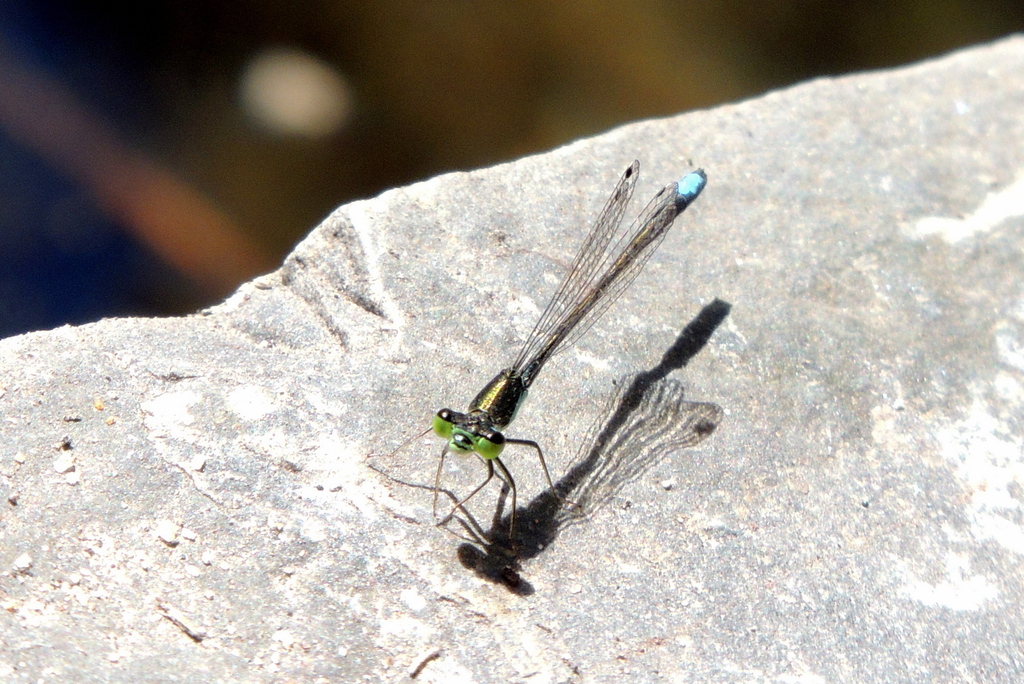
no rights reserved · CC0
Family: Coenagrionidae · Class: Insecta · Order: Odonata
Ischnura denticollis (Black-fronted Forktail) is a California animal in the Coenagrionidae family.
The Black-fronted Forktail is a small damselfly belonging to the narrow-winged damselfly family Coenagrionidae. Adults typically measure 25-35 mm (1.0-1.4 inches) in total length with a wingspan of approximately 35-45 mm (1.4-1.8 inches). Males display a distinctive black face and forehead that gives the species its common name, contrasting with bright blue coloration on the thorax and anterior abdominal segments. The posterior abdomen segments are typically black with blue markings. Females are generally less colorful, exhibiting brownish or olive coloration with pale markings, though some may show blue coloration similar to males in certain populations. Ischnura denticollis has a broad distribution across much of North America, extending from southern Canada through the United States and into Mexico. In California, the species occurs throughout much of the state from sea level to moderate elevations, typically below 1,500 meters (4,900 feet). According to NatureServe, the species maintains a global conservation status of G5, indicating it is secure globally (NatureServe 2025). The Black-fronted Forktail is found in various California ecoregions including the Central Valley, coastal areas, and foothills of both the Sierra Nevada and Coast Ranges. This damselfly inhabits a wide variety of freshwater habitats including ponds, lakes, slow-moving streams, marshes, and artificial water bodies such as stock tanks and irrigation ditches. The species shows particular preference for areas with emergent vegetation along shorelines, which provides both egg-laying substrate and perching sites for adults. Black-fronted Forktails are often found in more open, sunny locations compared to some other damselfly species, and they can tolerate moderate levels of water pollution and habitat disturbance. Adults are active fliers that hunt small flying insects including midges, mosquitoes, and other small dipterans. Males establish territories along water margins and engage in courtship displays to attract females. Mating occurs in tandem, with pairs often remaining connected while the female oviposits eggs into aquatic vegetation or soft substrates. The species typically has one to two generations per year in California, with flight periods extending from late spring through early fall. Larvae are aquatic predators that feed on various small invertebrates including mosquito larvae, making them beneficial for natural pest control. The Black-fronted Forktail is not currently listed under federal or state endangered species legislation. The species appears to maintain stable populations throughout most of its range and has demonstrated adaptability to human-modified landscapes. However, like many aquatic insects, populations may face localized threats from habitat loss due to wetland drainage, water diversions, and pollution from agricultural runoff and urban development. Climate change impacts on freshwater habitats could potentially affect future distribution patterns, though the species' broad habitat tolerance may provide some resilience against environmental changes.
Classification
Class: Insecta · Order: Odonata · Family: Coenagrionidae
Frequently asked questions
How is Ischnura denticollis classified?
Ischnura denticollis belongs to class Insecta, order Odonata, family Coenagrionidae.
What family does Ischnura denticollis belong to?
Ischnura denticollis is in the Coenagrionidae family.
What is Ischnura denticollis?
The Black-fronted Forktail is a small damselfly belonging to the narrow-winged damselfly family Coenagrionidae.
Is Ischnura denticollis found in California?
Yes. Ischnura denticollis is recorded in California in The California Species Project's catalogue.
Related species
Other California species in the same genus, family, or bioregion.
Data from The California Species Project — 14,000+ California species with verified data from CNPS, CDFW, USFWS, and more.