Ischnura gemina
San Francisco Forktail Damselfly
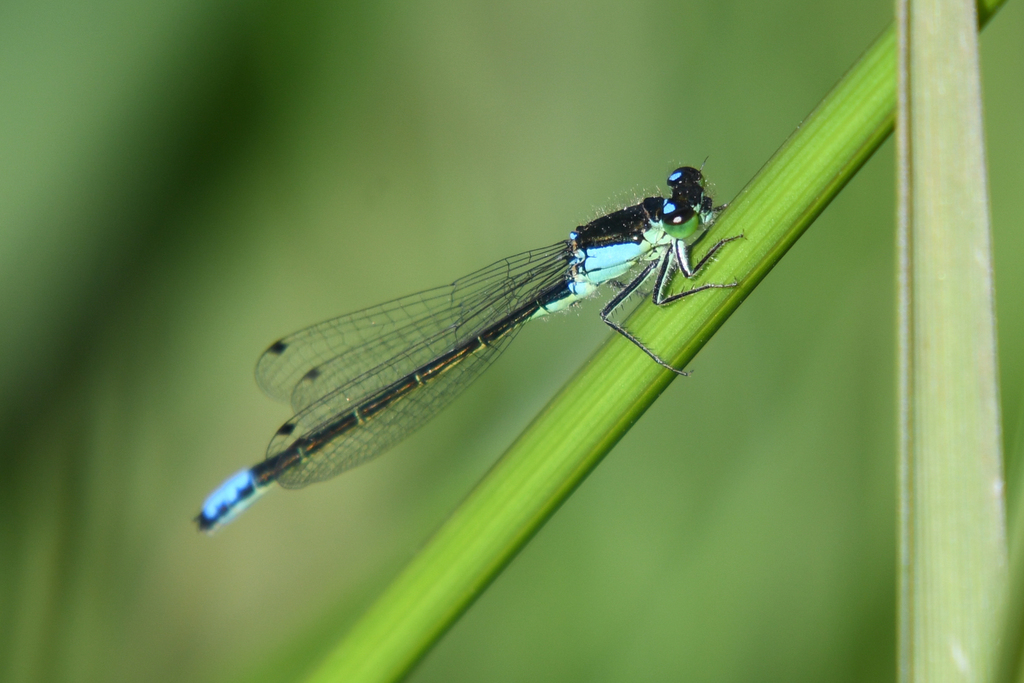
(c) Trevor Van Loon, some rights reserved (CC BY) · licence
Family: Coenagrionidae · Class: Insecta · Order: Odonata
Conservation status: G2 S2
Ischnura gemina (San Francisco Forktail Damselfly) is a California animal in the Coenagrionidae family.
The San Francisco forktail damselfly is a small odonata species endemic to a limited range in northern California. Adults are characterized by the typical slender body structure of forktail damselflies, with males displaying bright blue and black coloration and females exhibiting more subdued brownish tones. Like other Ischnura species, males possess distinctive pale postocular spots and females show polymorphic coloration patterns. The species can be distinguished from closely related forktails by specific wing venation patterns and genital structures. Historically, Ischnura gemina occurred in scattered localities throughout the San Francisco Bay Area and surrounding regions. Current distribution is severely restricted, with confirmed populations limited to a few remaining suitable habitats in northern California. The species has experienced significant range contraction from its historical extent, reflecting the widespread loss of appropriate wetland habitats throughout the region. The San Francisco forktail damselfly inhabits small, mostly open seepages, ponds, and canals covered with floating vegetation (NatureServe). These freshwater environments typically feature slow-moving or standing water with abundant emergent and submerged aquatic plants. The species shows preference for shallow areas with moderate vegetative cover that provide both larval habitat and adult perching sites. These wetland systems are often associated with coastal and near-coastal areas where freshwater sources create suitable breeding conditions. Reproductive behavior follows typical damselfly patterns, with males establishing territories around suitable egg-laying sites. Females deposit eggs in aquatic plants, where they undergo embryonic development (NatureServe). Larvae cling to submerged vegetation and debris while developing through multiple instars before emerging as adults. The species likely has an annual life cycle, though specific timing of emergence and reproductive periods requires further documentation. Adults feed on small flying insects captured during aerial hunting flights, while larvae are predaceous on aquatic invertebrates. The San Francisco forktail damselfly holds a global rank of G2 and state rank of S2, indicating it is imperiled both globally and within California due to rarity and habitat vulnerability. A petition to list the species as endangered under the Endangered Species Act was submitted to the U.S. Fish and Wildlife Service on September 10, 1990 (USFWS ECOS). However, the species currently lacks federal protection status, remaining unlisted as of December 2025. Primary threats include habitat destruction and degradation from urban development, water diversions, pollution, and invasive plant species that alter wetland plant communities. The restricted range and specialized habitat requirements make remaining populations particularly vulnerable to local extinction events. Climate change may pose additional challenges through altered precipitation patterns and increased drought frequency affecting the small freshwater systems this species requires. Conservation efforts focus on protecting and restoring suitable wetland habitats within the species' limited range.
Classification
Class: Insecta · Order: Odonata · Family: Coenagrionidae
Conservation status
G2 S2
Frequently asked questions
How is Ischnura gemina classified?
Ischnura gemina belongs to class Insecta, order Odonata, family Coenagrionidae.
What family does Ischnura gemina belong to?
Ischnura gemina is in the Coenagrionidae family.
Is Ischnura gemina protected or of conservation concern?
Ischnura gemina carries the following status: G2 S2.
What is Ischnura gemina?
The San Francisco forktail damselfly is a small odonata species endemic to a limited range in northern California.
Is Ischnura gemina found in California?
Yes. Ischnura gemina is recorded in California in The California Species Project's catalogue.
Related species
Other California species in the same genus, family, or bioregion.
Data from The California Species Project — 14,000+ California species with verified data from CNPS, CDFW, USFWS, and more.