Isodontia elegans
Elegant Grass-carrying Wasp
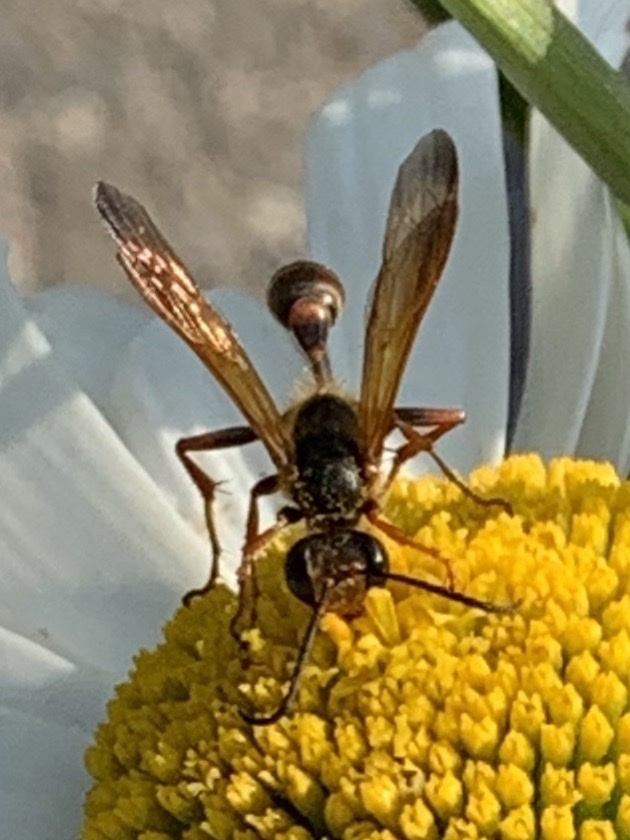
(c) eebee, some rights reserved (CC BY) · licence
Family: Sphecidae · Class: Insecta · Order: Hymenoptera
Isodontia elegans (Elegant Grass-carrying Wasp) is a California animal in the Sphecidae family.
The Elegant Grass-carrying Wasp is a solitary wasp in the family Sphecidae, subfamily Sphecinae. Adults are robust, thread-waisted wasps with distinctive coloration patterns. Females are larger than males and possess strong mandibles for excavating nesting burrows. The species exhibits typical sphecid characteristics including a narrow petiole connecting the thorax and abdomen, and well-developed wings suitable for sustained flight. Historically, Isodontia elegans was documented primarily in the western United States, but its range has expanded eastward over recent decades. According to BugGuide, specimens were collected in Cincinnati during the 1990s, representing a significant range extension from its previously known western distribution (BugGuide). The species now occurs across a broader geographic area than originally documented, though specific California distribution data remains limited in current databases. Elegant Grass-carrying Wasps inhabit diverse terrestrial environments where suitable nesting sites and prey are available. Like other Isodontia species, they require areas with exposed soil or sandy substrates for burrow construction, along with access to grass stems for nest lining material. The species appears adaptable to both natural and disturbed habitats, including urban and suburban environments where appropriate microhabitats exist. Females are solitary nest builders that excavate burrows in soil or utilize existing cavities. The common name derives from their behavior of collecting grass stems and other plant fibers to line their nests, a characteristic shared with other Isodontia species. Females provision their nests with paralyzed prey, typically orthopterans such as crickets and grasshoppers, which serve as food for developing larvae. Each cell receives one egg and sufficient paralyzed prey to support larval development through pupation. Adults are active during warmer months and can be observed foraging on flowers for nectar, which provides energy for their hunting and nesting activities. The taxonomic status of some Isodontia species, including I. elegans, has been noted as requiring revision by specialists (BugGuide). This taxonomic uncertainty reflects the complex relationships within the genus and highlights the need for additional systematic research. The species' apparent range expansion may represent natural population dynamics, climate-mediated shifts, or improved documentation of previously overlooked populations. No federal or state conservation status has been assigned to Isodontia elegans. The species appears to maintain stable populations across its range and demonstrates adaptability to various habitat conditions. However, like many solitary wasps, populations may be affected by habitat modification, pesticide use, and loss of prey species. The species' role as a predator of orthopteran insects contributes to ecosystem balance in the habitats it occupies. Continued monitoring and taxonomic clarification would benefit understanding of this species' conservation needs and ecological significance.
Classification
Class: Insecta · Order: Hymenoptera · Family: Sphecidae
Frequently asked questions
How is Isodontia elegans classified?
Isodontia elegans belongs to class Insecta, order Hymenoptera, family Sphecidae.
What family does Isodontia elegans belong to?
Isodontia elegans is in the Sphecidae family.
What is Isodontia elegans?
The Elegant Grass-carrying Wasp is a solitary wasp in the family Sphecidae, subfamily Sphecinae.
Is Isodontia elegans found in California?
Yes. Isodontia elegans is recorded in California in The California Species Project's catalogue.
Related species
Other California species in the same genus, family, or bioregion.
Data from The California Species Project — 14,000+ California species with verified data from CNPS, CDFW, USFWS, and more.