Isodontia mexicana
Mexican Grass-carrying Wasp
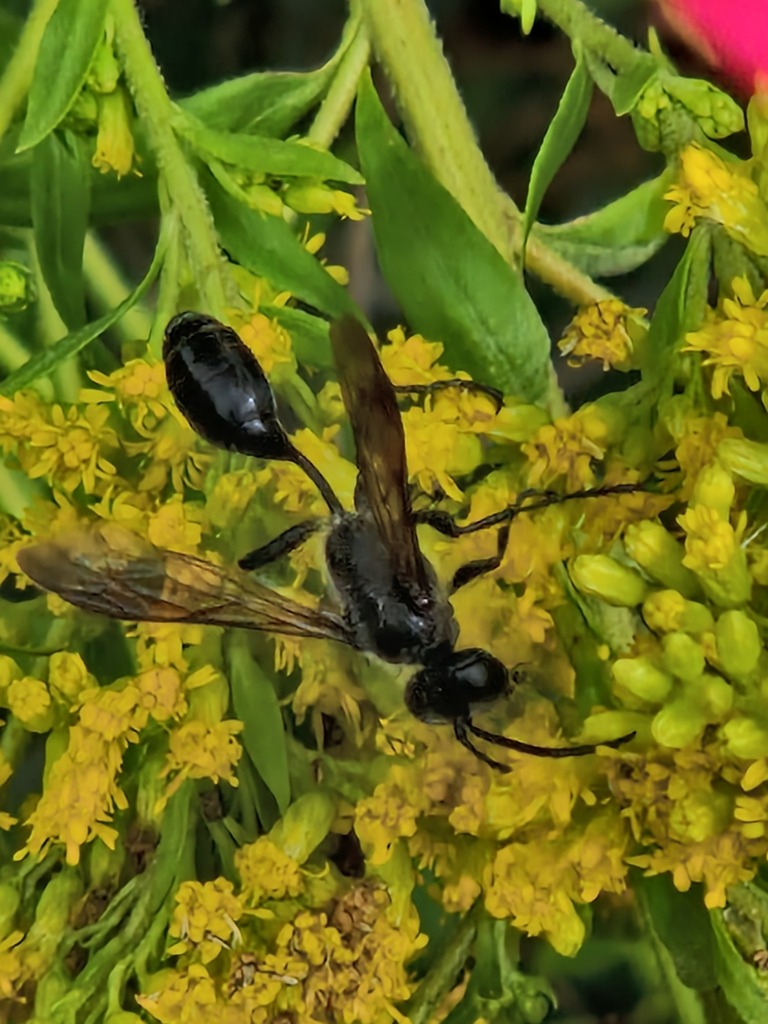
(c) Clive Freedman, some rights reserved (CC BY) · licence
Family: Sphecidae · Class: Insecta · Order: Hymenoptera
Isodontia mexicana (Mexican Grass-carrying Wasp) is a California animal in the Sphecidae family.
The Mexican Grass-carrying Wasp is a solitary sphecid wasp distinguished by its pale body hair and black legs. Females measure approximately 17 mm in length, while males are slightly smaller at 16 mm. The body exhibits pale hair coloration rather than black, which distinguishes it from the closely related I. philadelphica. The legs are entirely black, lacking the reddish coloration found in related species such as I. auripes, I. exornata, and I. elegans (BugGuide). This species occurs across a broad range in North America, extending from southern Canada through the United States into Mexico. Within California, the Mexican Grass-carrying Wasp is documented from multiple regions, though specific distribution patterns within the state have not been comprehensively mapped. The species' range overlaps with other Isodontia species, requiring careful examination of morphological features for accurate identification. Mexican Grass-carrying Wasps inhabit diverse terrestrial environments where suitable nesting sites and prey are available. Like other members of the genus Isodontia, this species typically selects pre-existing cavities for nest construction, including hollow plant stems, beetle galleries in dead wood, and artificial structures such as bamboo tubes or drilled blocks. The species shows adaptation to both natural and human-modified landscapes. As a member of the thread-waisted wasp family Sphecidae, I. mexicana is a specialized predator that provisions its nests with paralyzed orthopteran prey, primarily crickets and tree crickets. Adult females hunt by capturing prey, which they paralyze with venom and transport to their nests. The characteristic grass-carrying behavior of the genus involves females collecting grass stems and other plant material to partition nest cells and seal nest entrances. Each cell receives a single paralyzed cricket or tree cricket, upon which the female deposits an egg before sealing the chamber. Nesting occurs during the warmer months when prey is abundant and weather conditions are favorable for larval development. Females demonstrate solitary behavior, with each individual constructing and provisioning her own nest. The larval stage develops by consuming the provisioned prey, pupating within the sealed cell, and emerging as an adult the following season. The Mexican Grass-carrying Wasp is not federally or state-listed as threatened or endangered. Population trends and conservation status have not been formally assessed, though the species appears to maintain stable populations across its range. As a beneficial predator of orthopteran pests, the species may provide ecological services in agricultural and natural systems. No specific conservation measures are currently implemented for this species. Detailed ecological studies of I. mexicana remain limited compared to more thoroughly studied sphecid wasps. Research gaps include comprehensive distribution mapping within California, detailed prey preferences, seasonal activity patterns, and responses to habitat modification. The species' adaptability to human-modified environments suggests resilience to moderate landscape changes, though intensive agricultural or urban development may impact local populations through habitat loss.
Classification
Class: Insecta · Order: Hymenoptera · Family: Sphecidae
Frequently asked questions
How is Isodontia mexicana classified?
Isodontia mexicana belongs to class Insecta, order Hymenoptera, family Sphecidae.
What family does Isodontia mexicana belong to?
Isodontia mexicana is in the Sphecidae family.
What is Isodontia mexicana?
The Mexican Grass-carrying Wasp is a solitary sphecid wasp distinguished by its pale body hair and black legs.
Is Isodontia mexicana found in California?
Yes. Isodontia mexicana is recorded in California in The California Species Project's catalogue.
Related species
Other California species in the same genus, family, or bioregion.
Data from The California Species Project — 14,000+ California species with verified data from CNPS, CDFW, USFWS, and more.