Isodontia philadelphica
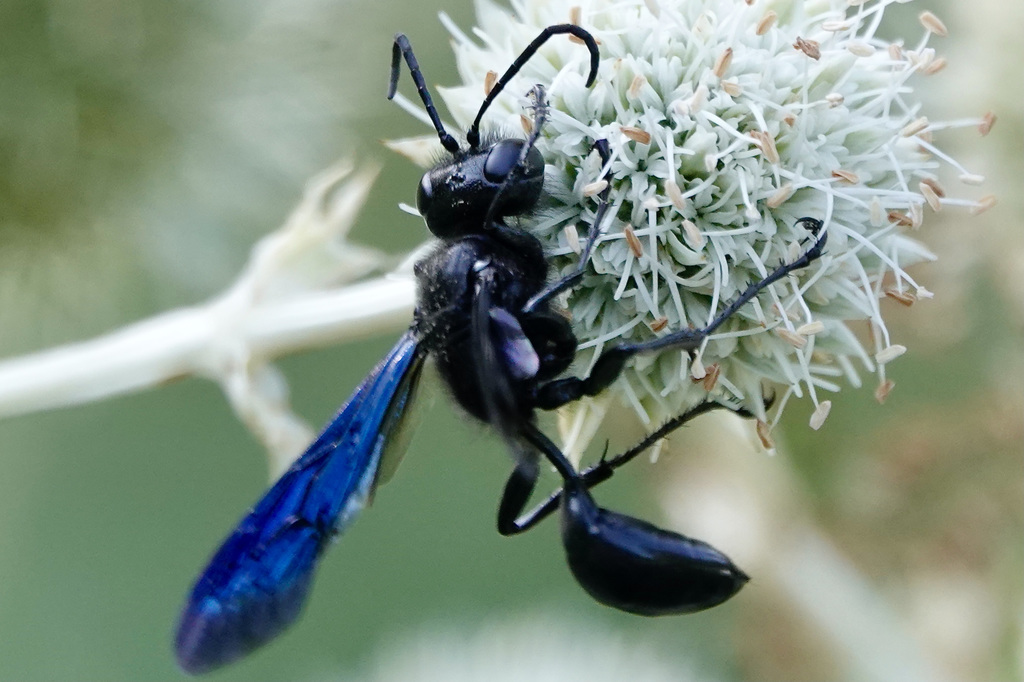
(c) Louise Woodrich, some rights reserved (CC BY) · licence
Family: Sphecidae · Class: Insecta · Order: Hymenoptera
Isodontia philadelphica is a California animal in the Sphecidae family.
Isodontia philadelphica is a thread-waisted wasp in the family Sphecidae, commonly known as a grass-carrying wasp. Adults are entirely black with dark wings that display strong blue reflections (BugGuide). The species belongs to the subfamily Sphecinae and can be distinguished from related species by its completely black coloration, contrasting with I. auripes which has brownish-red legs, and I. mexicana which may show brown spots on the first abdominal segment. The range of I. philadelphica extends across much of North America, though specific distributional data for California populations requires further documentation. The species has been recorded in various states where suitable habitat conditions exist, but detailed range maps for California are not currently available through standard wildlife databases. This wasp inhabits open areas, fields, and grasslands where it can access the materials needed for nest construction (BugGuide). The species shows a preference for areas with abundant grass resources, which are essential for its reproductive behavior. Specific elevation ranges and microhabitat requirements in California have not been well documented in the scientific literature. Isodontia philadelphica exhibits the characteristic behavior that gives grass-carrying wasps their common name. Females construct nests in pre-existing cavities, including hollow plant stems, abandoned beetle galleries, and artificial structures. The female provisions each nest cell with paralyzed crickets or katydids as food for developing larvae. After stocking the cell with prey, she uses grass stems, leaves, and other plant material to partition the nest and seal the entrance. This grass-carrying behavior is distinctive among thread-waisted wasps and serves both protective and structural functions. Adult wasps are active during warmer months, with activity patterns varying by geographic location. The conservation status of I. philadelphica has not been formally assessed at federal or state levels. The species appears on Arkansas's Species of Greatest Conservation Need list, indicating some regional conservation concern (BugGuide). However, the rationale for this designation and whether similar concerns apply to California populations is unclear. Like many specialized wasps, the species may be sensitive to habitat loss, particularly the conversion of grasslands and open areas to intensive agriculture or development. The availability of suitable nesting sites and prey species likely influences local population stability. Scientific documentation for this species remains limited, particularly regarding its specific distribution, abundance, and ecological requirements in California. The information presented here synthesizes available sources including BugGuide taxonomic accounts. Detailed ecological studies, population assessments, and habitat mapping would enhance understanding of this species' status and conservation needs in the state.
Classification
Class: Insecta · Order: Hymenoptera · Family: Sphecidae
Frequently asked questions
How is Isodontia philadelphica classified?
Isodontia philadelphica belongs to class Insecta, order Hymenoptera, family Sphecidae.
What family does Isodontia philadelphica belong to?
Isodontia philadelphica is in the Sphecidae family.
What is Isodontia philadelphica?
Isodontia philadelphica is a thread-waisted wasp in the family Sphecidae, commonly known as a grass-carrying wasp.
Is Isodontia philadelphica found in California?
Yes. Isodontia philadelphica is recorded in California in The California Species Project's catalogue.
Related species
Other California species in the same genus, family, or bioregion.
Data from The California Species Project — 14,000+ California species with verified data from CNPS, CDFW, USFWS, and more.