Judolia instabilis
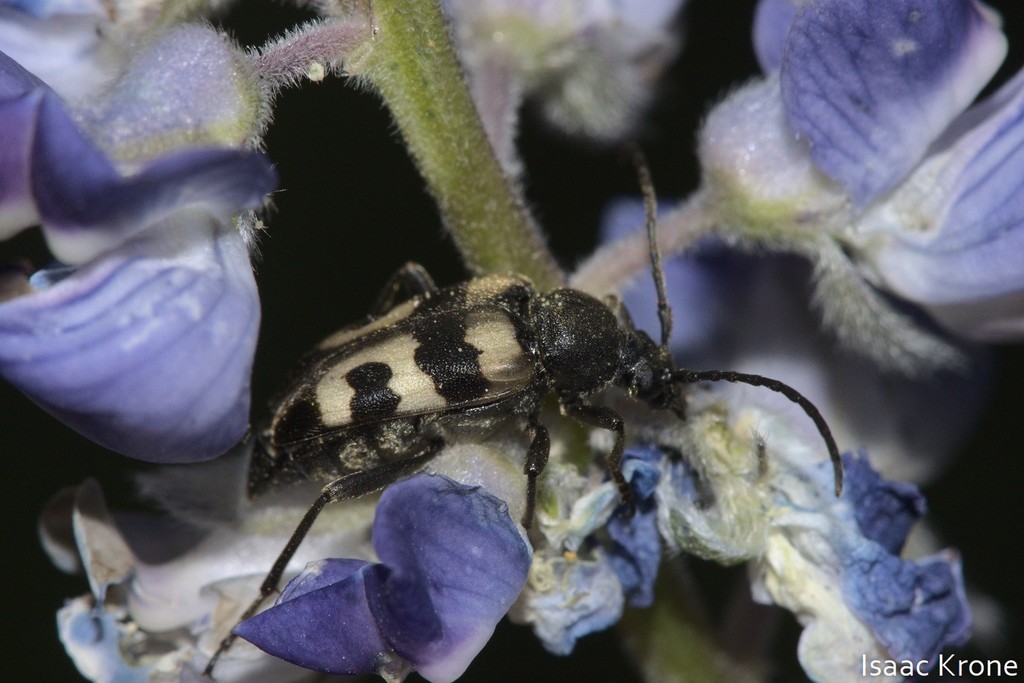
(c) Isaac Krone, some rights reserved (CC BY) · licence
Family: Cerambycidae · Class: Insecta · Order: Coleoptera
Judolia instabilis is a California animal in the Cerambycidae family.
Judolia instabilis is a longhorn beetle in the family Cerambycidae, subfamily Lepturinae, tribe Lepturini. This species belongs to a genus of flower longhorns that are typically found feeding on blossoms during their adult stage. The beetle exhibits the characteristic elongated antennae and narrow body form typical of lepturine longhorns, though specific morphological details for this species remain poorly documented in available literature. The range of Judolia instabilis appears to be centered in western North America, distinguishing it from its eastern relative Judolia cordifera. According to available taxonomic sources, there may be some overlap in range between these two species, though J. instabilis is primarily associated with western regions while J. cordifera occurs in the eastern United States (Yanega, as referenced in BugGuide). The specific distribution within California and other western states requires further documentation through systematic surveys. Habitat preferences for Judolia instabilis have not been thoroughly documented in the scientific literature. Based on patterns observed in related Judolia species, adults likely inhabit areas with abundant flowering plants where they feed on nectar and pollen. The related J. cordifera is found in meadows feeding on flowers, suggesting J. instabilis may occupy similar open habitats with diverse flowering plant communities. Elevation ranges and specific vegetation associations remain undocumented for this species. The ecology and life history of Judolia instabilis follow the general pattern of lepturine longhorns. Adults are presumed to be active during warmer months when flowers are available, feeding on nectar and pollen from various plant species. Like other members of the genus, larvae likely develop in dead or dying wood of deciduous trees or shrubs, though specific host plants have not been identified. The larval development period and number of generations per year remain unknown. Adult beetles likely play a role as pollinators while visiting flowers for feeding. No formal conservation status has been assigned to Judolia instabilis at federal or state levels as of December 2025. The species does not appear on U.S. Fish and Wildlife Service species lists or California Department of Fish and Wildlife tracking lists, suggesting it is not currently considered threatened or endangered. However, the limited scientific documentation for this species makes it difficult to assess population trends or conservation needs. The apparent rarity of this beetle in collections and the lack of recent ecological studies suggest that systematic surveys would be valuable to better understand its distribution, abundance, and habitat requirements. Climate change and habitat modification in western ecosystems could potentially impact populations, but specific threats cannot be assessed without baseline ecological data. Scientific documentation for this species remains extremely limited. The information presented here is based on available taxonomic sources and inference from related species. We welcome contributions of verified scientific data, photographs, or field observations to enhance this species account.
Classification
Class: Insecta · Order: Coleoptera · Family: Cerambycidae
Frequently asked questions
How is Judolia instabilis classified?
Judolia instabilis belongs to class Insecta, order Coleoptera, family Cerambycidae.
What family does Judolia instabilis belong to?
Judolia instabilis is in the Cerambycidae family.
What is Judolia instabilis?
Judolia instabilis is a longhorn beetle in the family Cerambycidae, subfamily Lepturinae, tribe Lepturini.
Is Judolia instabilis found in California?
Yes. Judolia instabilis is recorded in California in The California Species Project's catalogue.
Related species
Other California species in the same genus, family, or bioregion.
Data from The California Species Project — 14,000+ California species with verified data from CNPS, CDFW, USFWS, and more.