Juga hemphilli subsp. nov.
Indian ford juga
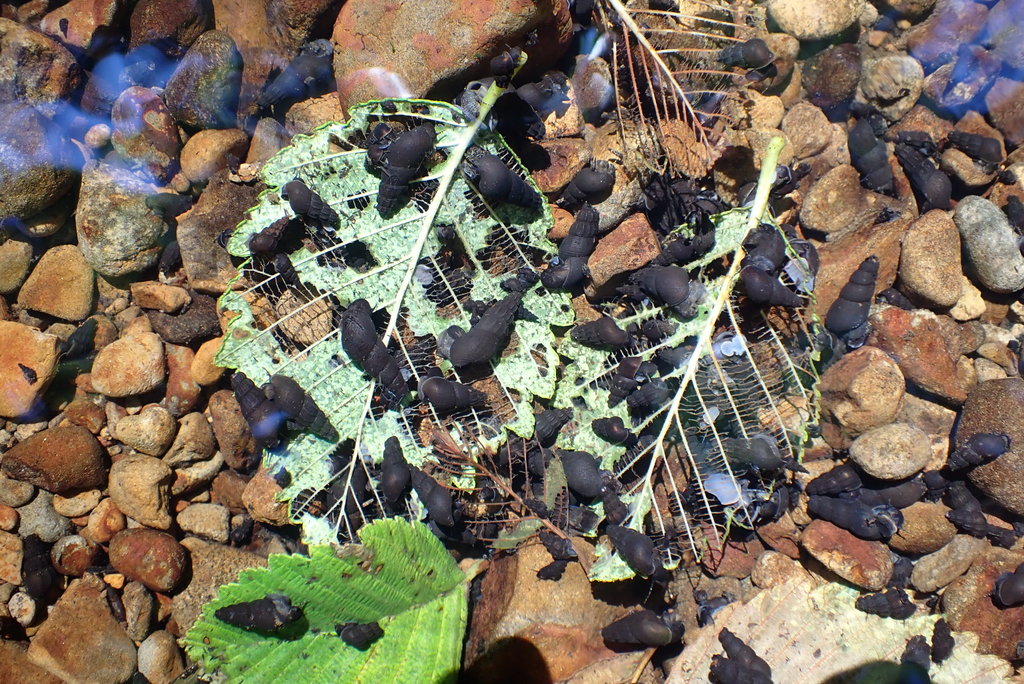
(c) Lee Cain, some rights reserved (CC BY) · licence
Family: Semisulcospiridae · Class: Gastropoda · Order: Caenogastropoda
Juga hemphilli subsp. nov. (Indian ford juga) is a California animal in the Semisulcospiridae family.
The Indian Ford juga (Juga hemphilli subsp. nov.) is an undescribed subspecies of medium-sized aquatic gastropod in the family Semisulcospiridae. This freshwater snail reaches approximately 25 mm in length, making it relatively large among Juga species and similar in size to Juga hemphilli maupinensis (Xerces Society). The shell is dark brown with two distinct dark brown bands, while the nacre displays a characteristic white coloration. The species possesses gills and exhibits the typical conical spiral shell morphology of the genus. The Indian Ford juga has an extremely restricted range, currently known from only a single location: Indian Ford Creek near Black Butte in Deschutes National Forest, Deschutes County, Oregon (Xerces Society). This subspecies may have historically occurred more widely throughout the upper Deschutes River system, but extensive habitat loss has reduced its distribution to this isolated population. The broader species Juga hemphilli occurs in the headwaters of the Columbia River in British Columbia, the Columbia River Gorge of Oregon and Washington, and other parts of the Deschutes River system. This subspecies inhabits streams and spring-seeps within montane forest environments. Indian Ford Creek represents cold, clear mountain stream habitat typical of the Cascade Range. The species requires clean, well-oxygenated flowing water with stable substrate conditions. Like other Juga species, it likely prefers areas with moderate current flow and rocky or gravel substrates that support algal growth and organic matter accumulation. Juga hemphilli subspecies function as rasper-grazers in their aquatic ecosystems, feeding on both algae scraped from hard surfaces and detritus including decomposing organic matter such as dead alder leaves. The species exhibits iteroparous reproduction, meaning individuals can reproduce multiple times throughout their lives. Most Juga species breed annually as adults, depositing eggs once per year (Xerces Society). The reproductive cycle and specific breeding requirements for this subspecies remain poorly documented due to its recent recognition and limited study. Although this subspecies lacks formal taxonomic description, it faces significant conservation challenges. The species is currently listed in Oregon, reflecting concern about its limited distribution and population status. Major threats include nutrient enhancement from agricultural runoff, livestock grazing impacts, water diversions that alter flow regimes, and other activities that degrade water quality. The restriction to a single known location makes this subspecies extremely vulnerable to habitat disturbance or environmental changes. The taxonomic status of this subspecies requires formal description and publication to establish its scientific validity. Current knowledge suggests this population represents a distinct evolutionary lineage within the Juga hemphilli complex, but comprehensive surveys of suitable habitat throughout the upper Deschutes system are needed to better evaluate its current distribution and conservation status. Stream surveys in the region have historically focused on springs and terrestrial mollusk habitat rather than flowing water environments, potentially leaving additional populations undiscovered.
Classification
Class: Gastropoda · Order: Caenogastropoda · Family: Semisulcospiridae
Frequently asked questions
How is Juga hemphilli subsp. nov. classified?
Juga hemphilli subsp. nov. belongs to class Gastropoda, order Caenogastropoda, family Semisulcospiridae.
What family does Juga hemphilli subsp. nov. belong to?
Juga hemphilli subsp. nov. is in the Semisulcospiridae family.
What is Juga hemphilli subsp. nov.?
The Indian Ford juga (Juga hemphilli subsp.
Is Juga hemphilli subsp. nov. found in California?
Yes. Juga hemphilli subsp. nov. is recorded in California in The California Species Project's catalogue.
Related species
Other California species in the same genus, family, or bioregion.
Data from The California Species Project — 14,000+ California species with verified data from CNPS, CDFW, USFWS, and more.