Juga newberryi
A freshwater snail
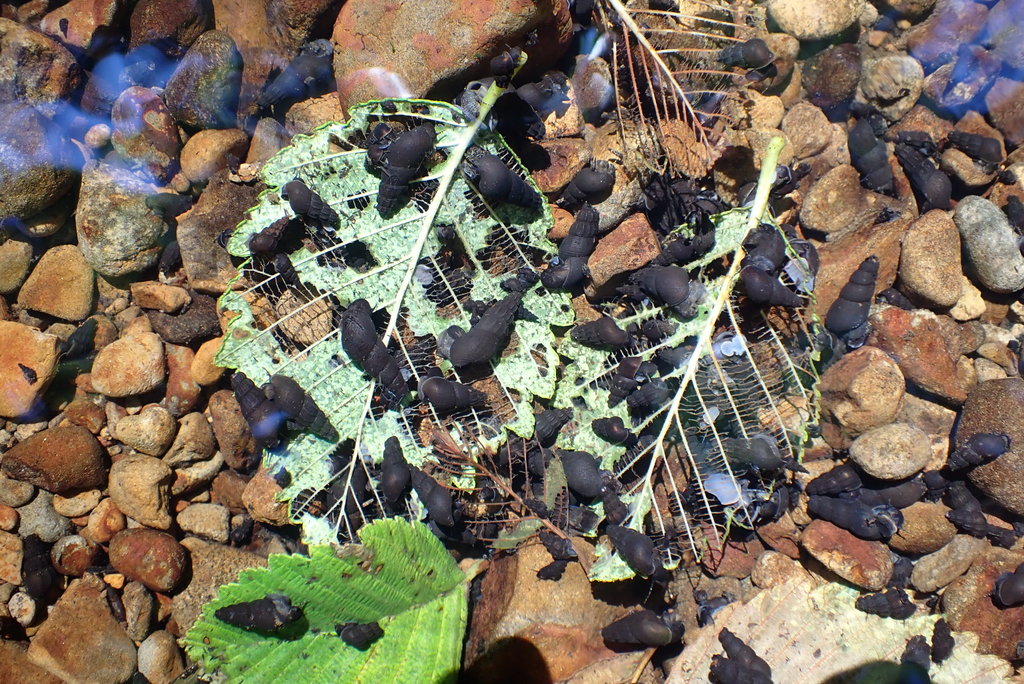
(c) Lee Cain, some rights reserved (CC BY) · licence
Family: Semisulcospiridae · Class: Gastropoda · Order: Caenogastropoda
Juga newberryi (A freshwater snail) is a California animal in the Semisulcospiridae family.
Juga newberryi is a medium-sized freshwater snail characterized by distinctive shell banding patterns. The shell typically exhibits three yellow bands separated by three almost black bands, though the lower band may occasionally be divided into two or more bands, and the dark bands may appear tan in color rather than black (Strong & Frest 2007). This aquatic gastropod belongs to the Oreobasis subgenus, a small group of Juga species characterized by smooth whorls throughout development. Historically distributed throughout the Deschutes River system in Oregon, J. newberryi now occurs only in the lower 90 miles of the Deschutes River drainage below Pelton Dam in Wasco and Sherman counties. The species' range has contracted significantly from its original distribution, with populations now occurring very sporadically within this restricted area. According to NatureServe, the species is now known from restricted areas in three river systems in Oregon, indicating some expansion of known localities since earlier surveys (NatureServe 2025). This large-river species inhabits cold, clear water environments at depths ranging from 0 to 16 inches (0 to 41 centimeters). J. newberryi occurs primarily in gravel-boulder riffles and rapids edges where moderately swift current is present. The species appears highly sensitive to habitat disturbance and is found only in the most undisturbed portions of river systems. Water quality appears critical for population persistence, as the species has experienced long-term declines associated with deteriorating water conditions. As an algae-grazer, J. newberryi feeds on both algae and detritus found on substrate surfaces in its aquatic habitat. The species possesses gills for respiration and maintains its position in swift-flowing waters through attachment to rocky substrates. Specific reproductive behaviors, seasonal activity patterns, and life cycle details have not been well documented in the scientific literature. J. newberryi faces significant conservation challenges due to its extremely limited range and sensitivity to environmental disturbance. Increasing recreational usage of the Deschutes Wild and Scenic River poses a major threat to remaining populations through physical disturbance of habitat. The species' restriction to undisturbed river sections makes it particularly vulnerable to human activities and habitat degradation. NatureServe reports that long-term population declines are associated with loss of water quality, indicating that maintaining pristine aquatic conditions is essential for species persistence. Taxonomic clarification has been important for conservation planning. Although J. newberryi was once considered synonymous with J. bulbosa, recent literature review and examination of type specimens confirmed these as distinct species (Strong & Frest 2007). Much existing literature documenting J. newberryi was published under the name J. bulbosa, which has created confusion in historical records and distribution data. Further surveys and watershed management are necessary for conserving this species. The combination of restricted range, habitat sensitivity, and ongoing threats from recreational activities creates an urgent need for targeted conservation actions to prevent further population declines and potential extirpation from its remaining habitat.
Classification
Class: Gastropoda · Order: Caenogastropoda · Family: Semisulcospiridae
Frequently asked questions
How is Juga newberryi classified?
Juga newberryi belongs to class Gastropoda, order Caenogastropoda, family Semisulcospiridae.
What family does Juga newberryi belong to?
Juga newberryi is in the Semisulcospiridae family.
What is Juga newberryi?
Juga newberryi is a medium-sized freshwater snail characterized by distinctive shell banding patterns.
Is Juga newberryi found in California?
Yes. Juga newberryi is recorded in California in The California Species Project's catalogue.
Related species
Other California species in the same genus, family, or bioregion.
Data from The California Species Project — 14,000+ California species with verified data from CNPS, CDFW, USFWS, and more.