Juga orickensis
Redwood Juga
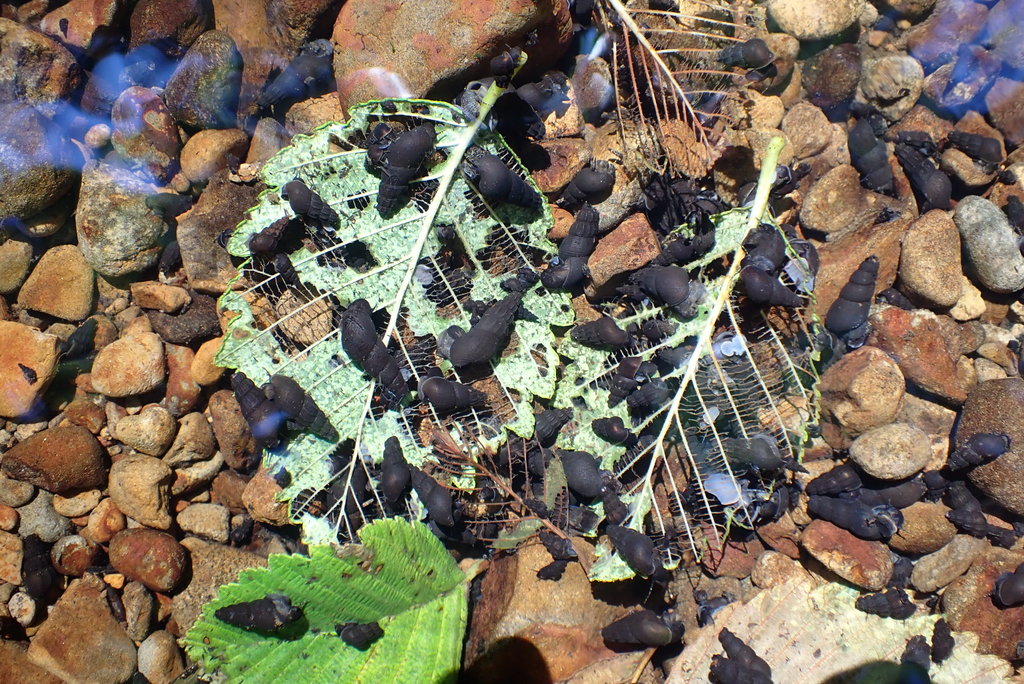
(c) Lee Cain, some rights reserved (CC BY) · licence
Family: Semisulcospiridae · Class: Gastropoda · Order: Caenogastropoda
Conservation status: G2 S1S3
Juga orickensis (Redwood Juga) is a California animal in the Semisulcospiridae family.
The Redwood juga (Juga orickensis) is a freshwater gastropod mollusk endemic to California's North Coast region. This aquatic snail belongs to the family Semisulcospiridae and represents one of several endemic Juga species found in California's coastal watersheds. Adult specimens typically measure 15-25 mm in shell length, with a conical, elongated shell displaying a dark brown to blackish coloration. The shell surface exhibits fine spiral ridges and growth lines, with 6-7 whorls that gradually taper to a pointed apex. The species occurs exclusively in select coastal drainages of northwestern California, with its distribution centered in the redwood forest region. Historical records indicate populations in Humboldt and Del Norte counties, though current distribution appears more restricted than originally documented. The species' common name reflects its association with the Sequoia sempervirens forest ecosystem, where it inhabits streams flowing through old-growth and second-growth redwood groves. Redwood juga inhabits cool, well-oxygenated streams and springs within the coastal redwood belt. These aquatic environments are characterized by stable temperatures year-round, typically ranging from 8-15°C, and consistent moisture levels maintained by fog drip from the redwood canopy. The species prefers rocky substrates including cobble, gravel, and bedrock surfaces where it can graze on periphyton and organic detritus. Stream habitats typically feature moderate to slow current velocities and are often shaded by dense riparian vegetation including redwoods, Douglas fir, and associated understory species. Like other pleurocerid snails, Juga orickensis is a benthic grazer that feeds primarily on algae, diatoms, and organic matter accumulated on submerged surfaces. The species exhibits direct development, with females depositing small numbers of large eggs that hatch directly into juvenile snails without a larval stage. This reproductive strategy limits dispersal capacity, contributing to the species' restricted distribution and vulnerability to habitat fragmentation. Reproductive activity likely peaks during spring and early summer when water temperatures are optimal and food resources are most abundant. The Redwood juga is classified as imperiled, with a Global Rank of G2 and California State Rank of S1S3, indicating it faces a high risk of extinction. This species is included on the California Department of Fish and Wildlife's Special Animals List. The species is not currently listed under federal or state endangered species legislation, but its restricted range and specialized habitat requirements make it particularly vulnerable to environmental changes. Primary threats include habitat degradation from logging activities, stream channelization, water diversions, and sedimentation. Climate change poses additional risks through altered precipitation patterns and increased wildfire frequency in the redwood region. The species' limited dispersal ability and specific habitat requirements make population recovery difficult following local extinctions. Conservation efforts focus on protecting intact redwood watersheds and maintaining natural hydrological processes essential for stream ecosystem health.
Classification
Class: Gastropoda · Order: Caenogastropoda · Family: Semisulcospiridae
Conservation status
G2 S1S3
Frequently asked questions
How is Juga orickensis classified?
Juga orickensis belongs to class Gastropoda, order Caenogastropoda, family Semisulcospiridae.
What family does Juga orickensis belong to?
Juga orickensis is in the Semisulcospiridae family.
Is Juga orickensis protected or of conservation concern?
Juga orickensis carries the following status: G2 S1S3.
What is Juga orickensis?
The Redwood juga (Juga orickensis) is a freshwater gastropod mollusk endemic to California's North Coast region.
Is Juga orickensis found in California?
Yes. Juga orickensis is recorded in California in The California Species Project's catalogue.
Related species
Other California species in the same genus, family, or bioregion.
Data from The California Species Project — 14,000+ California species with verified data from CNPS, CDFW, USFWS, and more.