Junco hyemalis
Dark-eyed Junco
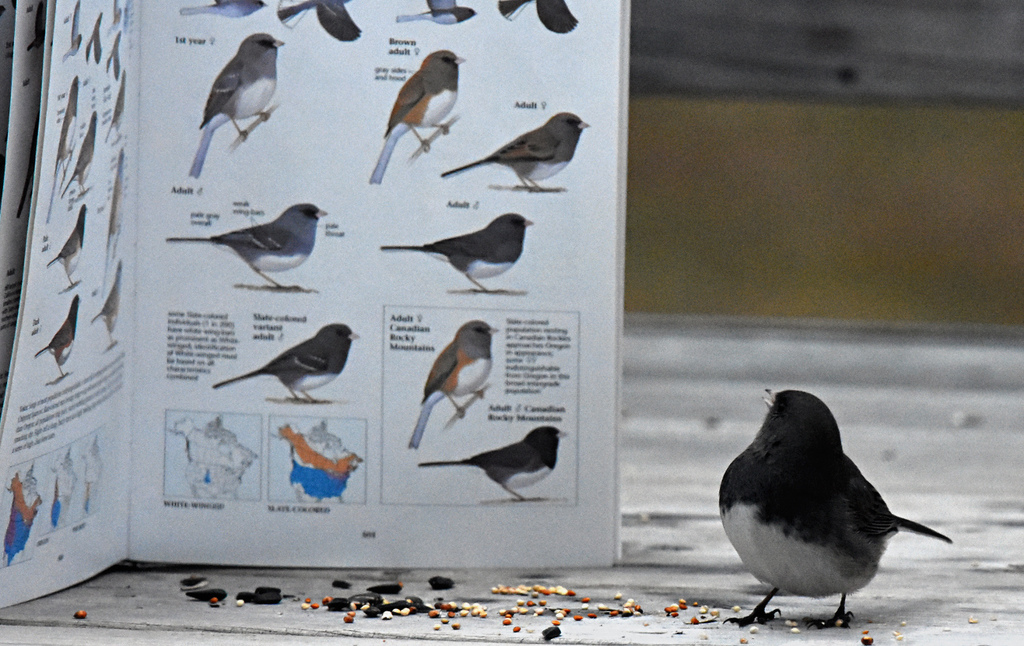
(c) Jimmy Dee, some rights reserved (CC BY-SA) · licence
Family: Emberizidae · Class: Aves · Order: Passeriformes
Junco hyemalis (Dark-eyed Junco) is a California animal in the Emberizidae family.
The Dark-eyed Junco is a medium-sized songbird measuring 14 to 16 centimeters (5.5 to 6.3 inches) in length with a wingspan of 18 to 25 centimeters (7.1 to 9.8 inches). Adults weigh between 18 to 30 grams (0.6 to 1.1 ounces). The species exhibits considerable geographic variation across its range, with multiple subspecies recognized. In California, the most common forms include the Oregon group, characterized by a dark hood contrasting with rusty-brown back and sides, and the Pink-sided group, which displays pinkish-buff flanks. All subspecies share distinctive white outer tail feathers that flash conspicuously during flight and a pale pink to horn-colored bill. Dark-eyed Juncos breed across a vast range from Alaska to Mexico, with year-round populations throughout much of western North America including California. In California, the species occurs in suitable habitat from sea level to over 3,350 meters (11,000 feet) elevation, found in all counties except those in the Central Valley where they occur primarily as winter visitors. Northern and high-elevation populations migrate to lower elevations and more southern latitudes during winter, creating seasonal abundance patterns across the state. The species inhabits coniferous and mixed forests, preferring areas with dense understory vegetation for nesting and foraging. In California, juncos occupy diverse forest types including redwood, Douglas fir, pine, and oak woodlands. They also utilize riparian corridors, chaparral edges, and urban parks with adequate tree cover. Breeding habitat typically includes areas with fallen logs, thick shrubs, or rocky outcrops that provide nesting sites, while wintering birds may occupy more open woodlands and suburban environments. Dark-eyed Juncos are primarily ground-foragers, using a distinctive double-scratch technique to uncover food items beneath leaf litter. Their diet consists mainly of seeds from grasses, forbs, and trees, supplemented with insects, particularly during the breeding season when protein requirements increase for nestlings. Breeding occurs from April through August, with peak activity in May and June. Females construct cup-shaped nests on the ground or in low vegetation, typically concealed under overhanging branches or rock ledges. Clutch size ranges from three to five eggs, with incubation lasting 11 to 13 days. Young fledge after 10 to 13 days in the nest, and pairs may produce two to three broods annually in favorable conditions. The Dark-eyed Junco is not federally or state listed and maintains stable populations across most of its range as of December 2025. According to the North American Breeding Bird Survey, continental populations have remained relatively stable over the past several decades, though some regional variations exist. Climate change poses potential long-term threats through habitat shifts at high elevations and altered precipitation patterns affecting forest composition. However, the species' adaptability to various forest types and elevations, combined with its ability to utilize human-modified landscapes, contributes to its overall conservation security.
Classification
Class: Aves · Order: Passeriformes · Family: Emberizidae
Frequently asked questions
How is Junco hyemalis classified?
Junco hyemalis belongs to class Aves, order Passeriformes, family Emberizidae.
What family does Junco hyemalis belong to?
Junco hyemalis is in the Emberizidae family.
What is Junco hyemalis?
The Dark-eyed Junco is a medium-sized songbird measuring 14 to 16 centimeters (5.5 to 6.3 inches) in length with a wingspan of 18 to 25 centimeters (7.1 to 9.8 inches).
Is Junco hyemalis found in California?
Yes. Junco hyemalis is recorded in California in The California Species Project's catalogue.
Related species
Other California species in the same genus, family, or bioregion.
Data from The California Species Project — 14,000+ California species with verified data from CNPS, CDFW, USFWS, and more.