Junco hyemalis caniceps
Gray-headed Junco
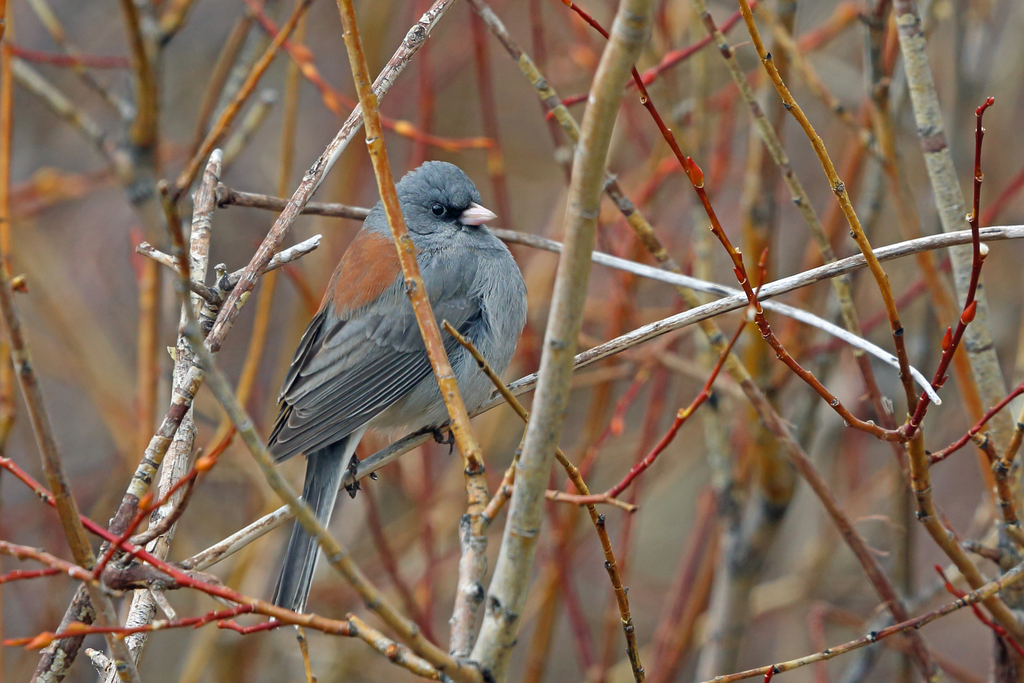
(c) Nigel Voaden, some rights reserved (CC BY) · licence
Family: Emberizidae · Class: Aves · Order: Passeriformes
Conservation status: WL · G5T5 S1
Junco hyemalis caniceps (Gray-headed Junco) is a California animal in the Emberizidae family.
The Gray-headed Junco is a subspecies of the Dark-eyed Junco, distinguished by its gray head and rufous back that contrasts with white outer tail feathers and whitish underparts. Adults measure approximately 14-16 cm (5.5-6.3 inches) in length with a wingspan of 18-25 cm (7-10 inches). The species displays sexual dimorphism, with males typically showing more pronounced coloration patterns. The Gray-headed Junco's diagnostic features include a pale gray head, rufous-brown back and wings, and dark eyes, differentiating it from other junco groups within the Dark-eyed Junco complex. Historically, the Gray-headed Junco ranged throughout montane regions of the western United States, including parts of California's Sierra Nevada and southern Cascade ranges. In California, this subspecies has extremely limited distribution, with the Global/State Rank of G5T5 S1 indicating it is secure globally and as a subspecies, but critically imperiled within California with typically 5 or fewer known occurrences. Current California records are sparse and primarily restricted to high-elevation coniferous forests in the eastern Sierra Nevada region. The Gray-headed Junco inhabits coniferous and mixed forests, particularly favoring areas with ponderosa pine, Douglas fir, and other montane conifers. Breeding habitat typically occurs at elevations between 1,500-3,000 meters (4,900-9,800 feet), though specific elevation ranges in California have not been well documented. The subspecies shows preference for forest edges, clearings, and areas with dense understory vegetation that provide foraging opportunities and nesting sites. During winter months, individuals may move to lower elevations or more open woodland habitats. Gray-headed Juncos are ground-foraging birds that employ a characteristic double-scratch feeding behavior, using both feet simultaneously to uncover food beneath leaf litter and debris. Their diet consists primarily of seeds from grasses, forbs, and conifers, supplemented with insects during breeding season. Breeding occurs from May through July, with females constructing cup-shaped nests on the ground or in low shrubs. Clutch size typically ranges from 3-5 eggs, which are incubated for 12-13 days. The species exhibits partial migratory behavior, with some populations moving altitudinally or latitudinally in response to seasonal food availability and weather conditions. While the overall Dark-eyed Junco population is estimated at approximately 630 million individuals (Birds of the World), the Gray-headed Junco subspecies faces significant conservation challenges in California. The S1 state ranking reflects critical imperilment, likely due to habitat loss, climate change impacts on montane ecosystems, and the subspecies' naturally limited California range. Specific population trends and conservation measures for this subspecies in California have not been well documented. The rarity of confirmed California records suggests this subspecies may be extirpated from the state or exists only as occasional vagrant individuals. Continued monitoring and habitat protection in potential range areas remain important for determining the current status of this subspecies in California.
Classification
Class: Aves · Order: Passeriformes · Family: Emberizidae
Conservation status
WL · G5T5 S1
Frequently asked questions
How is Junco hyemalis caniceps classified?
Junco hyemalis caniceps belongs to class Aves, order Passeriformes, family Emberizidae.
What family does Junco hyemalis caniceps belong to?
Junco hyemalis caniceps is in the Emberizidae family.
Is Junco hyemalis caniceps protected or of conservation concern?
Junco hyemalis caniceps carries the following status: WL · G5T5 S1.
What is Junco hyemalis caniceps?
The Gray-headed Junco is a subspecies of the Dark-eyed Junco, distinguished by its gray head and rufous back that contrasts with white outer tail feathers and whitish underparts.
Is Junco hyemalis caniceps found in California?
Yes. Junco hyemalis caniceps is recorded in California in The California Species Project's catalogue.
Related species
Other California species in the same genus, family, or bioregion.
Data from The California Species Project — 14,000+ California species with verified data from CNPS, CDFW, USFWS, and more.