Junonia coenia
Common Buckeye
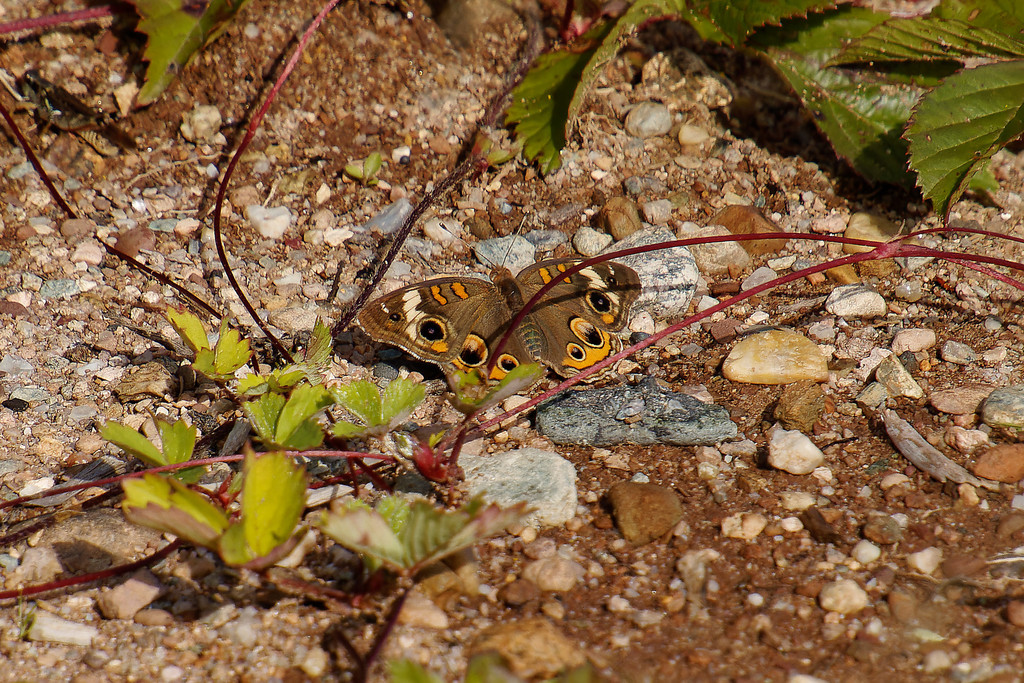
(c) Christian Back, some rights reserved (CC BY) · licence
Family: Nymphalidae · Class: Insecta · Order: Lepidoptera
Junonia coenia (Common Buckeye) is a California animal in the Nymphalidae family.
The Common Buckeye is a medium-sized butterfly with distinctive eyespot markings on its wings. Adults have a wingspan of 5.0 to 7.0 cm (2.0 to 2.8 inches). The dorsal wing surfaces are brown with prominent eyespots: typically two large eyespots on each hindwing and smaller eyespots on the forewings. The upper eyespots are black with white centers and blue outer rings. The ventral wing surfaces are lighter brown with less prominent eyespots and additional white markings. Males and females are similar in appearance, though females are slightly larger. The Common Buckeye is a widespread species resident in the southern United States and extending north along the coasts to central California and North Carolina. Its range extends south to Bermuda, Cuba, Isle of Pines, and southern Mexico. Adults from the southern regions' first brood migrate northward in late spring and summer, temporarily colonizing most of the United States and parts of southern Canada. In California, the species is found throughout much of the state, with populations concentrated in central and southern regions. This species inhabits a variety of open habitats including fields, meadows, roadsides, gardens, and disturbed areas. Common Buckeyes prefer sunny locations with low vegetation and are commonly found in areas where their host plants grow abundantly. They occur from sea level to elevations of approximately 2,100 meters (6,900 feet) in montane environments. The species thrives in human-modified landscapes and agricultural areas where weedy host plants are present. Common Buckeyes are active fliers that exhibit territorial behavior, particularly males defending perching sites. Adults feed on nectar from various flowering plants including composites, legumes, and other native and non-native species. The species is multivoltine, producing multiple generations per year in warmer climates. Females lay pale green eggs singly on host plant leaves or flower buds. Larvae are black with orange markings and numerous branched spines. Host plants include species from the snapdragon family such as snapdragon (Antirrhinum) and toadflax (Linaria), the plantain family including plantains (Plantago), and the acanthus family including ruellia (Ruellia nodiflora). Pupation occurs in a chrysalis attached to the host plant or nearby vegetation. The complete life cycle from egg to adult takes approximately one month under favorable conditions. The Common Buckeye is not federally or state listed and maintains stable populations throughout its range. The species' adaptability to disturbed habitats and human-modified landscapes has contributed to its conservation success. The prominent eyespots serve as a defensive mechanism, potentially startling or confusing predators when the butterfly suddenly displays them. Climate change may influence the species' northern range limits and migration patterns, as warmer temperatures could allow for range expansion into previously unsuitable areas. The species faces minimal conservation concerns due to its widespread distribution, habitat flexibility, and ability to utilize common weedy host plants.
Classification
Class: Insecta · Order: Lepidoptera · Family: Nymphalidae
Frequently asked questions
How is Junonia coenia classified?
Junonia coenia belongs to class Insecta, order Lepidoptera, family Nymphalidae.
What family does Junonia coenia belong to?
Junonia coenia is in the Nymphalidae family.
What is Junonia coenia?
The Common Buckeye is a medium-sized butterfly with distinctive eyespot markings on its wings.
Is Junonia coenia found in California?
Yes. Junonia coenia is recorded in California in The California Species Project's catalogue.
Related species
Other California species in the same genus, family, or bioregion.
Data from The California Species Project — 14,000+ California species with verified data from CNPS, CDFW, USFWS, and more.