Junonia evarete
Tropical Buckeye
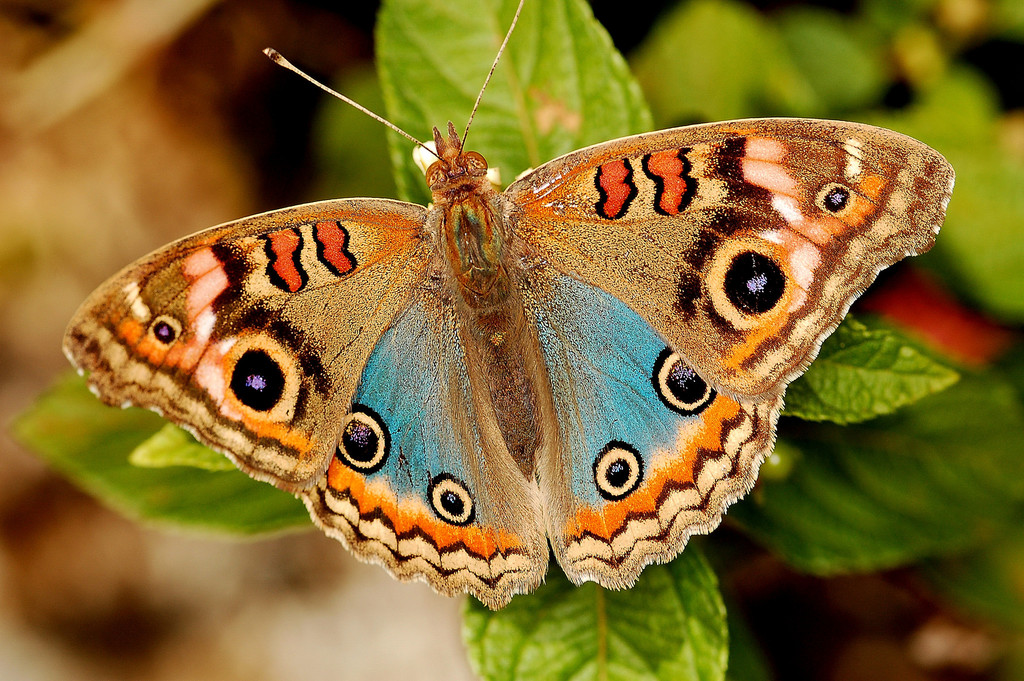
(c) Carlos Alexandre Mattos Raposo, some rights reserved (CC BY-SA) · licence
Family: Nymphalidae · Class: Insecta · Order: Lepidoptera
Junonia evarete (Tropical Buckeye) is a California animal in the Nymphalidae family.
The Tropical Buckeye is a medium-sized butterfly in the brush-footed butterfly family Nymphalidae. Adults have a wingspan of approximately 55-75 mm (2.2-3.0 inches). The dorsal wing surfaces are orange-brown with distinctive dark eyespots that serve as a predator deterrent mechanism. Each forewing typically displays two prominent eyespots, while the hindwings feature one large eyespot. The ventral surfaces are paler with cryptic mottling that provides camouflage when at rest. Males and females exhibit similar coloration patterns, though females are typically slightly larger. The Tropical Buckeye has a primarily neotropical distribution, ranging from southern New Mexico, southern Arizona, South Texas, and southern Florida southward through the West Indies, Mexico, and Central America to Argentina. Within this extensive range, the species is a rare wanderer to southeastern California, southeastern Colorado, and central Florida. In California, records are extremely limited and represent occasional vagrant individuals rather than established populations. The species' occurrence in the state appears to be associated with favorable weather patterns that facilitate northward dispersal from core populations in Mexico and Central America. Tropical Buckeyes inhabit open areas including disturbed sites, roadsides, gardens, and agricultural edges where host plants are present. The species shows a preference for warm, sunny locations with moderate humidity. In its core range, it occurs from sea level to approximately 2,000 meters elevation. The butterfly demonstrates considerable ecological flexibility, adapting to both natural and human-modified landscapes. Adults are active year-round in tropical regions, with multiple overlapping generations. In temperate portions of the range, activity is restricted to warmer months. Males engage in territorial behavior, perching on prominent objects and investigating passing insects. Mating occurs after courtship flights, and females deposit eggs singly on host plant leaves. Larvae feed on plants in the Acanthaceae and Verbenaceae families, including Stemodia, Lippia, Ruellia, and porterweed species. The caterpillars are dark with branching spines and feed openly on foliage. Pupation occurs in a chrysalis attached to the host plant or nearby vegetation. Development from egg to adult requires approximately 25-30 days under optimal conditions. The Tropical Buckeye is not federally or state-listed as threatened or endangered. The species maintains stable populations throughout most of its extensive range and demonstrates resilience to habitat modification. In California, the species' status as a rare vagrant means it has no established conservation concerns within the state. Climate change may potentially influence the frequency of vagrant occurrences, as warming temperatures could facilitate more northward dispersal events. The species' broad host plant requirements and tolerance for disturbed habitats suggest it is not immediately threatened by habitat loss, though localized populations may face pressure from intensive agricultural practices or urban development in some regions.
Classification
Class: Insecta · Order: Lepidoptera · Family: Nymphalidae
Frequently asked questions
How is Junonia evarete classified?
Junonia evarete belongs to class Insecta, order Lepidoptera, family Nymphalidae.
What family does Junonia evarete belong to?
Junonia evarete is in the Nymphalidae family.
What is Junonia evarete?
The Tropical Buckeye is a medium-sized butterfly in the brush-footed butterfly family Nymphalidae.
Is Junonia evarete found in California?
Yes. Junonia evarete is recorded in California in The California Species Project's catalogue.
Related species
Other California species in the same genus, family, or bioregion.
Data from The California Species Project — 14,000+ California species with verified data from CNPS, CDFW, USFWS, and more.