Junonia grisea
Gray Buckeye
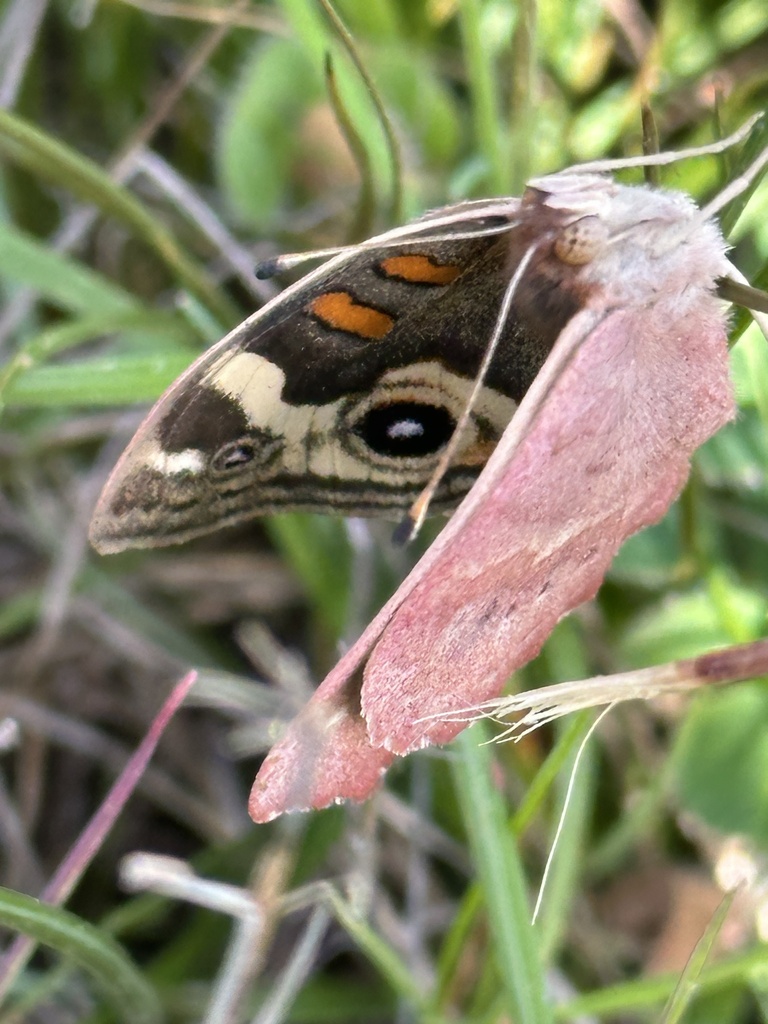
(c) Irina Mitine, some rights reserved (CC BY) · licence
Family: Nymphalidae · Class: Insecta · Order: Lepidoptera
Junonia grisea (Gray Buckeye) is a California animal in the Nymphalidae family.
The Gray Buckeye (Junonia grisea) is a medium-sized butterfly in the brush-footed butterfly family Nymphalidae, described by Austin & J. Emmel in 1998. This species is closely related to the more widespread Common Buckeye (Junonia coenia) and was historically considered a subspecies before taxonomic revision elevated it to full species status. The Gray Buckeye exhibits the characteristic eyespots typical of Junonia species, with distinctive wing patterns that help distinguish it from its congeners. The Gray Buckeye occurs primarily in the southwestern United States, with populations documented in California, Arizona, Nevada, and Utah. In California, the species has been recorded from desert regions and lower elevation areas, particularly in the southern and eastern portions of the state. The distribution appears to overlap partially with that of the Common Buckeye, though the Gray Buckeye typically occupies more arid environments. Recent lepidopterological surveys have documented sightings as far north as Mesa County, Colorado, suggesting potential range expansion or vagrant movements (Lepidopterists' Society Season Summaries). This species inhabits desert scrub, chaparral, and semi-arid grassland environments at elevations typically below 4,000 feet. Gray Buckeyes prefer open areas with scattered shrubs and herbaceous plants that provide both nectar sources and larval host plants. The species shows adaptation to xeric conditions, thriving in areas with low annual precipitation and high temperature variation between seasons. Adult Gray Buckeyes are active fliers that engage in territorial behavior, particularly males defending perching sites. Flight periods typically extend from spring through fall, with multiple broods possible in favorable conditions. Like other Junonia species, Gray Buckeyes utilize plants in the snapdragon family (Plantaginaceae, formerly Scrophulariaceae) and acanthus family (Acanthaceae) as larval hosts. Adults nectar on a variety of flowering plants, including desert willow, brittlebush, and various composite flowers. Males exhibit hilltopping behavior, congregating on elevated terrain to locate mates. The Gray Buckeye is not federally listed or designated as a species of special concern in California as of December 2025. However, like many desert-adapted species, it faces potential threats from habitat fragmentation due to urban development, agricultural conversion, and climate change impacts on desert ecosystems. The species' relatively recent taxonomic recognition means that historical population trends are not well documented, and current population status requires further study. Conservation efforts focused on preserving intact desert scrub habitats will benefit this species along with other endemic desert fauna. Continued taxonomic research and field surveys are needed to better understand the Gray Buckeye's distribution, population dynamics, and ecological requirements. The species serves as an example of the ongoing discovery of biodiversity in North American Lepidoptera, particularly in arid western regions where cryptic species complexes continue to be resolved through modern systematic techniques.
Classification
Class: Insecta · Order: Lepidoptera · Family: Nymphalidae
Frequently asked questions
How is Junonia grisea classified?
Junonia grisea belongs to class Insecta, order Lepidoptera, family Nymphalidae.
What family does Junonia grisea belong to?
Junonia grisea is in the Nymphalidae family.
What is Junonia grisea?
The Gray Buckeye (Junonia grisea) is a medium-sized butterfly in the brush-footed butterfly family Nymphalidae, described by Austin & J.
Is Junonia grisea found in California?
Yes. Junonia grisea is recorded in California in The California Species Project's catalogue.
Related species
Other California species in the same genus, family, or bioregion.
Data from The California Species Project — 14,000+ California species with verified data from CNPS, CDFW, USFWS, and more.