Kinosternon sonoriense
Sonora Mud Turtle
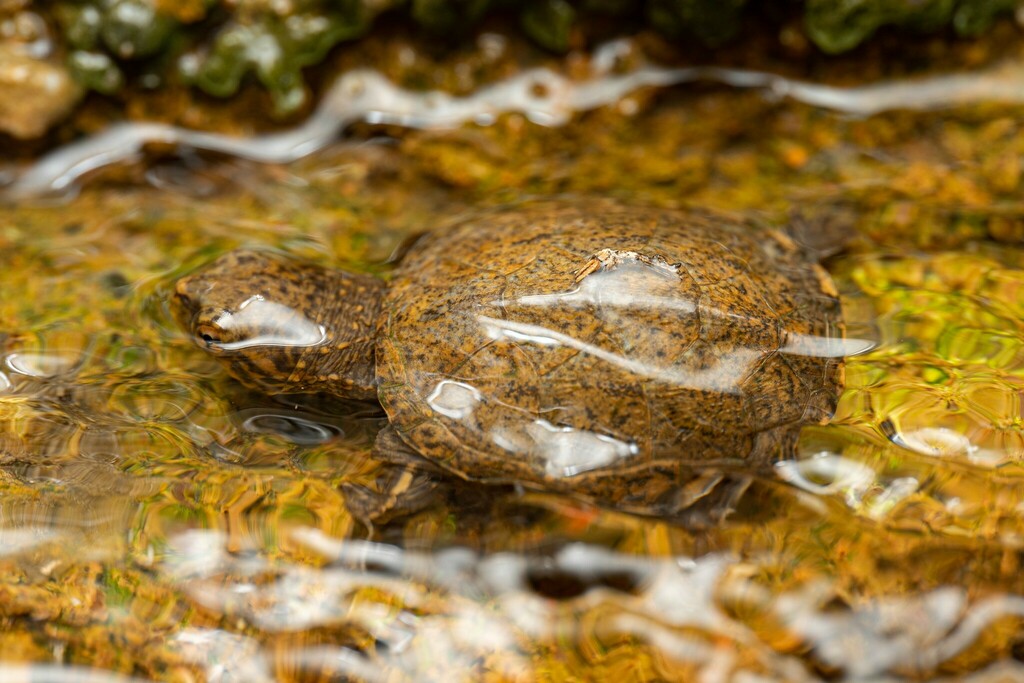
(c) Jake Nitta, some rights reserved (CC BY) · licence
Family: Kinosternidae · Class: Reptilia · Order: Testudines
Conservation status: G3 SH
Kinosternon sonoriense (Sonora Mud Turtle) is a California animal in the Kinosternidae family.
The Sonora mud turtle is a small to medium-sized freshwater turtle endemic to the southwestern United States and northwestern Mexico. Adults typically measure 100 to 165 mm (3.9 to 6.5 inches) in carapace length, with females generally larger than males. The carapace is olive-brown to dark brown, often with darker radiating lines or spots on each scute. The plastron is yellowish to cream-colored and features two hinges that allow partial closure of the shell. The head and neck are olive-brown with yellow striping, and males can be distinguished by their longer, thicker tails and concave plastrons. Historically, Sonora mud turtles occurred in southeastern California, primarily in the Colorado River drainage system and associated tributaries. The species ranged through parts of Imperial and Riverside counties, inhabiting permanent water sources in desert regions. However, current distribution in California is extremely limited or possibly extirpated, with no confirmed populations documented in recent decades. The species continues to occur in Arizona, New Mexico, Sonora, and Sinaloa, Mexico. Sonora mud turtles inhabit permanent or semi-permanent aquatic habitats including streams, ponds, cattle tanks, and irrigation canals in desert and semi-desert regions. They prefer areas with muddy bottoms and aquatic vegetation, typically at elevations below 1,200 meters (3,937 feet). During dry periods, individuals may aestivate buried in mud or under vegetation near water sources. The species demonstrates exceptional drought tolerance, remaining dormant for extended periods when surface water disappears. These omnivorous turtles feed on aquatic invertebrates, small fish, amphibian larvae, carrion, and aquatic plants. Mating occurs primarily in spring and early summer. Females nest from May through August, digging shallow nests in sandy or loose soil near water. Clutch sizes range from one to nine eggs, with an average of three to five eggs per clutch. Incubation periods vary from 70 to 120 days depending on temperature. Hatchlings emerge in late summer or fall and may overwinter in the nest. The Sonora mud turtle holds a global conservation rank of G3 (vulnerable) and is considered state historic (SH) in California, indicating the species formerly occurred in the state but has not been documented in recent years. Primary threats include habitat loss due to water diversions, groundwater pumping, and development of riparian areas. Introduced predators, water pollution, and climate change-induced drought further threaten remaining populations. In California, the species may be functionally extinct, with habitat modification along the Colorado River system eliminating suitable conditions. Conservation efforts focus on habitat protection and restoration in remaining range states, though no active recovery programs currently target California populations.
Classification
Class: Reptilia · Order: Testudines · Family: Kinosternidae
Conservation status
G3 SH
Frequently asked questions
How is Kinosternon sonoriense classified?
Kinosternon sonoriense belongs to class Reptilia, order Testudines, family Kinosternidae.
What family does Kinosternon sonoriense belong to?
Kinosternon sonoriense is in the Kinosternidae family.
Is Kinosternon sonoriense protected or of conservation concern?
Kinosternon sonoriense carries the following status: G3 SH.
What is Kinosternon sonoriense?
The Sonora mud turtle is a small to medium-sized freshwater turtle endemic to the southwestern United States and northwestern Mexico.
Is Kinosternon sonoriense found in California?
Yes. Kinosternon sonoriense is recorded in California in The California Species Project's catalogue.
Related species
Other California species in the same genus, family, or bioregion.
Data from The California Species Project — 14,000+ California species with verified data from CNPS, CDFW, USFWS, and more.