Kinosternon sonoriense longifemorale
Sonoyta mud turtle
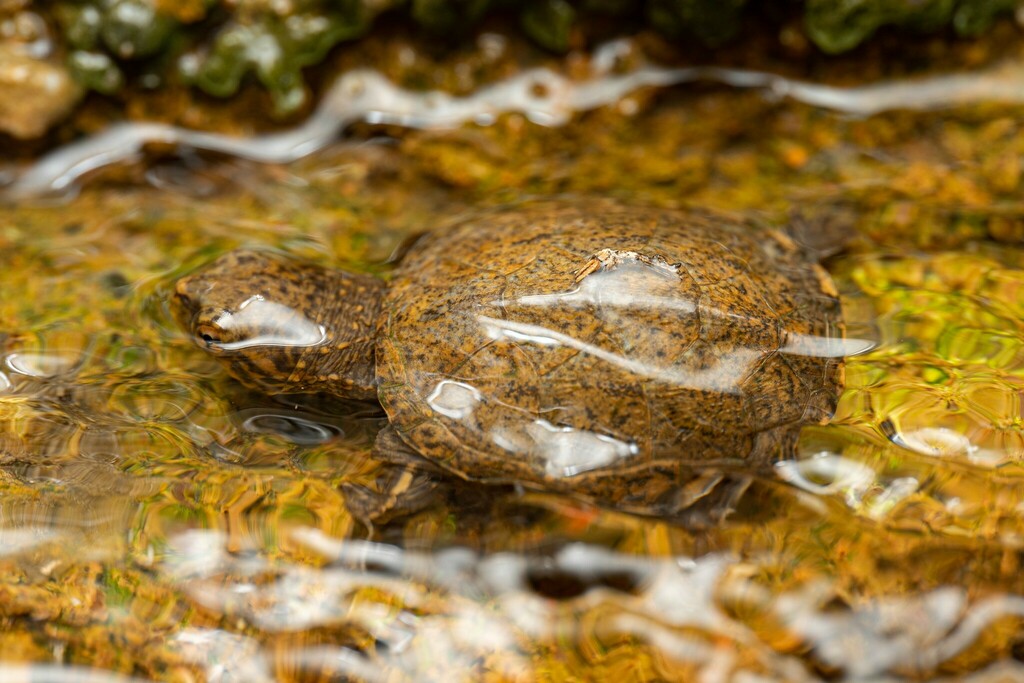
(c) Jake Nitta, some rights reserved (CC BY) · licence
Family: Kinosternidae · Class: Reptilia · Order: Testudines
Conservation status: Endangered
Kinosternon sonoriense longifemorale (Sonoyta mud turtle) is a California animal in the Kinosternidae family.
The Sonoyta mud turtle is a small, dark freshwater turtle endemic to the Sonoran Desert region of southern Arizona and northwestern Mexico. Adults typically measure 7.5 to 12 centimeters (3 to 4.7 inches) in carapace length, making it one of the smaller North American mud turtles. The carapace is dark brown to black with a smooth, dome-shaped profile, while the plastron is yellow to cream-colored with dark seams. Males can be distinguished from females by their concave plastrons, longer tails, and slightly larger size. Historically, the Sonoyta mud turtle occurred in scattered aquatic habitats across the Sonoran Desert. Currently, the subspecies is restricted to extremely limited locations in southern Arizona and northwestern Sonora, Mexico. In Arizona, the species persists at Quitobaquito Springs within Organ Pipe Cactus National Monument. In Mexico, populations are found in the Rio Sonoyta and Quitovac Spring systems. This represents a dramatic range reduction from historical distribution patterns. Sonoyta mud turtles require permanent or near-permanent surface water sources including springs, pools, streams, and associated riparian areas. They inhabit shallow aquatic environments with soft substrates and emergent vegetation that provide cover and basking sites. The species depends on both aquatic habitat for feeding and reproduction and adjacent terrestrial areas for nesting, overwintering, and refuge during dry periods. Water temperatures and flow regimes are critical habitat components, as the subspecies has evolved specific adaptations to desert spring ecosystems. These turtles are omnivorous, feeding on aquatic invertebrates, small fish, plant material, and detritus. Reproduction typically occurs during warmer months, with females depositing small clutches of 2 to 6 eggs in sandy or muddy substrates near water sources. The species exhibits high site fidelity and limited dispersal ability, making populations particularly vulnerable to habitat disruption. Sonoyta mud turtles are long-lived, with individuals potentially surviving several decades under favorable conditions. The U.S. Fish and Wildlife Service listed the Sonoyta mud turtle as endangered under the Endangered Species Act in 2017, with critical habitat designated in 2019 (USFWS). Primary threats include habitat loss and degradation from agricultural and municipal groundwater pumping, which reduces surface water availability in desert springs and streams. Long-term drought conditions exacerbated by climate change further stress remaining populations. Water diversions for irrigation and development have eliminated or severely degraded much of the subspecies' historical habitat. The species is also listed as endemic and in danger of extinction under Mexico's Norma Oficial Mexicana. A draft recovery plan was released in 2025, outlining strategies to restore populations and protect remaining habitat. Conservation efforts focus on maintaining adequate water levels at occupied sites, preventing further groundwater depletion, and potential population augmentation through captive breeding programs. The subspecies' extremely limited range and small population size make it highly vulnerable to extinction without intensive management intervention.
Classification
Class: Reptilia · Order: Testudines · Family: Kinosternidae
Conservation status
Endangered
Frequently asked questions
How is Kinosternon sonoriense longifemorale classified?
Kinosternon sonoriense longifemorale belongs to class Reptilia, order Testudines, family Kinosternidae.
What family does Kinosternon sonoriense longifemorale belong to?
Kinosternon sonoriense longifemorale is in the Kinosternidae family.
Is Kinosternon sonoriense longifemorale protected or of conservation concern?
Kinosternon sonoriense longifemorale carries the following status: Endangered.
What is Kinosternon sonoriense longifemorale?
The Sonoyta mud turtle is a small, dark freshwater turtle endemic to the Sonoran Desert region of southern Arizona and northwestern Mexico.
Is Kinosternon sonoriense longifemorale found in California?
Yes. Kinosternon sonoriense longifemorale is recorded in California in The California Species Project's catalogue.
Related species
Other California species in the same genus, family, or bioregion.
Data from The California Species Project — 14,000+ California species with verified data from CNPS, CDFW, USFWS, and more.