Lacinipolia davena
Red-spot Polia Moth
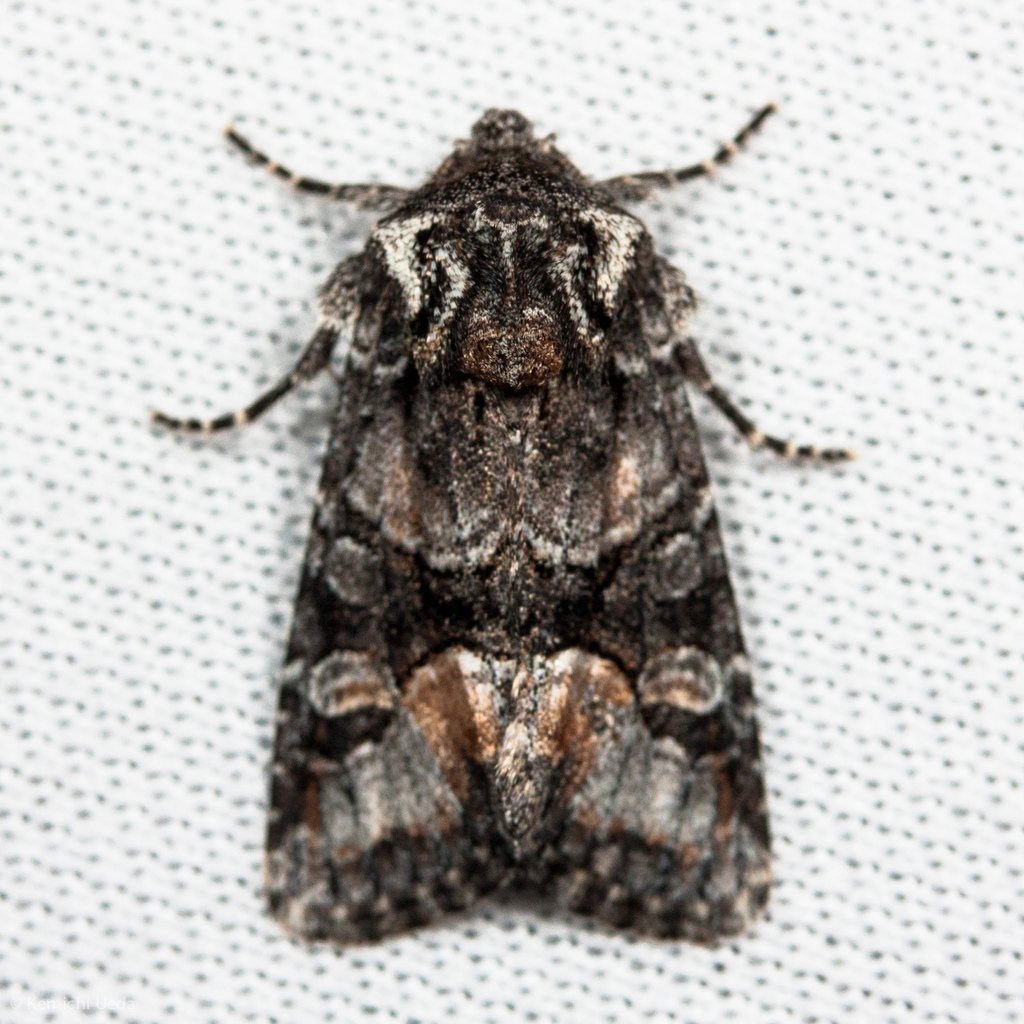
(c) Ken-ichi Ueda, some rights reserved (CC BY) · licence
Family: Noctuidae · Class: Insecta · Order: Lepidoptera
Lacinipolia davena (Red-spot Polia Moth) is a California animal in the Noctuidae family.
Lacinipolia davena, commonly known as the Red-spot Polia Moth, is a small nocturnal moth in the family Noctuidae. Adults have a wingspan of approximately 27 mm (1.1 inches) (BugGuide 2025). The forewings display a distinctive pattern with dark gray to blackish coloration extending to the postmedian line, followed by a pale gray subterminal area. The reniform spot appears pale, while the orbicular spot and antemedian line are dark and edged in black. The hindwings are brownish-gray with dark veins, a discal lunule, and a double terminal line. This species is assigned Hodges number 10407 in the standardized classification system for North American Lepidoptera. The geographic distribution of L. davena extends across western North America. Records indicate populations in California, Oregon, Colorado, and other western states (Lepidopterists' Society 2004, 2006, 2013). In California, the species has been documented in multiple counties including Del Norte, Humboldt, Ventura, Fresno, and Kern counties, with elevational records ranging from coastal areas to montane forests at elevations exceeding 7,500 feet (Lepidopterists' Society 2004, 2013). Oregon populations have been recorded in Jackson, Lane, and Coos counties, while Colorado records span from low elevation sites near 3,800 feet to high elevation localities above 9,700 feet. The species inhabits diverse ecosystems across its range, from coastal forests to montane environments. California records span from sea level coastal areas to high elevation sites in the Sierra Nevada and other mountain ranges. In Oregon, L. davena has been collected in the Cascade-Siskiyou National Monument and H.J. Andrews Experimental Forest, suggesting associations with both mixed conifer and old-growth forest habitats (Lepidopterists' Society 2006). Colorado populations occur in habitats ranging from grasslands and shrublands to subalpine forests, indicating considerable ecological flexibility. Adult flight periods vary geographically and with elevation. California records indicate activity from March through August, with peak abundance typically occurring from May through July. Higher elevation populations may have more restricted flight periods, with Colorado records showing activity primarily from July through September. Adults are nocturnal and attracted to ultraviolet and mercury vapor lights, which has facilitated much of the distributional data collection (Lepidopterists' Society 2004, 2013). Specific host plant associations and larval biology remain largely undocumented in the scientific literature. Lacinipolia davena currently lacks formal conservation status designations at federal or state levels. The species appears to maintain stable populations across its range based on consistent collection records over multiple decades. However, like many nocturnal Lepidoptera, population trends are difficult to assess due to limited standardized monitoring efforts. Climate change and habitat modification represent potential long-term threats, particularly for high-elevation populations that may face upslope range shifts as temperatures increase. The species' apparent ecological flexibility across diverse habitats may provide some resilience to environmental changes, though specific vulnerability assessments have not been conducted.
Classification
Class: Insecta · Order: Lepidoptera · Family: Noctuidae
Frequently asked questions
How is Lacinipolia davena classified?
Lacinipolia davena belongs to class Insecta, order Lepidoptera, family Noctuidae.
What family does Lacinipolia davena belong to?
Lacinipolia davena is in the Noctuidae family.
What is Lacinipolia davena?
Lacinipolia davena, commonly known as the Red-spot Polia Moth, is a small nocturnal moth in the family Noctuidae.
Is Lacinipolia davena found in California?
Yes. Lacinipolia davena is recorded in California in The California Species Project's catalogue.
Related species
Other California species in the same genus, family, or bioregion.
Data from The California Species Project — 14,000+ California species with verified data from CNPS, CDFW, USFWS, and more.