Lacinipolia vicina
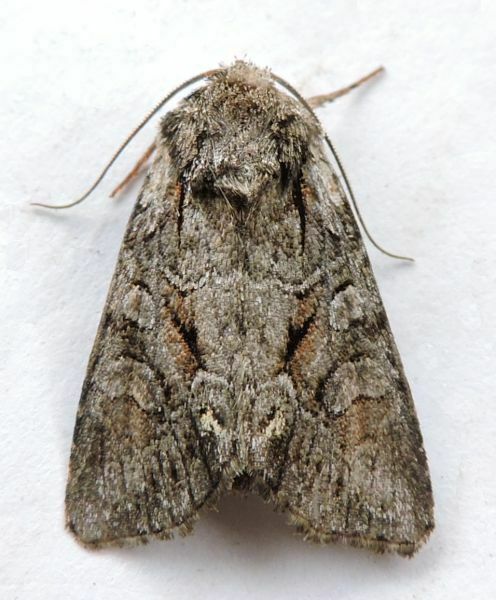
(c) jimeckert49, some rights reserved (CC BY) · licence
Family: Noctuidae · Class: Insecta · Order: Lepidoptera
Lacinipolia vicina is a California animal in the Noctuidae family.
Lacinipolia vicina is a moth species in the family Noctuidae, commonly known as owlet moths or cutworm moths. This nocturnal lepidopteran belongs to a genus of medium-sized moths that are primarily distributed across North America. Adult moths typically measure 12 to 16 mm in forewing length, with wingspan ranging from 28 to 35 mm. The forewings display a mottled pattern of gray and brown tones, with darker scaling creating subtle banding across the wing surface. The hindwings are pale gray to whitish with darker marginal borders. Like other Lacinipolia species, L. vicina exhibits sexual dimorphism, with males possessing more feathered antennae compared to the thread-like antennae of females. The historical and current range of Lacinipolia vicina includes portions of western North America, though detailed distribution records remain limited in published literature. The species appears to occur in California, though specific county records and elevation ranges require further documentation. Distribution patterns suggest the species may be associated with montane and foothill regions, similar to related Lacinipolia taxa. Habitat preferences for L. vicina likely include areas with native grasslands, oak woodlands, and chaparral communities. The species may occupy elevations ranging from foothill zones to mid-montane areas, typically between 300 and 1,500 meters elevation. Adult moths are attracted to artificial lights and are most commonly observed during nocturnal activity periods. Microhabitat selection may be influenced by the distribution of larval host plants and suitable oviposition sites. Adult flight periods for Lacinipolia vicina occur during spring and early summer months, typically from April through July, depending on elevation and local climate conditions. Females deposit eggs on or near host plant foliage, where larvae develop through five instars before pupating in soil chambers. Larvae are likely generalist feeders on herbaceous plants and grasses, consistent with the feeding ecology of related species in the genus. The species completes one generation annually, overwintering as pupae in underground chambers. The conservation status of Lacinipolia vicina has not been formally assessed by state or federal agencies. Population trends and demographic data are not available in current literature, reflecting the limited research attention given to many nocturnal Lepidoptera species. The species does not appear on federal or California state endangered species lists as of December 2025. Primary threats to the species likely include habitat loss from urban development, agricultural conversion, and invasive plant species that may alter native plant communities upon which larvae depend. Climate change may affect the species through shifts in temperature and precipitation patterns that influence host plant phenology and distribution. Conservation efforts would benefit from systematic surveys to document current distribution, population status, and ecological requirements.
Classification
Class: Insecta · Order: Lepidoptera · Family: Noctuidae
Frequently asked questions
How is Lacinipolia vicina classified?
Lacinipolia vicina belongs to class Insecta, order Lepidoptera, family Noctuidae.
What family does Lacinipolia vicina belong to?
Lacinipolia vicina is in the Noctuidae family.
What is Lacinipolia vicina?
Lacinipolia vicina is a moth species in the family Noctuidae, commonly known as owlet moths or cutworm moths.
Is Lacinipolia vicina found in California?
Yes. Lacinipolia vicina is recorded in California in The California Species Project's catalogue.
Related species
Other California species in the same genus, family, or bioregion.
Data from The California Species Project — 14,000+ California species with verified data from CNPS, CDFW, USFWS, and more.