Ladona julia
Chalk-fronted Corporal
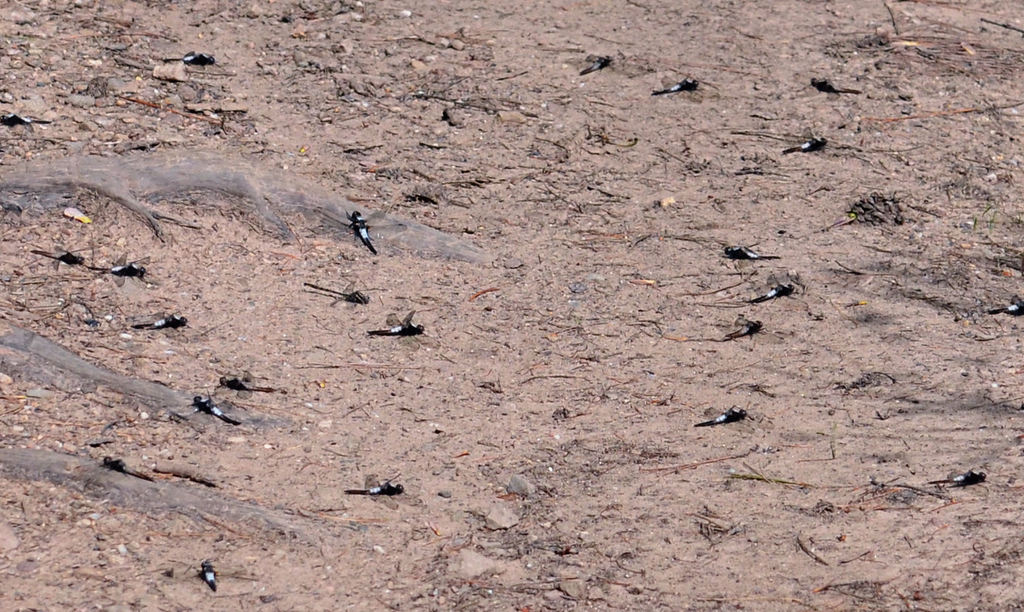
(c) Jimmy Dee, some rights reserved (CC BY-SA) · licence
Family: Libellulidae · Class: Insecta · Order: Odonata
Ladona julia (Chalk-fronted Corporal) is a California animal in the Libellulidae family.
The Chalk-fronted Corporal (Ladona julia) is a medium-sized dragonfly in the skimmer family Libellulidae. Males are distinctive with a chalky white front to their face and thorax, contrasting with their dark abdomen that develops pruinose markings with age. The wings are clear with dark basal patches, and mature males display a characteristic white pruinescence on the thorax and early abdominal segments. Females are brownish with yellow markings and lack the white coloration of males. Body length ranges from 38 to 45 millimeters (1.5 to 1.8 inches), with a wingspan of approximately 70 to 80 millimeters (2.8 to 3.1 inches). This species has a broad distribution across much of North America, ranging from southern Canada south to northern Florida and from the Atlantic coast west to the Great Plains. In the western United States, populations extend into parts of Montana, Wyoming, and Colorado. The species occurs throughout much of the eastern and central United States, with scattered populations in suitable habitat across its range. Chalk-fronted Corporals inhabit a variety of aquatic habitats, showing preference for still or slow-moving waters. They are commonly found around ponds, lakes, marshes, bogs, and slow streams, particularly those with emergent vegetation. The species tolerates both temporary and permanent water bodies and can be found from near sea level to moderate elevations. Adults are often observed perching on emergent vegetation, logs, or bare ground near water sources. Adults are active from late spring through early fall, with peak flight periods typically occurring from June through August in most regions. Males are territorial, establishing and defending perching sites along shorelines where they watch for females and chase away intruders. Mating occurs in flight, followed by oviposition where females deposit eggs in shallow water among vegetation or detritus. The aquatic nymphs are predatory, feeding on small aquatic invertebrates, and development typically requires one to two years depending on climate conditions. Adults are opportunistic predators, capturing flying insects including mosquitoes, midges, and other small flying prey. According to NatureServe, Ladona julia has a global conservation status of G5, indicating the species is secure with stable populations across its range. The species does not face significant conservation threats and maintains healthy populations throughout most of its distribution. However, like many freshwater-dependent species, local populations may be affected by habitat degradation, water pollution, or wetland loss. The species' adaptability to various aquatic habitats and broad distribution contribute to its overall stability. Some state wildlife agencies include dragonflies in their comprehensive wildlife conservation strategies, though specific management actions for this species are generally not required due to its secure status.
Classification
Class: Insecta · Order: Odonata · Family: Libellulidae
Frequently asked questions
How is Ladona julia classified?
Ladona julia belongs to class Insecta, order Odonata, family Libellulidae.
What family does Ladona julia belong to?
Ladona julia is in the Libellulidae family.
What is Ladona julia?
The Chalk-fronted Corporal (Ladona julia) is a medium-sized dragonfly in the skimmer family Libellulidae.
Is Ladona julia found in California?
Yes. Ladona julia is recorded in California in The California Species Project's catalogue.
Related species
Other California species in the same genus, family, or bioregion.
Data from The California Species Project — 14,000+ California species with verified data from CNPS, CDFW, USFWS, and more.