Lagopus leucura
White-tailed Ptarmigan
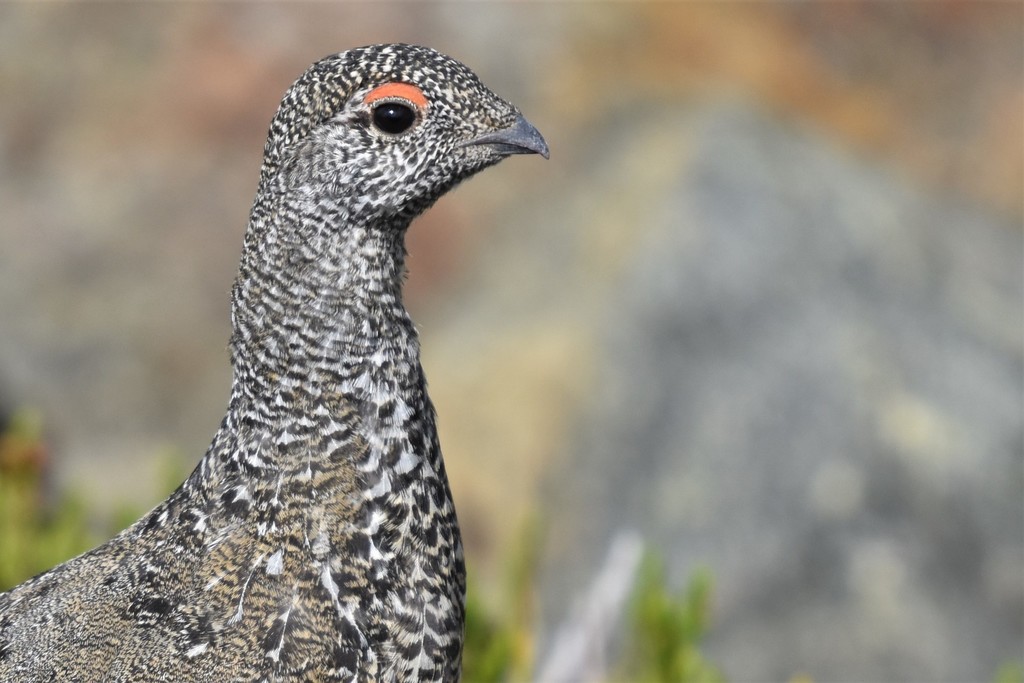
no rights reserved · CC0
Family: Phasianidae · Class: Aves · Order: Galliformes
Lagopus leucura (White-tailed Ptarmigan) is a California animal in the Phasianidae family.
The White-tailed Ptarmigan is a small grouse species measuring 30 to 36 centimeters (12 to 14 inches) in length and weighing 340 to 430 grams (12 to 15 ounces). This compact bird exhibits dramatic seasonal plumage changes. During summer, adults display mottled brown, gray, and white upperparts that provide camouflage against alpine terrain, while underparts remain predominantly white. Winter plumage transforms the bird completely white except for black eyes and bill, allowing concealment against snow. Males develop prominent red combs above the eyes during breeding season. The species' feathered feet, extending to the toes, provide insulation and traction on snow and rocky surfaces. White-tailed Ptarmigan occupy high-elevation alpine and subalpine zones throughout western North America. In California, the species is found primarily in the Sierra Nevada range, inhabiting elevations from 2,100 to 4,300 meters (7,000 to 14,000 feet). According to CDFW, California populations represent the southernmost extent of the species' range, with documented occurrences in alpine areas of the central and southern Sierra Nevada, including portions of Fresno, Inyo, Mono, and Tulare counties. The species requires treeless alpine habitat characterized by rocky slopes, talus fields, willow thickets, and alpine meadows. Preferred terrain includes areas with scattered boulders and low-growing vegetation such as alpine willows, sedges, and cushion plants. Winter habitat consists of windswept ridges and slopes where snow depth remains manageable for foraging. The species shows strong fidelity to areas with diverse microtopography that provides both feeding opportunities and shelter from harsh weather. White-tailed Ptarmigan are primarily herbivorous, feeding on buds, leaves, flowers, and seeds of alpine plants. Summer diet includes willows, sedges, alpine sorrel, and various forbs. Winter feeding focuses on exposed buds and twigs of shrubs protruding above snow. Breeding occurs from May through July, with females constructing ground nests in shallow depressions lined with vegetation and feathers. Clutch size ranges from 4 to 8 eggs, with incubation lasting 22 to 24 days. Chicks are precocial and capable of flight within 10 to 14 days. The species exhibits strong sexual dimorphism in territorial behavior, with males defending territories through elaborate displays and vocalizations. White-tailed Ptarmigan are not federally listed and maintain stable populations across much of their range. However, California populations face increasing pressure from climate change, which threatens to shift suitable habitat to higher elevations. Rising temperatures may reduce available alpine habitat and alter vegetation communities essential for survival. Additional threats include recreational activities in alpine areas and potential habitat fragmentation. Climate models suggest significant habitat loss at lower elevations may occur within decades, making California's populations particularly vulnerable as they occupy the species' southern range limit.
Classification
Class: Aves · Order: Galliformes · Family: Phasianidae
Frequently asked questions
How is Lagopus leucura classified?
Lagopus leucura belongs to class Aves, order Galliformes, family Phasianidae.
What family does Lagopus leucura belong to?
Lagopus leucura is in the Phasianidae family.
What is Lagopus leucura?
The White-tailed Ptarmigan is a small grouse species measuring 30 to 36 centimeters (12 to 14 inches) in length and weighing 340 to 430 grams (12 to 15 ounces).
Is Lagopus leucura found in California?
Yes. Lagopus leucura is recorded in California in The California Species Project's catalogue.
Related species
Other California species in the same genus, family, or bioregion.
Data from The California Species Project — 14,000+ California species with verified data from CNPS, CDFW, USFWS, and more.