Lagopus leucura rainierensis
Mt. Rainier white-tailed ptarmigan
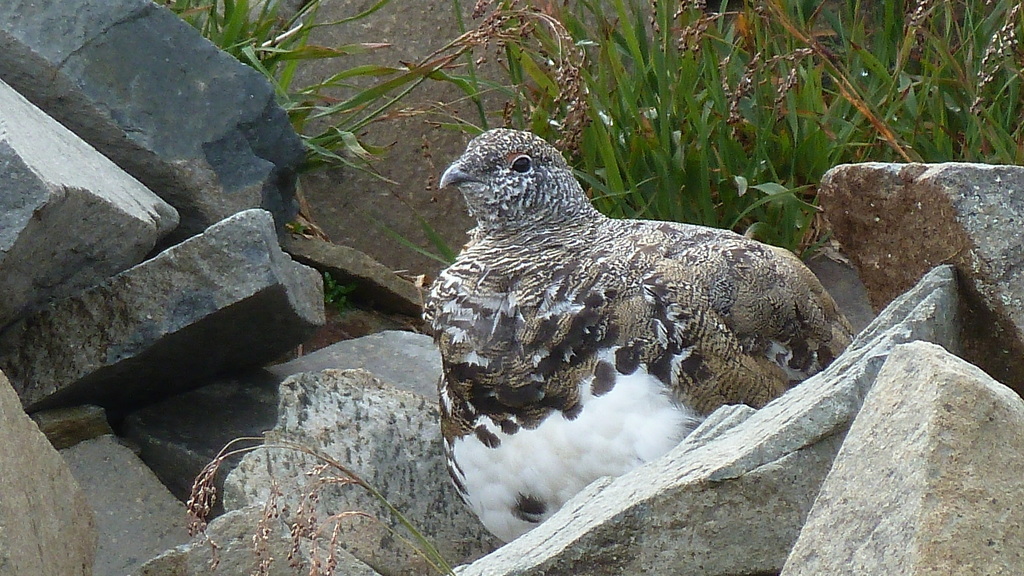
(c) tlaloc27, some rights reserved (CC BY) · licence
Family: Phasianidae · Class: Aves · Order: Galliformes
Conservation status: Threatened
Lagopus leucura rainierensis (Mt. Rainier white-tailed ptarmigan) is a California animal in the Phasianidae family.
The Mt. Rainier white-tailed ptarmigan (Lagopus leucura rainierensis) is a chicken-sized grouse endemic to the alpine environments of Washington State and southern British Columbia. Adults measure approximately 30 to 32 centimeters (12 to 13 inches) in length and weigh 350 to 425 grams (12 to 15 ounces). The species exhibits distinct seasonal plumage changes as camouflage adaptation: pure white feathers during winter months that molt to mottled brown and gray patterns by summer. The scientific name Lagopus means "hare-foot," reflecting their distinctive feathered feet that function like natural snowshoes for traversing snow and ice. This subspecies occurs exclusively in Washington State and British Columbia south of the Fraser River Valley, distinguishing it from other white-tailed ptarmigan subspecies found in Alaska, Vancouver Island, and the Rocky Mountains (USFWS). The Mt. Rainier white-tailed ptarmigan represents one of five recognized subspecies of Lagopus leucura in North America. The species inhabits alpine and upper subalpine environments above treeline, typically at elevations exceeding 1,500 meters (4,921 feet). They occupy some of the most extreme habitats in North America, remaining in alpine zones year-round rather than migrating to lower elevations during winter. Preferred habitat includes rocky alpine slopes, alpine meadows, krummholz zones, and areas with scattered vegetation interspersed with bare ground and rock formations. The species has been documented nesting at elevations up to 4,054 meters, making white-tailed ptarmigan North America's third highest elevation breeding bird (Martin 2014). Mt. Rainier white-tailed ptarmigan are herbivorous, feeding primarily on alpine plants including willow buds, leaves, flowers, and berries during summer months. Winter diet consists mainly of willow and birch buds and twigs that remain accessible above snow. Breeding occurs from late May through August, with females constructing ground nests in shallow depressions lined with vegetation and feathers. Clutch sizes typically range from 4 to 8 eggs, with incubation lasting 22 to 24 days. Chicks are precocial, capable of leaving the nest within hours of hatching. The U.S. Fish and Wildlife Service listed the Mt. Rainier white-tailed ptarmigan as threatened under the Endangered Species Act in 2022, with protection measures implemented through a Section 4(d) rule (USFWS). Climate change represents the primary threat to this subspecies, as warming temperatures reduce available alpine habitat through upslope vegetation shifts and reduced snow cover duration. Alpine habitats are projected to experience significant reduction, with populations likely to follow similar declines. Additional threats include recreational disturbance in alpine areas and potential habitat fragmentation. The Service has indicated that recovery planning will address necessary actions to halt or reverse population decline through development of a Recovery Outline and subsequent Recovery Plan.
Classification
Class: Aves · Order: Galliformes · Family: Phasianidae
Conservation status
Threatened
Frequently asked questions
How is Lagopus leucura rainierensis classified?
Lagopus leucura rainierensis belongs to class Aves, order Galliformes, family Phasianidae.
What family does Lagopus leucura rainierensis belong to?
Lagopus leucura rainierensis is in the Phasianidae family.
Is Lagopus leucura rainierensis protected or of conservation concern?
Lagopus leucura rainierensis carries the following status: Threatened.
Is Lagopus leucura rainierensis found in California?
Yes. Lagopus leucura rainierensis is recorded in California in The California Species Project's catalogue.
Related species
Other California species in the same genus, family, or bioregion.
Data from The California Species Project — 14,000+ California species with verified data from CNPS, CDFW, USFWS, and more.