Lampetra ayersii
River lamprey
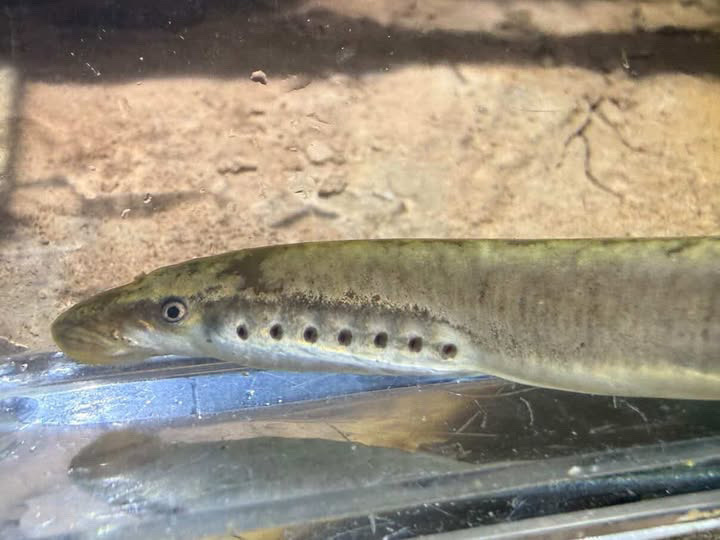
(c) Nick Tobler (Cowturtle), some rights reserved (CC BY) · licence
Family: Petromyzontidae · Class: Cephalaspidomorphi · Order: Petromyzontiformes
Conservation status: G4 S3
Lampetra ayersii (River lamprey) is a California animal in the Petromyzontidae family.
The river lamprey is a primitive, eel-like fish species native to Pacific Coast watersheds. Adults measure 280 to 310 mm (11 to 12.2 inches) in total length, with a cylindrical body that lacks paired fins and scales. The species displays a distinctive circular, suction-cup mouth filled with rows of rasping teeth used for attachment to host fish. Adult river lampreys are dark olive to brownish-gray dorsally, fading to yellowish or cream coloration on the ventral surface. Two well-developed dorsal fins are present, with the second dorsal fin continuous with the caudal fin. River lampreys historically occurred in coastal rivers and streams from Alaska south to central California. In California, populations are documented in the Russian River, Eel River, and several smaller coastal watersheds in Mendocino, Sonoma, and Lake counties. The species also inhabits tributaries of the Sacramento River system, including Clear Creek and portions of the upper Sacramento River drainage. Current distribution appears significantly reduced compared to historical records. This species requires cool, clear flowing water with gravel and cobble substrates for successful reproduction. Adults inhabit both freshwater streams and estuarine environments, while larvae, known as ammocoetes, burrow into fine sediments in quiet backwaters and pool margins. Ammocoetes filter-feed on organic detritus and algae in soft substrate for three to seven years before metamorphosis. Water temperatures below 20°C (68°F) are essential for larval development and adult survival. River lampreys exhibit an anadromous life cycle, with adults migrating from marine or estuarine environments to freshwater streams for spawning. Spawning occurs from late winter through early summer, typically in shallow gravel beds or riffles. Adults construct nests by moving stones with their oral discs, creating depressions where females deposit 50,000 to 100,000 small eggs. Both sexes die shortly after spawning. Larvae drift downstream after hatching and burrow into sediment where they remain for several years before transforming into parasitic juveniles that migrate to larger water bodies. The river lamprey is classified as globally secure but vulnerable in California, with a state rank of S3 indicating moderate concern. Population declines are attributed to habitat degradation, dam construction that blocks migration routes, water diversions that reduce stream flows, and sedimentation from logging and agricultural practices. The species faces particular threats in watersheds where historical spawning areas have been eliminated by large dams. Climate change poses additional risks through altered precipitation patterns and increased water temperatures. Water quality degradation from urban and agricultural runoff further compromises habitat suitability. While not federally listed, the river lamprey is considered a species of special concern by fisheries biologists due to documented population reductions throughout its California range. Conservation efforts focus on habitat restoration, dam removal or fish passage installation, and maintaining adequate instream flows in critical watersheds.
Classification
Class: Cephalaspidomorphi · Order: Petromyzontiformes · Family: Petromyzontidae
Conservation status
G4 S3
Frequently asked questions
How is Lampetra ayersii classified?
Lampetra ayersii belongs to class Cephalaspidomorphi, order Petromyzontiformes, family Petromyzontidae.
What family does Lampetra ayersii belong to?
Lampetra ayersii is in the Petromyzontidae family.
Is Lampetra ayersii protected or of conservation concern?
Lampetra ayersii carries the following status: G4 S3.
What is Lampetra ayersii?
The river lamprey is a primitive, eel-like fish species native to Pacific Coast watersheds.
Is Lampetra ayersii found in California?
Yes. Lampetra ayersii is recorded in California in The California Species Project's catalogue.
Related species
Other California species in the same genus, family, or bioregion.
Data from The California Species Project — 14,000+ California species with verified data from CNPS, CDFW, USFWS, and more.