Lampetra ayresii
Western River Lamprey
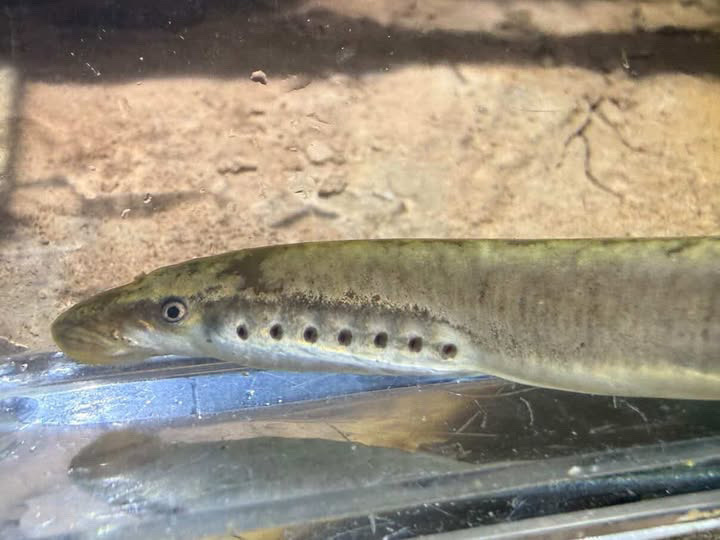
(c) Nick Tobler (Cowturtle), some rights reserved (CC BY) · licence
Family: Petromyzontidae · Class: Cephalaspidomorphi · Order: Petromyzontiformes
Conservation status: G5 S3
Lampetra ayresii (Western River Lamprey) is a California animal in the Petromyzontidae family.
The Western River Lamprey (Lampetra ayresii) is a primitive eel-like vertebrate belonging to the class Cephalaspidomorphi, order Petromyzontiformes. Adults typically measure 15 to 30 centimeters (6 to 12 inches) in length, with an elongated, scaleless body and circular, sucker-like mouth equipped with rows of rasping teeth. The species exhibits a dark olive-brown to grayish coloration dorsally, with lighter silvery tones on the ventral surface. Unlike parasitic lamprey species, adult Western River Lampreys lack functional teeth and do not feed during their adult phase. The Western River Lamprey occurs along the Pacific coast from Alaska south to California, with populations documented in major river systems including the Columbia, Willamette, and various California coastal watersheds. In California, the species inhabits streams throughout much of the northern and central regions, though its distribution has become fragmented due to habitat modifications. The species has been documented in the Sacramento-San Joaquin system and various coastal drainages. This lamprey species utilizes different habitats throughout its complex life cycle. Larval ammocoetes burrow in soft sediments of river and stream bottoms, preferring areas with fine sand and organic matter where they remain for several years as filter feeders. Adult lampreys migrate to spawning areas in freshwater streams, typically selecting gravel beds in riffle areas with moderate current flow. The species requires unobstructed migration corridors between marine and freshwater environments for population connectivity. Western River Lampreys display multiple life history strategies, with some populations exhibiting anadromous behavior while others complete their entire life cycle in freshwater (Carim et al. 2023). Larvae spend 3 to 7 years buried in sediment, feeding on algae, organic detritus, and microscopic organisms through filter feeding. After metamorphosis, adults migrate upstream to spawn in spring, constructing shallow redds in gravel substrates. Females deposit thousands of small eggs, which are fertilized externally. Adults typically die after spawning, contributing nutrients to the ecosystem. The Western River Lamprey is not federally listed but carries a Global rank of G5 (secure globally) and a California State rank of S3 (vulnerable), indicating some concern about population viability within the state. Primary threats include habitat fragmentation from dams and water diversions, which block migration routes essential for completing the species' life cycle. Stream channelization, sedimentation, and water quality degradation further impact both larval rearing habitat and adult spawning areas. Climate change poses additional challenges through altered streamflow patterns and increased water temperatures. Conservation efforts focus on improving fish passage at barriers and protecting critical spawning and rearing habitats. The species serves as an important ecological indicator, as healthy lamprey populations typically indicate good overall stream ecosystem health.
Classification
Class: Cephalaspidomorphi · Order: Petromyzontiformes · Family: Petromyzontidae
Conservation status
G5 S3
Frequently asked questions
How is Lampetra ayresii classified?
Lampetra ayresii belongs to class Cephalaspidomorphi, order Petromyzontiformes, family Petromyzontidae.
What family does Lampetra ayresii belong to?
Lampetra ayresii is in the Petromyzontidae family.
Is Lampetra ayresii protected or of conservation concern?
Lampetra ayresii carries the following status: G5 S3.
What is Lampetra ayresii?
The Western River Lamprey (Lampetra ayresii) is a primitive eel-like vertebrate belonging to the class Cephalaspidomorphi, order Petromyzontiformes.
Is Lampetra ayresii found in California?
Yes. Lampetra ayresii is recorded in California in The California Species Project's catalogue.
Related species
Other California species in the same genus, family, or bioregion.
Data from The California Species Project — 14,000+ California species with verified data from CNPS, CDFW, USFWS, and more.