Lampetra hubbsi
Kern Brook Lamprey
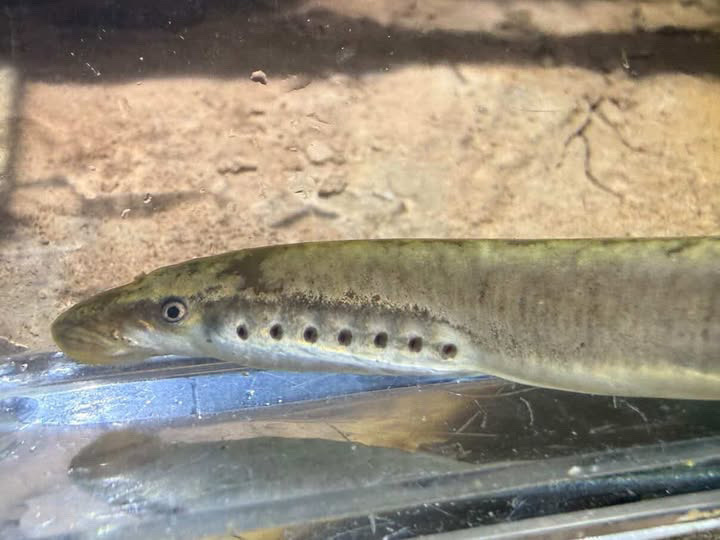
(c) Nick Tobler (Cowturtle), some rights reserved (CC BY) · licence
Family: Petromyzontidae · Class: Cephalaspidomorphi · Order: Petromyzontiformes
Conservation status: G1G2 S1S2
Lampetra hubbsi (Kern Brook Lamprey) is a California animal in the Petromyzontidae family.
The Kern brook lamprey is a small, non-parasitic freshwater fish endemic to California's San Joaquin Valley drainage system. Adults typically measure 100 to 150 millimeters (4 to 6 inches) in total length, with a slender, eel-like body and smooth, scaleless skin. The species displays a mottled brown to olive coloration on the dorsal surface, transitioning to pale yellow or cream on the ventral side. Like other brook lampreys, adults lack functional teeth and possess a circular, sucker-like oral disc that is non-functional for feeding. Historically, the Kern brook lamprey occurred throughout the Kern River system and associated tributaries in Kern County, California. Current distribution is severely restricted compared to its historical range, with populations documented primarily in the upper Kern River watershed above Isabella Lake. The species has been recorded in tributaries including Peppermint Creek, Golden Trout Creek, and portions of the South Fork Kern River. Surveys conducted in recent decades suggest the species may be extirpated from much of its former range in the lower elevation portions of the system. Kern brook lampreys inhabit cool, clear streams and creeks with gravel and cobble substrates. Adults are typically found in pools and slow-moving sections of streams, while larvae (ammocoetes) burrow into fine sediments in depositional areas. The species occurs at elevations ranging from approximately 760 to 2,100 meters (2,500 to 6,900 feet), showing preference for well-oxygenated waters with stable temperatures. Suitable habitat includes areas with adequate cover such as undercut banks, large woody debris, and overhanging vegetation. The Kern brook lamprey exhibits a complex life cycle typical of non-parasitic lampreys. Larvae spend 3 to 7 years filter-feeding on detritus and algae while buried in stream sediments. Metamorphosis occurs during late summer or fall, after which adults emerge with a non-functional digestive system. Adults typically spawn once in spring, constructing redds in gravel substrates where females deposit adhesive eggs. Adults die shortly after spawning, completing their annual adult phase. The species serves as an important component of stream ecosystems, with larvae helping to process organic matter and adults providing food for fish, birds, and other predators. The Kern brook lamprey is considered critically imperiled, with a global conservation rank of G1G2 and state rank of S1S2, indicating extremely high risk of extinction. Although not federally listed, the species faces severe threats from habitat degradation, water diversions, and altered flow regimes in the Kern River system. Dam construction and water management practices have fragmented populations and eliminated habitat connectivity. Additional threats include sedimentation from land use activities, climate change impacts on streamflow patterns, and potential hybridization with other lamprey species. The species' restricted range and small population size make it particularly vulnerable to local extinctions from drought, wildfire, or other disturbance events.
Classification
Class: Cephalaspidomorphi · Order: Petromyzontiformes · Family: Petromyzontidae
Conservation status
G1G2 S1S2
Frequently asked questions
How is Lampetra hubbsi classified?
Lampetra hubbsi belongs to class Cephalaspidomorphi, order Petromyzontiformes, family Petromyzontidae.
What family does Lampetra hubbsi belong to?
Lampetra hubbsi is in the Petromyzontidae family.
Is Lampetra hubbsi protected or of conservation concern?
Lampetra hubbsi carries the following status: G1G2 S1S2.
What is Lampetra hubbsi?
The Kern brook lamprey is a small, non-parasitic freshwater fish endemic to California's San Joaquin Valley drainage system.
Is Lampetra hubbsi found in California?
Yes. Lampetra hubbsi is recorded in California in The California Species Project's catalogue.
Related species
Other California species in the same genus, family, or bioregion.
Data from The California Species Project — 14,000+ California species with verified data from CNPS, CDFW, USFWS, and more.