Lampetra tridentata ssp.
Goose Lake lamprey
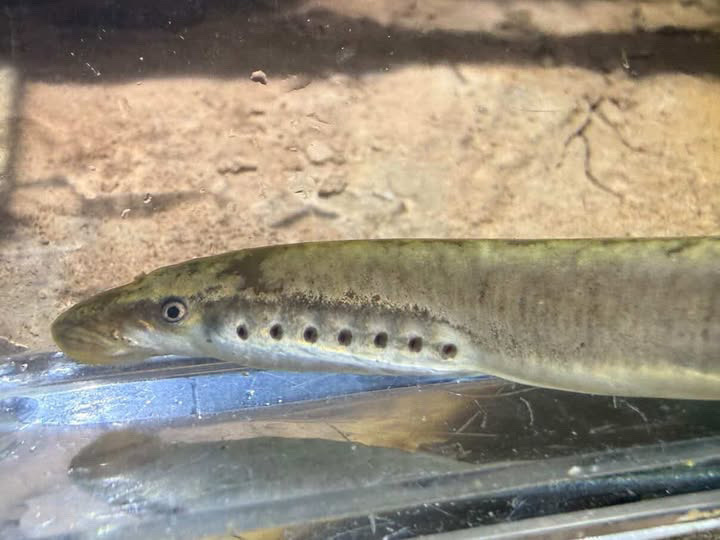
(c) Nick Tobler (Cowturtle), some rights reserved (CC BY) · licence
Family: Petromyzontidae · Class: Cephalaspidomorphi · Order: Petromyzontiformes
Lampetra tridentata ssp. (Goose Lake lamprey) is a California animal in the Petromyzontidae family.
The Goose Lake lamprey is a subspecies of the Pacific lamprey (Entosphenus tridentatus) endemic to the Goose Lake basin in Oregon and California. This jawless fish exhibits the characteristic elongated, eel-like body form of lampreys, with adults typically measuring 300 to 610 mm (12 to 24 inches) in total length. The body is dark olive-brown to blue-black dorsally, fading to lighter coloration ventrally. Like other lampreys, this subspecies possesses a circular, sucker-like oral disc with rows of rasping teeth arranged in concentric circles, though the specific dental formula may vary from the typical Pacific lamprey pattern. The Goose Lake lamprey is restricted to the Goose Lake basin, a closed-basin system straddling the Oregon-California border in Lake and Modoc counties. This endemic population is geographically isolated from other Pacific lamprey populations, occurring only in Goose Lake itself and its tributary streams including the Drews Creek system in Oregon and smaller California tributaries. The subspecies represents the only anadromous lamprey population in a closed-basin lake system within the Pacific lamprey's range. This lamprey inhabits both lacustrine and riverine environments within the Goose Lake system. According to NatureServe, the population spawns in gravel riffles of tributary streams, selecting areas far enough upstream to provide adequate ammocoete habitat in muddy or sandy substrates. Adult lampreys utilize the open waters of Goose Lake for feeding and growth, while larvae (ammocoetes) require soft sediments in tributary streams for burrowing and filter-feeding during their prolonged larval stage. The Goose Lake lamprey follows a complex life cycle typical of lampreys but adapted to the closed-basin system. Adults spawn in tributary streams during spring months, with females depositing eggs in gravel redds constructed in riffle areas. After hatching, larvae burrow into soft sediments where they remain for several years as filter-feeders, consuming detritus and microscopic organisms. Upon metamorphosis, juveniles migrate downstream to Goose Lake where they attach to host fish using their oral disc, feeding parasitically on body fluids. Unlike anadromous Pacific lampreys that migrate to the ocean, Goose Lake lampreys complete their entire life cycle within the closed-basin system. The conservation status of the Goose Lake lamprey has become a significant concern. A petition to list the subspecies as threatened or endangered under the Endangered Species Act was submitted to USFWS in January 2025, indicating serious population decline and habitat threats. The closed-basin nature of Goose Lake makes this population particularly vulnerable to water level fluctuations, drought, and habitat degradation. Lake level reductions can eliminate spawning habitat in tributary streams and concentrate fish in reduced lake volume, potentially disrupting the host-parasite relationships essential for lamprey survival. The geographic isolation of this population means that recolonization from other Pacific lamprey populations is impossible, making local extinctions permanent. Climate change and ongoing water management challenges in the region pose additional threats to this unique endemic subspecies.
Classification
Class: Cephalaspidomorphi · Order: Petromyzontiformes · Family: Petromyzontidae
Frequently asked questions
How is Lampetra tridentata ssp. classified?
Lampetra tridentata ssp. belongs to class Cephalaspidomorphi, order Petromyzontiformes, family Petromyzontidae.
What family does Lampetra tridentata ssp. belong to?
Lampetra tridentata ssp. is in the Petromyzontidae family.
What is Lampetra tridentata ssp.?
The Goose Lake lamprey is a subspecies of the Pacific lamprey (Entosphenus tridentatus) endemic to the Goose Lake basin in Oregon and California.
Is Lampetra tridentata ssp. found in California?
Yes. Lampetra tridentata ssp. is recorded in California in The California Species Project's catalogue.
Related species
Other California species in the same genus, family, or bioregion.
Data from The California Species Project — 14,000+ California species with verified data from CNPS, CDFW, USFWS, and more.