Lampornis clemenciae
Blue-throated Hummingbird
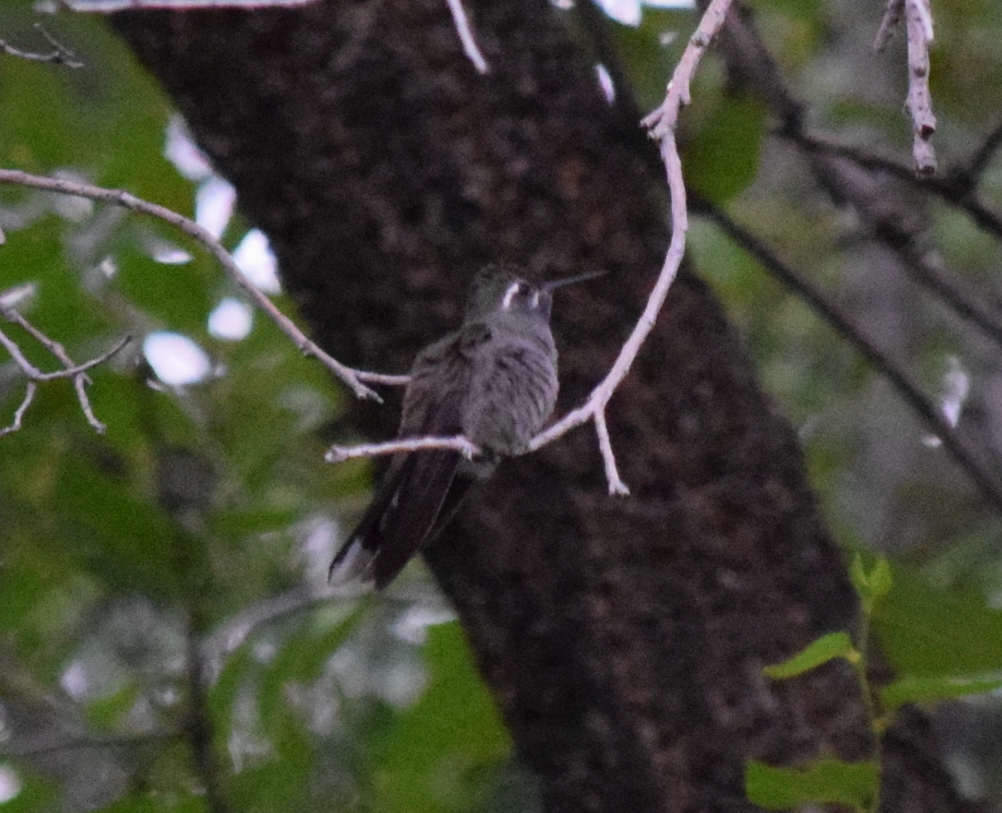
(c) William Harmon, some rights reserved (CC BY) · licence
Family: Trochilidae · Class: Aves · Order: Apodiformes
Lampornis clemenciae (Blue-throated Hummingbird) is a California animal in the Trochilidae family.
The Blue-throated Hummingbird is among North America's largest hummingbirds, measuring 11.5 to 12.7 cm (4.5 to 5.0 inches) in length with a wingspan reaching 15 cm (5.9 inches). Adult males weigh 7.5 to 8.5 grams, while females are slightly smaller at 6.5 to 8.0 grams. Males display an iridescent blue throat patch bordered by black, contrasting with bronze-green upperparts and gray underparts. A prominent white postocular stripe extends behind each eye to the nape. Females lack the blue throat, showing gray underparts with a white throat and the same distinctive white eye stripe. Both sexes have straight, black bills measuring approximately 20 to 22 mm in length, and dark, slightly forked tails with white tips on the outer feathers. In California, the Blue-throated Hummingbird occurs primarily in the southeastern desert mountain ranges, including the Panamint Mountains in Inyo County and portions of San Bernardino County. The species reaches its northernmost distribution in these California mountains. The core range extends southward through Arizona, New Mexico, and western Texas into the mountains of central Mexico, where populations are year-round residents. This species inhabits montane forest and woodland environments, typically at elevations between 1,500 and 3,000 meters (4,900 to 9,800 feet). Preferred habitats include pine-oak forests, mixed coniferous forests with Douglas fir and white fir, and riparian woodlands in mountain canyons. Blue-throated Hummingbirds show strong associations with areas near permanent water sources, including streams, springs, and seeps. They frequently occupy shaded canyon bottoms and north-facing slopes where moisture levels remain higher. Blue-throated Hummingbirds feed primarily on nectar from tubular flowers, showing preference for red-colored blooms such as penstemons, salvias, and painted cups. They also consume small arthropods including gnats, flies, and spiders, which provide essential protein for reproduction. Males establish feeding territories around concentrated nectar sources and defend them aggressively from other hummingbirds. Breeding occurs from April through August, with females constructing cup-shaped nests on horizontal branches or in forks of trees, typically 1.5 to 6 meters above ground. Nests are built with plant fibers, moss, and spider webs, camouflaged with lichens. Females lay two white eggs measuring approximately 12.7 by 8.4 mm, which are incubated for 17 to 18 days. The Blue-throated Hummingbird is not federally listed and faces no immediate conservation threats. According to the North American Breeding Bird Survey, populations appear stable across most of the species' range. Climate change may pose future challenges by altering montane forest composition and shifting suitable habitat to higher elevations. Habitat management focuses on maintaining mature forest structure and protecting riparian areas that support both nesting sites and diverse flowering plant communities essential for foraging.
Classification
Class: Aves · Order: Apodiformes · Family: Trochilidae
Frequently asked questions
How is Lampornis clemenciae classified?
Lampornis clemenciae belongs to class Aves, order Apodiformes, family Trochilidae.
What family does Lampornis clemenciae belong to?
Lampornis clemenciae is in the Trochilidae family.
What is Lampornis clemenciae?
The Blue-throated Hummingbird is among North America's largest hummingbirds, measuring 11.5 to 12.7 cm (4.5 to 5.0 inches) in length with a wingspan reaching 15 cm (5.9 inches).
Is Lampornis clemenciae found in California?
Yes. Lampornis clemenciae is recorded in California in The California Species Project's catalogue.
Related species
Other California species in the same genus, family, or bioregion.
Data from The California Species Project — 14,000+ California species with verified data from CNPS, CDFW, USFWS, and more.