Lampropeltis multifasciata
Coast Mountain Kingsnake
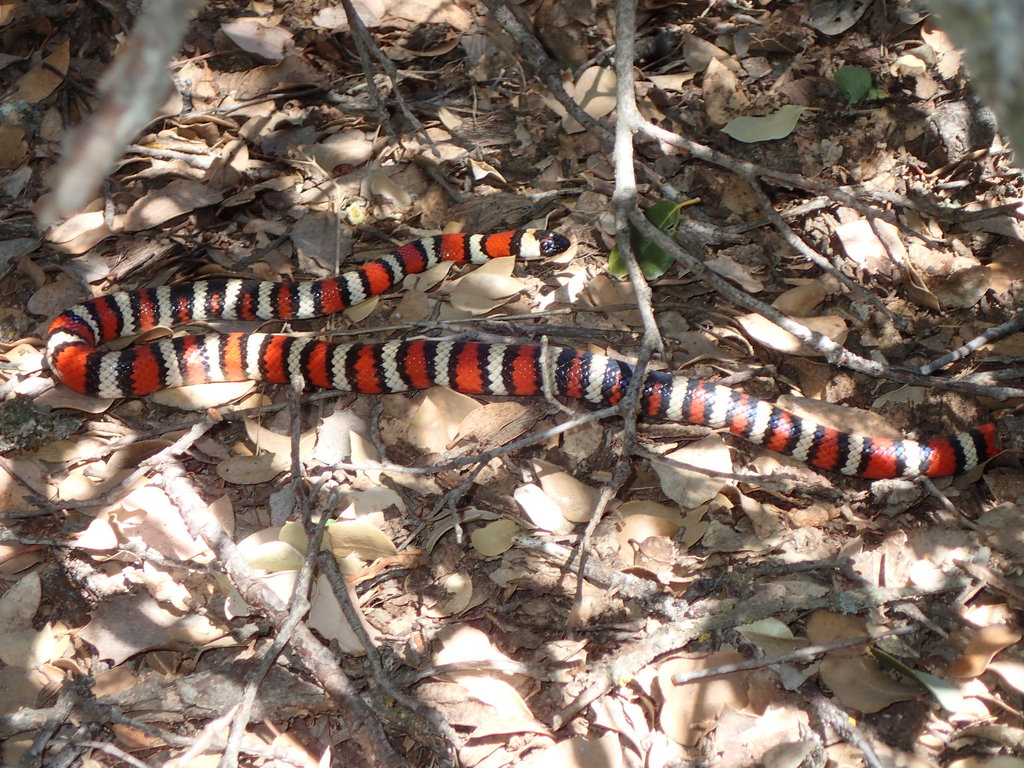
(c) George Williams, some rights reserved (CC BY) · licence
Family: Colubridae · Class: Reptilia · Order: Squamata
Lampropeltis multifasciata (Coast Mountain Kingsnake) is a California animal in the Colubridae family.
The Coast Mountain Kingsnake is a slender, medium-sized snake with a distinctive banded pattern of black, red, and white or yellowish rings that encircle the body. Adults typically measure 60 to 76 centimeters (24 to 30 inches) in length, while hatchlings range from 18 to 28 centimeters (7 to 11 inches). The body is rounded with almost no visible neck constriction. In some individuals, black bands may cross over the top of red bands, creating variation in the banding pattern (californiaherps.com). According to Myers et al. (2013), Lampropeltis multifasciata comprises all populations in the Peninsular Ranges and Transverse Ranges, extending north into the Coast Ranges just south of Monterey Bay, California. The species occurs from near sea level along the coast to elevations of 2,743 meters (9,000 feet) on Mt. San Jacinto, demonstrating a broad elevational range (californiaherps.com). Coast Mountain Kingsnakes inhabit diverse vegetation communities including coniferous forest, oak-pine woodlands, riparian woodland, chaparral, manzanita, and coastal sage scrub. They show preference for wooded areas near streams with rock outcrops, talus slopes, or rotting logs that receive sun exposure. This species demonstrates adaptability to both montane forests and coastal scrub environments, reflecting its wide elevational range (californiaherps.com). This species exhibits primarily diurnal behavior, becoming active during daylight hours when temperatures are moderate. During periods of hot weather, they shift to nocturnal activity patterns to avoid thermal stress. Coast Mountain Kingsnakes are secretive and often found underneath rocks in sunny mountain clearings or along mountain streams. They may occasionally be observed on roads during evening or nighttime hours. As constrictors, they feed primarily on other reptiles including snakes, lizards, and occasionally small mammals and birds. The species is harmless to humans and non-venomous (californiaherps.com). Taxonomically, this species was elevated from subspecies status following molecular phylogenetic analysis. In 2013, Myers et al. conducted a multilocus phylogeographic assessment of the California Mountain Kingsnake complex, which resulted in the recognition of Lampropeltis multifasciata as a distinct species separate from L. zonata. This taxonomic revision was based on genetic differentiation patterns that corresponded to geographic distributions across California's mountain ranges (Myers et al. 2013). Currently, no specific conservation concerns have been documented for this species, and it lacks federal or state listing status. The Coast Mountain Kingsnake benefits from occurring across a broad range that includes numerous protected areas and conservation lands throughout California's mountain systems. Its ability to utilize diverse habitat types and elevational zones likely contributes to population stability across its range.
Classification
Class: Reptilia · Order: Squamata · Family: Colubridae
Frequently asked questions
How is Lampropeltis multifasciata classified?
Lampropeltis multifasciata belongs to class Reptilia, order Squamata, family Colubridae.
What family does Lampropeltis multifasciata belong to?
Lampropeltis multifasciata is in the Colubridae family.
What is Lampropeltis multifasciata?
The Coast Mountain Kingsnake is a slender, medium-sized snake with a distinctive banded pattern of black, red, and white or yellowish rings that encircle the body.
Is Lampropeltis multifasciata found in California?
Yes. Lampropeltis multifasciata is recorded in California in The California Species Project's catalogue.
Related species
Other California species in the same genus, family, or bioregion.
Data from The California Species Project — 14,000+ California species with verified data from CNPS, CDFW, USFWS, and more.