Lampropeltis zonata
California Mountain Kingsnake
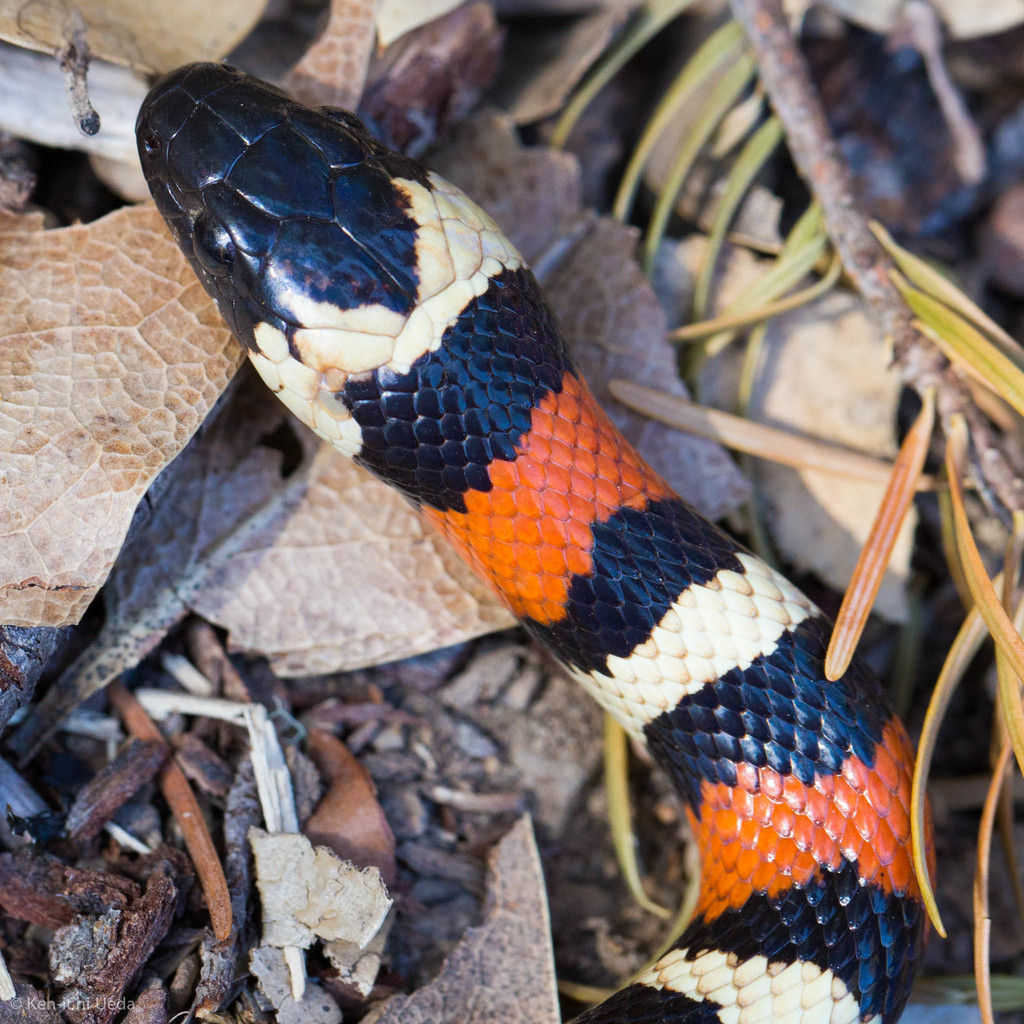
(c) Ken-ichi Ueda, some rights reserved (CC BY) · licence
Family: Colubridae · Class: Reptilia · Order: Squamata
Lampropeltis zonata (California Mountain Kingsnake) is a California animal in the Colubridae family.
The California Mountain Kingsnake is a medium-sized, non-venomous constrictor with distinctive banding patterns that can reach lengths of 61 to 122 cm (24 to 48 inches). The species displays alternating bands of red, black, and white or cream, with the red bands typically bordered by black bands. This tricolored pattern serves as Batesian mimicry, resembling the venomous coral snake, though the arrangement differs with red bands touching black rather than yellow. The head is relatively small and slightly distinct from the neck, with smooth dorsal scales arranged in 21 to 25 rows at midbody. Juveniles exhibit the same banding pattern as adults but may have more vibrant coloration. The California Mountain Kingsnake ranges throughout mountainous regions of California, extending into Oregon, Nevada, and Baja California. In California, the species occurs in the Sierra Nevada, Coast Ranges, Transverse Ranges, and Peninsular Ranges. Populations are documented from Shasta County south to San Diego County, with elevational distribution typically between 305 and 2,745 meters (1,000 to 9,000 feet). The species shows considerable geographic variation in banding patterns across its range, with some populations exhibiting reduced white banding or aberrant color patterns. This kingsnake inhabits mixed coniferous forests, oak woodlands, chaparral, and riparian areas. Preferred microhabitats include areas with abundant ground cover such as fallen logs, rock outcrops, and dense vegetation. The species demonstrates a preference for cooler, moister conditions and is often associated with permanent or seasonal water sources. During hot weather, individuals seek shelter under rocks, logs, or in rodent burrows. Winter hibernation occurs in underground retreats, often in communal hibernacula. California Mountain Kingsnakes are primarily ophiophagous, specializing in consuming other snakes including rattlesnakes, though they also prey on lizards, small mammals, birds, and bird eggs. They are constrictors, subduing prey by coiling around it and applying pressure. Mating occurs in spring following emergence from hibernation, typically between April and June. Females are oviparous, laying 3 to 9 eggs in rotting logs, compost piles, or loose soil during summer months. Eggs incubate for 65 to 75 days, with hatchlings emerging in late summer measuring 20 to 25 cm (8 to 10 inches) in length. The species is not federally or state listed and appears to maintain stable populations across most of its range. However, localized populations face pressure from habitat fragmentation due to urbanization, particularly in foothill regions. Wildfire suppression has altered natural fire cycles in some areas, potentially affecting habitat quality. Road mortality represents a significant threat in developed areas, as snakes often use paved surfaces for thermoregulation. Climate change may impact the species through altered precipitation patterns and increased fire frequency. The species benefits from protected status in national and state parks throughout its range, and its secretive nature and varied habitat requirements provide some resilience to environmental changes.
Classification
Class: Reptilia · Order: Squamata · Family: Colubridae
Frequently asked questions
How is Lampropeltis zonata classified?
Lampropeltis zonata belongs to class Reptilia, order Squamata, family Colubridae.
What family does Lampropeltis zonata belong to?
Lampropeltis zonata is in the Colubridae family.
What is Lampropeltis zonata?
The California Mountain Kingsnake is a medium-sized, non-venomous constrictor with distinctive banding patterns that can reach lengths of 61 to 122 cm (24 to 48 inches).
Is Lampropeltis zonata found in California?
Yes. Lampropeltis zonata is recorded in California in The California Species Project's catalogue.
Related species
Other California species in the same genus, family, or bioregion.
Data from The California Species Project — 14,000+ California species with verified data from CNPS, CDFW, USFWS, and more.