Lampropeltis zonata ssp. (parvirubra)
California mountain kingsnake (San Bernardino population)
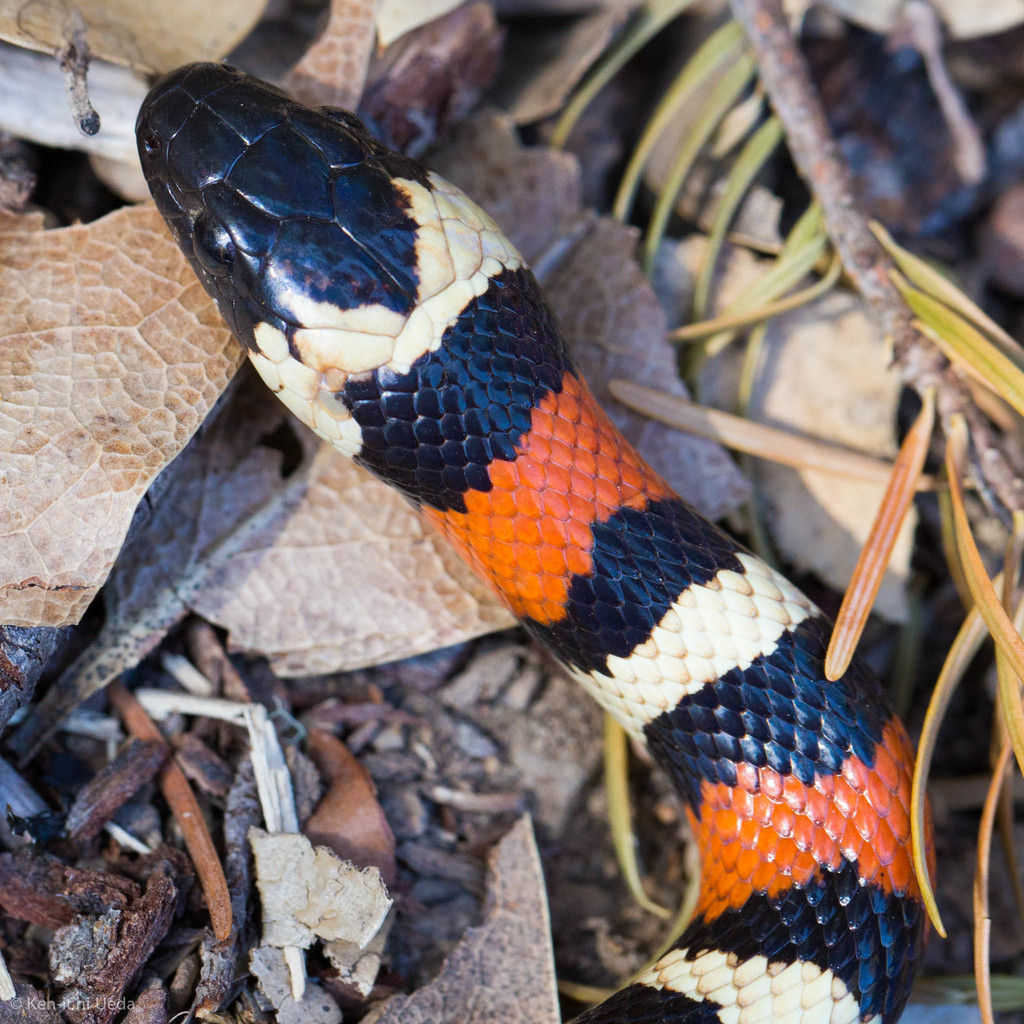
(c) Ken-ichi Ueda, some rights reserved (CC BY) · licence
Family: Colubridae · Class: Reptilia · Order: Squamata
Conservation status: WL · G4G5 S2?
Lampropeltis zonata ssp. (parvirubra) (California mountain kingsnake (San Bernardino population)) is a California animal in the Colubridae family.
The California mountain kingsnake (San Bernardino population) represents a subspecies (Lampropeltis zonata parvirubra) of the California mountain kingsnake complex. This moderately sized colubrid typically measures 60 to 100 cm (24 to 39 inches) in total length. The species displays the characteristic kingsnake pattern of alternating bands, with red bands bordered by black bands, which are separated by white or cream-colored bands. The red bands are typically narrower in this subspecies compared to other California mountain kingsnake populations, reflecting the subspecific designation "parvirubra" (meaning "little red"). The San Bernardino population of California mountain kingsnake occurs in the San Bernardino Mountains of southern California. According to NatureServe, the broader species Lampropeltis zonata has a range extending from Washington south to central California, but this particular subspecies is geographically restricted to the San Bernardino Mountain region. The population's limited distribution contributes to its California listing as a Watch List (WL) species and its state ranking of S2?, indicating it is imperiled in California with 6 to 20 occurrences or few remaining individuals. This subspecies inhabits mountainous terrain, typically occurring in coniferous forests, oak-pine woodlands, and chaparral communities. According to Animal Diversity Web, California mountain kingsnakes inhabit elevations ranging from sea level to 3,000 meters above sea level, though the San Bernardino population likely occurs at middle to higher elevations within this range. The species functions as a habitat generalist within its montane environment, utilizing diverse microhabitats including areas with rocky outcrops, fallen logs, and dense vegetation that provide shelter and foraging opportunities. California mountain kingsnakes are ophiophagous, meaning they primarily consume other snakes, including venomous species such as rattlesnakes. They also prey on lizards, small mammals, birds, and eggs when available. The species is oviparous, with females laying clutches of 3 to 9 eggs in late spring or early summer. Eggs are typically deposited in decomposing logs, rock crevices, or loose soil, where they incubate for approximately 60 to 75 days before hatching in late summer or early fall. These snakes are primarily active during daylight hours in spring and fall, becoming more crepuscular during warmer summer months. The San Bernardino population faces conservation challenges typical of montane subspecies with restricted ranges. According to the Washington Department of Fish and Wildlife's assessment of the broader species, primary threats include habitat loss, degradation, and fragmentation, as well as increased vehicle traffic in mountain areas. Climate change poses additional concerns for this high-elevation population, as warming temperatures may alter suitable habitat zones and prey availability. The subspecies' Watch List status in California reflects ongoing monitoring needs and conservation concern, though it currently lacks formal state or federal protection. The global ranking of G4G5 indicates the broader species is secure globally, but the S2? ranking emphasizes the precarious status of this particular California population.
Classification
Class: Reptilia · Order: Squamata · Family: Colubridae
Conservation status
WL · G4G5 S2?
Frequently asked questions
How is Lampropeltis zonata ssp. (parvirubra) classified?
Lampropeltis zonata ssp. (parvirubra) belongs to class Reptilia, order Squamata, family Colubridae.
What family does Lampropeltis zonata ssp. (parvirubra) belong to?
Lampropeltis zonata ssp. (parvirubra) is in the Colubridae family.
Is Lampropeltis zonata ssp. (parvirubra) protected or of conservation concern?
Lampropeltis zonata ssp. (parvirubra) carries the following status: WL · G4G5 S2?.
What is Lampropeltis zonata ssp. (parvirubra)?
The California mountain kingsnake (San Bernardino population) represents a subspecies (Lampropeltis zonata parvirubra) of the California mountain kingsnake complex.
Is Lampropeltis zonata ssp. (parvirubra) found in California?
Yes. Lampropeltis zonata ssp. (parvirubra) is recorded in California in The California Species Project's catalogue.
Related species
Other California species in the same genus, family, or bioregion.
Data from The California Species Project — 14,000+ California species with verified data from CNPS, CDFW, USFWS, and more.