Lanius borealis
Northern Shrike
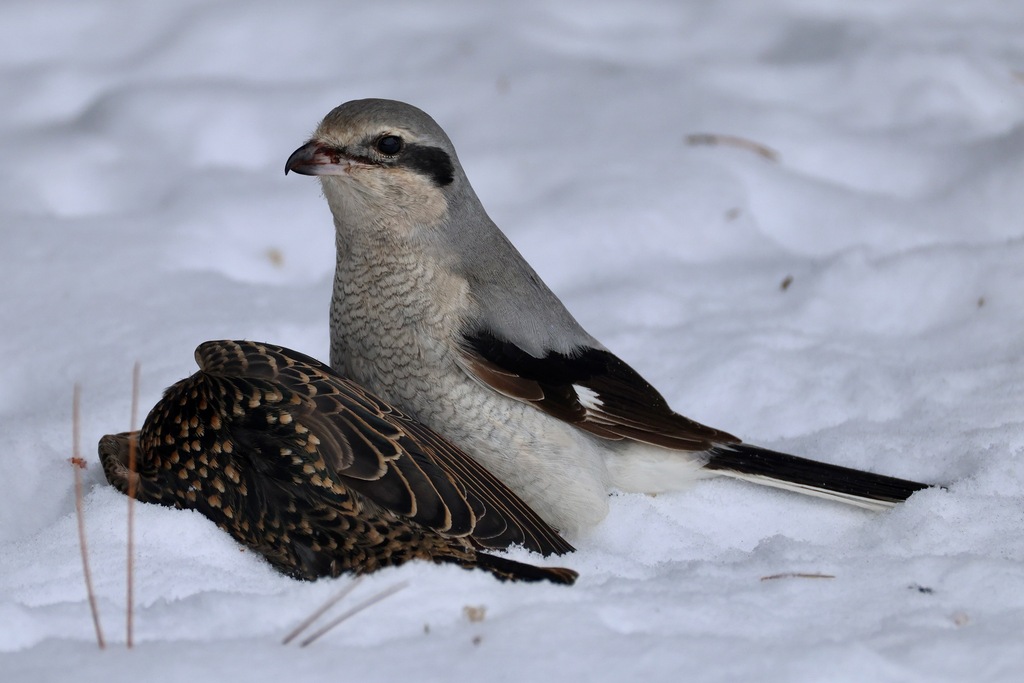
(c) Cole Wolf, some rights reserved (CC BY) · licence
Family: Laniidae · Class: Aves · Order: Passeriformes
Lanius borealis (Northern Shrike) is a California animal in the Laniidae family.
The Northern Shrike is a medium-sized predatory songbird measuring 24 to 25 centimeters (9.4 to 9.8 inches) in length with a wingspan of 35 to 37 centimeters (13.8 to 14.6 inches). Adults weigh between 60 to 81 grams (2.1 to 2.9 ounces). The species displays subtle sexual dimorphism, with males typically showing more pronounced black markings. Both sexes have a distinctive black mask extending from the bill through the eye, pale gray upperparts, and white to pale gray underparts with faint barring. The bill is heavy, hooked, and black with a pale base. Juveniles show brownish upperparts with more extensive barring below. The Northern Shrike breeds across the boreal forests of Alaska and northern Canada, extending south into the northernmost United States. During winter, the species migrates south across much of the northern and western United States. In California, Northern Shrikes occur primarily as uncommon winter visitors from October through March, with most records from the northeastern counties including Modoc, Siskiyou, and Lassen. The species also appears irregularly in the Central Valley and occasionally reaches coastal areas during irruptive years when northern prey populations crash. Wintering Northern Shrikes occupy open habitats including agricultural fields, grasslands, sagebrush steppe, and woodland edges. The species requires elevated perches such as fence posts, utility lines, or isolated trees for hunting. During the breeding season in their northern range, they inhabit the edge zones between boreal forests and tundra, particularly areas with scattered trees and shrubs. Elevation ranges from sea level to approximately 2,100 meters (6,900 feet) in mountainous regions. Northern Shrikes are solitary predators that hunt from conspicuous perches, diving down to capture prey or pursuing it in short flights. Their diet consists primarily of small mammals, including voles, mice, and shrews, supplemented by birds up to the size of American Robins, large insects, and occasionally reptiles and amphibians. The species exhibits the characteristic shrike behavior of impaling prey on thorns, barbed wire, or sharp twigs, creating food caches called "larders." This adaptation allows them to store excess prey and facilitates handling of items too large to consume immediately. Breeding occurs from May through July in their northern range, with females constructing bulky nests of twigs and grass lined with feathers and fur. Clutches typically contain 4 to 7 eggs, which are incubated for 15 to 17 days. The Northern Shrike is not federally or state listed and maintains stable populations across its range. The species is classified as Least Concern by the International Union for Conservation of Nature. Population trends show relative stability, though the species faces challenges from habitat loss in agricultural areas and climate change effects on northern ecosystems. Christmas Bird Count data indicates variable winter numbers in California, likely reflecting natural population fluctuations and prey availability in northern breeding areas rather than long-term decline.
Classification
Class: Aves · Order: Passeriformes · Family: Laniidae
Frequently asked questions
How is Lanius borealis classified?
Lanius borealis belongs to class Aves, order Passeriformes, family Laniidae.
What family does Lanius borealis belong to?
Lanius borealis is in the Laniidae family.
What is Lanius borealis?
The Northern Shrike is a medium-sized predatory songbird measuring 24 to 25 centimeters (9.4 to 9.8 inches) in length with a wingspan of 35 to 37 centimeters (13.8 to 14.6 inches).
Is Lanius borealis found in California?
Yes. Lanius borealis is recorded in California in The California Species Project's catalogue.
Related species
Other California species in the same genus, family, or bioregion.
Data from The California Species Project — 14,000+ California species with verified data from CNPS, CDFW, USFWS, and more.