Lanius ludovicianus
Loggerhead Shrike
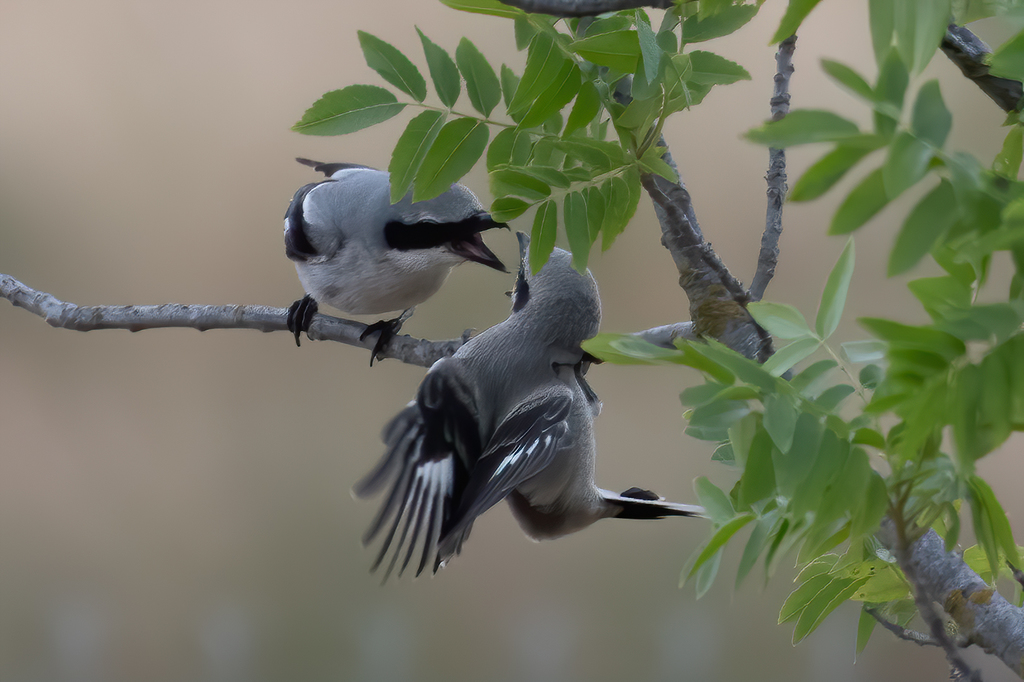
(c) Jonathan Eisen, some rights reserved (CC BY) · licence
Family: Laniidae · Class: Aves · Order: Passeriformes
Conservation status: G4 S4
Lanius ludovicianus (Loggerhead Shrike) is a California animal in the Laniidae family.
The Loggerhead Shrike is a medium-sized passerine bird measuring 20-25 cm (8-10 inches) in length with a wingspan of 27-32 cm (11-13 inches). Adults weigh 35-50 grams and display distinctive predatory features unusual among songbirds. The head is proportionally large with a thick, hooked black bill designed for tearing prey. Adults show gray upperparts and white underparts with black wings marked by white patches visible in flight. A prominent black mask extends from the bill through the eye to the ear coverts. Juveniles appear browner overall with barred underparts and a less distinct facial mask. The species exhibits sexual dimorphism, with males typically showing more contrasted plumage than females. Loggerhead Shrikes occur across much of North America, with populations distributed from southern Canada to Mexico. In California, the species inhabits suitable habitat throughout most of the state, from sea level to approximately 2,000 meters elevation. California populations are primarily year-round residents, though some northern populations may exhibit short-distance movements during winter. The species has experienced significant range contractions across North America since the mid-20th century, with declines documented in many northern and eastern portions of its historical range. The species occupies open habitats with scattered perches, including grasslands, agricultural areas, desert scrublands, and open woodlands. Loggerhead Shrikes require a combination of hunting perches such as fence posts, power lines, or isolated trees, and short-grass areas for foraging. Nesting occurs in dense shrubs or small trees, typically 1-3 meters above ground. The species shows particular preference for areas with thorny vegetation, which serves both nesting and prey storage functions. Loggerhead Shrikes are carnivorous, feeding primarily on insects, small reptiles, rodents, and occasionally small birds. The species employs a sit-and-wait hunting strategy, scanning from elevated perches before swooping down to capture prey. Lacking the strong talons of raptors, shrikes compensate by impaling prey on thorns, barbed wire, or sharp twigs for consumption and storage. This behavior has earned them the colloquial name "butcher bird." Breeding occurs from March through July, with pairs producing 1-2 broods annually. Females construct cup nests in thorny shrubs and lay 4-6 eggs. Incubation lasts 15-17 days, with young fledging after 17-20 days in the nest. The Loggerhead Shrike maintains a global conservation status of G4 (apparently secure) and state rank of S4 (apparently secure) in California as of December 2025. However, the species has experienced substantial population declines throughout much of its North American range, with Breeding Bird Survey data indicating a 76% decline since 1966. Primary threats include habitat loss through agricultural intensification, urban development, and pesticide use that reduces insect prey availability. Climate change may further impact the species through altered precipitation patterns affecting grassland habitats and prey abundance.
Classification
Class: Aves · Order: Passeriformes · Family: Laniidae
Conservation status
G4 S4
Frequently asked questions
How is Lanius ludovicianus classified?
Lanius ludovicianus belongs to class Aves, order Passeriformes, family Laniidae.
What family does Lanius ludovicianus belong to?
Lanius ludovicianus is in the Laniidae family.
Is Lanius ludovicianus protected or of conservation concern?
Lanius ludovicianus carries the following status: G4 S4.
What is Lanius ludovicianus?
The Loggerhead Shrike is a medium-sized passerine bird measuring 20-25 cm (8-10 inches) in length with a wingspan of 27-32 cm (11-13 inches).
Is Lanius ludovicianus found in California?
Yes. Lanius ludovicianus is recorded in California in The California Species Project's catalogue.
Related species
Other California species in the same genus, family, or bioregion.
Data from The California Species Project — 14,000+ California species with verified data from CNPS, CDFW, USFWS, and more.