Laphria posticata
Boreal Laphria
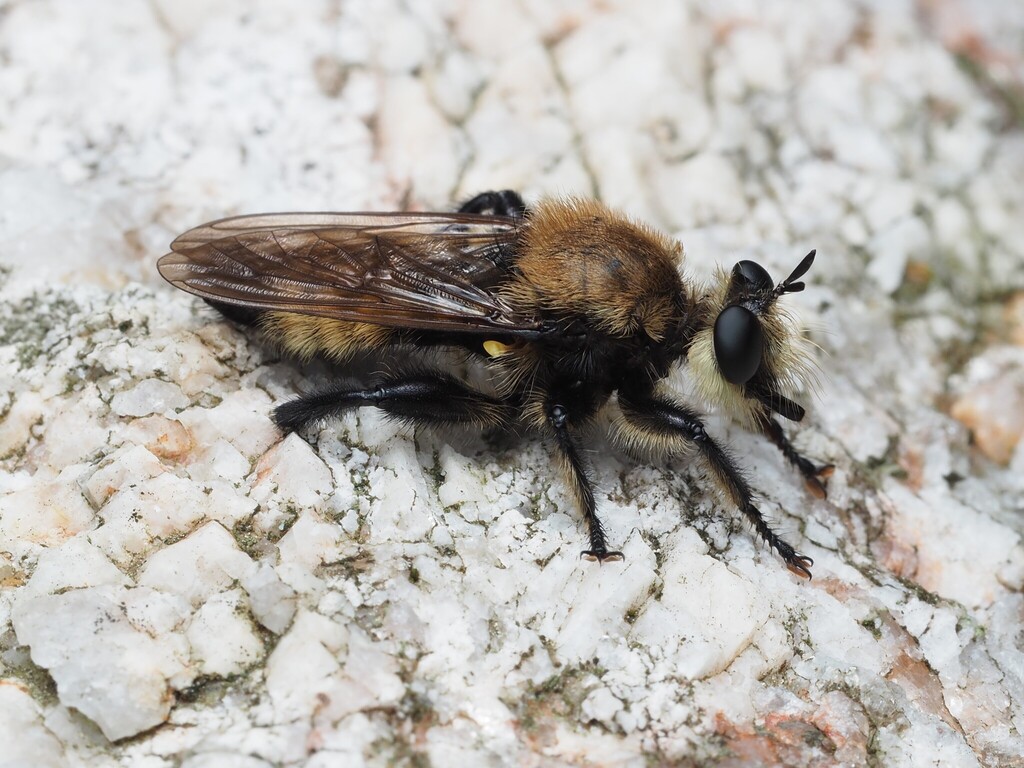
no rights reserved · CC0
Family: Asilidae · Class: Insecta · Order: Diptera
Laphria posticata (Boreal Laphria) is a California animal in the Asilidae family.
The Boreal Laphria (Laphria posticata) is a robust robber fly in the family Asilidae, recognized for its bee-mimicking appearance and predatory behavior. Adults are medium to large-sized flies with dense, yellowish hair covering much of the body, creating a strong resemblance to bumblebees. The species exhibits two distinct forms that may represent separate taxa: the nominate form posticata displays black scutellar bristles and yellow hairs on lateral portions of the third abdominal tergite and all of the fourth and fifth tergites, while the form scutellaris has yellowish scutellar bristles and shows yellow coloration on lateral portions of tergite three and the entirety of tergites 4-7 (BugGuide). Laphria posticata occurs across a broad range in North America, extending from the boreal forests of Canada southward through much of the United States. The species has been documented from Maine to California, with records from diverse regions including the serpentine barrens of Maryland, spruce forests of Maine, and various western states. Despite its common name suggesting northern affinity, the species demonstrates considerable adaptability across different latitudes and elevations. This robber fly inhabits a variety of forest and woodland environments, showing particular association with coniferous forests in northern portions of its range. In Maine, specimens have been collected in spruce forests, while Maryland records come from specialized serpentine barren habitats. The species appears to favor areas with mixed vegetation that provide both hunting perches and suitable microhabitats for development. Adults are typically observed on exposed branches, logs, or other elevated surfaces from which they launch hunting flights. As a member of the robber fly family, Laphria posticata is an active aerial predator that captures other flying insects. Adults are ambush hunters, using their excellent vision to detect prey before making rapid pursuit flights. The robust proboscis allows them to pierce and feed on a wide variety of insects, including bees, wasps, flies, and other flying arthropods. Their bee-like appearance may provide protection from predators through Batesian mimicry. Flight activity typically occurs during warmer months, with peak abundance varying by latitude and local climate conditions. Currently, Laphria posticata has no formal conservation status at federal or state levels. The species appears to maintain stable populations across much of its range, though specific population data are lacking. The broad geographic distribution and habitat flexibility suggest relative resilience to environmental changes. However, like many forest-dependent insects, the species could be vulnerable to large-scale habitat loss or fragmentation of mature forest ecosystems. Climate change may affect northern populations if warming temperatures shift suitable habitat ranges northward. The taxonomic uncertainty surrounding the two forms of this species indicates need for additional systematic research to clarify species boundaries and conservation priorities within this complex.
Classification
Class: Insecta · Order: Diptera · Family: Asilidae
Frequently asked questions
How is Laphria posticata classified?
Laphria posticata belongs to class Insecta, order Diptera, family Asilidae.
What family does Laphria posticata belong to?
Laphria posticata is in the Asilidae family.
What is Laphria posticata?
The Boreal Laphria (Laphria posticata) is a robust robber fly in the family Asilidae, recognized for its bee-mimicking appearance and predatory behavior.
Is Laphria posticata found in California?
Yes. Laphria posticata is recorded in California in The California Species Project's catalogue.
Related species
Other California species in the same genus, family, or bioregion.
Data from The California Species Project — 14,000+ California species with verified data from CNPS, CDFW, USFWS, and more.