Larinus curtus
Yellow Starthistle Flower Weevil
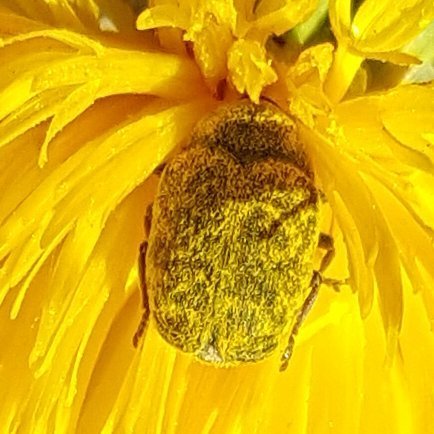
(c) Justin Johnsen, some rights reserved (CC BY) · licence
Family: Curculionidae · Class: Insecta · Order: Coleoptera
Larinus curtus (Yellow Starthistle Flower Weevil) is a California animal in the Curculionidae family.
The Yellow Starthistle Flower Weevil (Larinus curtus) is a small, introduced weevil in the family Curculionidae that was deliberately released as a biological control agent. Adult weevils are typically 3-5 mm in length with the characteristic elongated snout or rostrum common to weevils. The body is dark brown to black with dense, light-colored scales that give it a mottled appearance. Like other members of the genus Larinus, this species has a robust build with elbowed antennae and strong legs adapted for clinging to plant stems. This species is not native to California but was introduced from the Mediterranean region and Asia in 1992 as part of biological control efforts against yellow starthistle (BugGuide). The weevil has since established populations throughout California wherever its host plant occurs, particularly in grasslands, rangelands, and disturbed areas of the Central Valley, coastal ranges, and foothill regions. Its distribution closely follows that of yellow starthistle, extending into other western states including Oregon, Washington, and Nevada. Yellow Starthistle Flower Weevils inhabit areas dominated by their primary host plant, Centaurea solstitialis (yellow starthistle). These environments typically include annual grasslands, oak woodlands, chaparral margins, roadsides, and agricultural edges. The species thrives in Mediterranean-type climates with hot, dry summers and mild, wet winters. Adults are most commonly found on yellow starthistle plants from late spring through early fall, concentrating their activity in flower heads and upper stem portions. Adult weevils emerge in late spring and feed exclusively on yellow starthistle flower heads. Mating occurs on the host plants, and females use their elongated rostrum to bore holes deep into developing flower buds where they deposit single eggs. Larvae develop within the flower heads, feeding on seeds and floral tissues, effectively reducing seed production of the invasive plant. This feeding behavior is the basis for the weevil's use as a biological control agent. The species completes one generation per year, with adults dying after reproduction and new adults emerging the following spring. Larvae pupate within the dried flower heads over winter. As an introduced biological control agent, Larinus curtus does not have formal conservation status listings. The species was intentionally released by agricultural and land management agencies to help control yellow starthistle, which is considered one of California's most problematic invasive weeds. Studies have shown that the weevil can significantly reduce yellow starthistle seed production when present in sufficient numbers, though complete control of the weed requires integration with other management methods. The weevil's establishment and spread are monitored by the California Department of Food and Agriculture and university extension programs to assess biological control effectiveness. Environmental impacts on non-target plants have been minimal, as extensive host-specificity testing was conducted prior to release.
Classification
Class: Insecta · Order: Coleoptera · Family: Curculionidae
Frequently asked questions
How is Larinus curtus classified?
Larinus curtus belongs to class Insecta, order Coleoptera, family Curculionidae.
What family does Larinus curtus belong to?
Larinus curtus is in the Curculionidae family.
What is Larinus curtus?
The Yellow Starthistle Flower Weevil (Larinus curtus) is a small, introduced weevil in the family Curculionidae that was deliberately released as a biological control agent.
Is Larinus curtus found in California?
Yes. Larinus curtus is recorded in California in The California Species Project's catalogue.
Related species
Other California species in the same genus, family, or bioregion.
Data from The California Species Project — 14,000+ California species with verified data from CNPS, CDFW, USFWS, and more.