Larus belcheri
Belcher's Gull
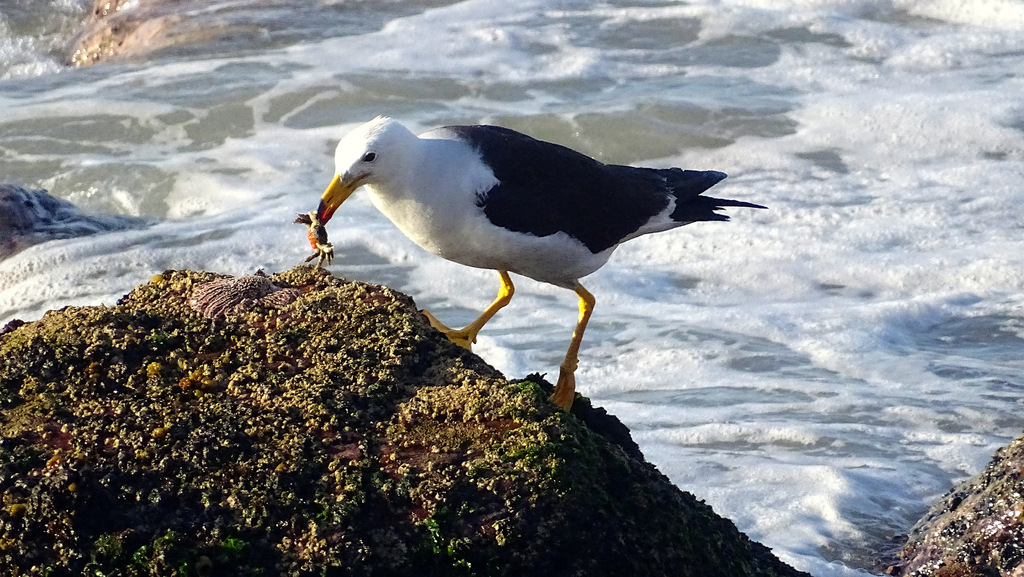
(c) Jorge Muñoz Camadro, some rights reserved (CC BY) · licence
Family: Laridae · Class: Aves · Order: Charadriiformes
Larus belcheri (Belcher's Gull) is a California animal in the Laridae family.
Belcher's Gull is a medium-sized seabird native to the Pacific coast of South America, with occasional vagrant appearances along the North American Pacific coast, including California. Adults measure 49-51 cm (19-20 inches) in length with a wingspan of approximately 120 cm (47 inches). The species exhibits distinct seasonal plumage variations. Breeding adults display a black hood extending from the bill to the nape, contrasting sharply with white underparts and pale gray upperparts. The bill is bright yellow with a red tip, and the legs are yellow. Non-breeding adults lose the black hood, retaining only a dark ear patch and partial collar. Juveniles show brownish mottling on the upperparts with a dark terminal band on the tail. Belcher's Gull breeds along the coasts of Peru and northern Chile, from approximately 3°S to 30°S latitude. The species inhabits rocky coastlines, offshore islands, and adjacent marine waters. In California, this species occurs only as a rare vagrant, with documented sightings primarily along the central and southern coastal regions. Records from California represent individuals that have strayed far north of their typical range, likely following oceanic currents or weather patterns that occasionally bring South American seabirds to North American waters. The species occupies marine and coastal environments, showing preference for rocky shores, sandy beaches, and nearshore waters. Belcher's Gulls are closely associated with the Humboldt Current system, which provides nutrient-rich upwelling waters that support abundant marine life. They utilize both intertidal zones for foraging and offshore waters for feeding, typically remaining within sight of land. Belcher's Gulls are opportunistic feeders, consuming small fish, marine invertebrates, and crustaceans. The species exhibits typical gull behavior, including surface plunging, scavenging, and kleptoparasitism. During breeding season, they form colonies on offshore islands and rocky headlands. Nesting occurs from September to February, with females laying 2-3 eggs in simple scrapes lined with vegetation or debris. The species shows strong site fidelity, returning to established breeding colonies annually. Belcher's Gull is classified as Least Concern by the International Union for Conservation of Nature, with stable populations throughout its South American range. The species faces localized threats from coastal development, fishing industry interactions, and climate-related changes to marine ecosystems. In California, the species has no conservation status as it occurs only as a vagrant. El Niño events appear to increase the frequency of vagrant records in North America, as altered oceanic conditions can influence seabird distribution patterns. The species benefits from marine protected areas established along the South American coast, which preserve critical breeding and foraging habitats.
Classification
Class: Aves · Order: Charadriiformes · Family: Laridae
Frequently asked questions
How is Larus belcheri classified?
Larus belcheri belongs to class Aves, order Charadriiformes, family Laridae.
What family does Larus belcheri belong to?
Larus belcheri is in the Laridae family.
What is Larus belcheri?
Belcher's Gull is a medium-sized seabird native to the Pacific coast of South America, with occasional vagrant appearances along the North American Pacific coast, including California.
Is Larus belcheri found in California?
Yes. Larus belcheri is recorded in California in The California Species Project's catalogue.
Related species
Other California species in the same genus, family, or bioregion.
Data from The California Species Project — 14,000+ California species with verified data from CNPS, CDFW, USFWS, and more.