Larus californicus
California Gull
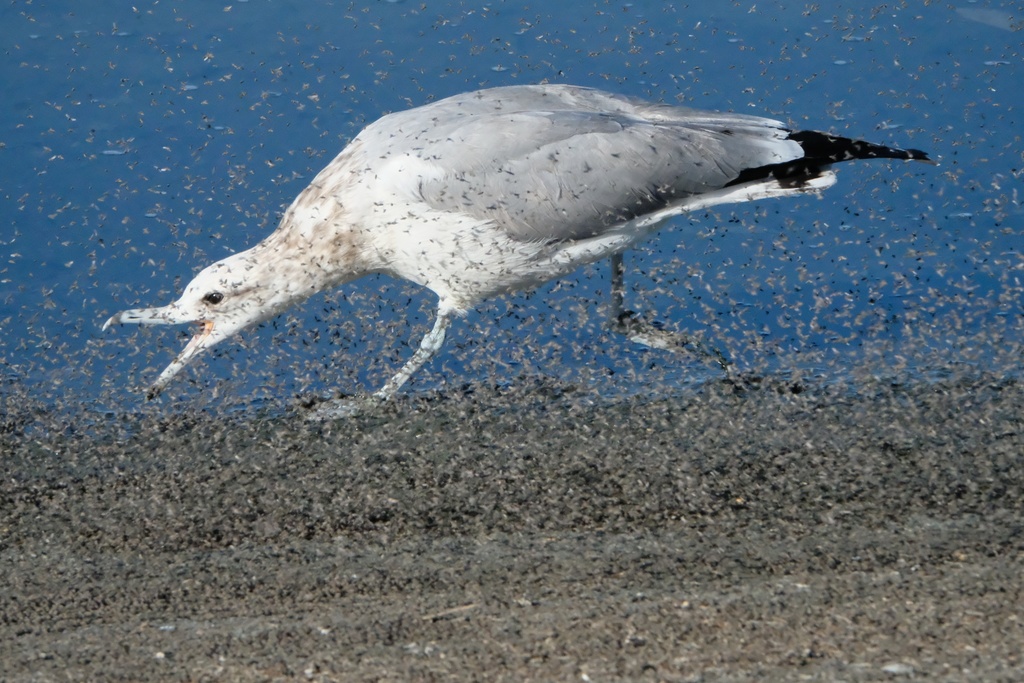
(c) Madeleine Claire, some rights reserved (CC BY) · licence
Family: Laridae · Class: Aves · Order: Charadriiformes
Conservation status: WL · G5 S4
Larus californicus (California Gull) is a California animal in the Laridae family.
The California Gull is a medium-sized gull measuring 46-54 cm (18-21 inches) in length with a wingspan of 122-137 cm (48-54 inches). Adults weigh between 430-1,045 grams (0.95-2.3 pounds). Breeding adults display white heads and underparts, gray backs and upperwings, and black wingtips with white spots. The bill is yellow with a red spot near the tip of the lower mandible, and legs are yellow to greenish-yellow. Non-breeding adults show brownish streaking on the head and neck. Juveniles are mottled brown overall with a dark bill and legs, requiring three years to reach adult plumage. The species can be distinguished from similar gulls by its size, bill coloration, and leg color. California Gulls breed primarily in the western United States and southwestern Canada, with major breeding colonies located in California, Nevada, Utah, Oregon, and Idaho. The largest breeding colony in California is at Mono Lake, supporting approximately 50,000 breeding pairs. Other significant California breeding sites include the Salton Sea, San Francisco Bay salt ponds, and various inland lakes. During winter, populations disperse along the Pacific Coast from British Columbia to Baja California, with many birds remaining in California year-round. The species has expanded its range eastward in recent decades. Breeding habitat consists of islands in alkaline and freshwater lakes, typically at elevations between 1,200-2,100 meters (4,000-7,000 feet). Nesting colonies are established on low-lying islands that provide protection from terrestrial predators. During migration and winter, California Gulls utilize diverse habitats including coastal beaches, estuaries, agricultural fields, urban areas, landfills, and parking lots. The species shows considerable habitat flexibility, foraging in both aquatic and terrestrial environments. California Gulls are opportunistic omnivores with a highly varied diet. During the breeding season, they consume fish, aquatic invertebrates, insects, and small mammals. The species gained historical recognition for consuming Mormon crickets in Utah during the 1848 agricultural crisis. Modern populations frequently forage at landfills, agricultural fields, and urban areas, consuming refuse, earthworms, and crop pests. Breeding occurs from April through July, with females laying 2-3 olive-brown eggs in ground scrapes lined with vegetation. Both parents incubate eggs for 23-27 days and care for young for approximately 45 days until fledging. The California Gull is classified as a Watch List species in California, indicating populations require monitoring but are not currently threatened. The global population is stable to increasing, estimated at approximately 500,000-700,000 individuals. Climate change poses potential long-term threats through altered precipitation patterns affecting breeding lake levels, particularly at key sites like Mono Lake. Water diversions and drought conditions can impact breeding success by reducing water levels and concentrating contaminants. Human development pressure on coastal wintering areas presents localized challenges. The species' adaptability to human-modified landscapes has generally benefited populations, though this also increases exposure to contaminants and vehicle strikes.
Classification
Class: Aves · Order: Charadriiformes · Family: Laridae
Conservation status
WL · G5 S4
Frequently asked questions
How is Larus californicus classified?
Larus californicus belongs to class Aves, order Charadriiformes, family Laridae.
What family does Larus californicus belong to?
Larus californicus is in the Laridae family.
Is Larus californicus protected or of conservation concern?
Larus californicus carries the following status: WL · G5 S4.
What is Larus californicus?
The California Gull is a medium-sized gull measuring 46-54 cm (18-21 inches) in length with a wingspan of 122-137 cm (48-54 inches).
Is Larus californicus found in California?
Yes. Larus californicus is recorded in California in The California Species Project's catalogue.
Related species
Other California species in the same genus, family, or bioregion.
Data from The California Species Project — 14,000+ California species with verified data from CNPS, CDFW, USFWS, and more.