Larus delawarensis
Ring-billed Gull
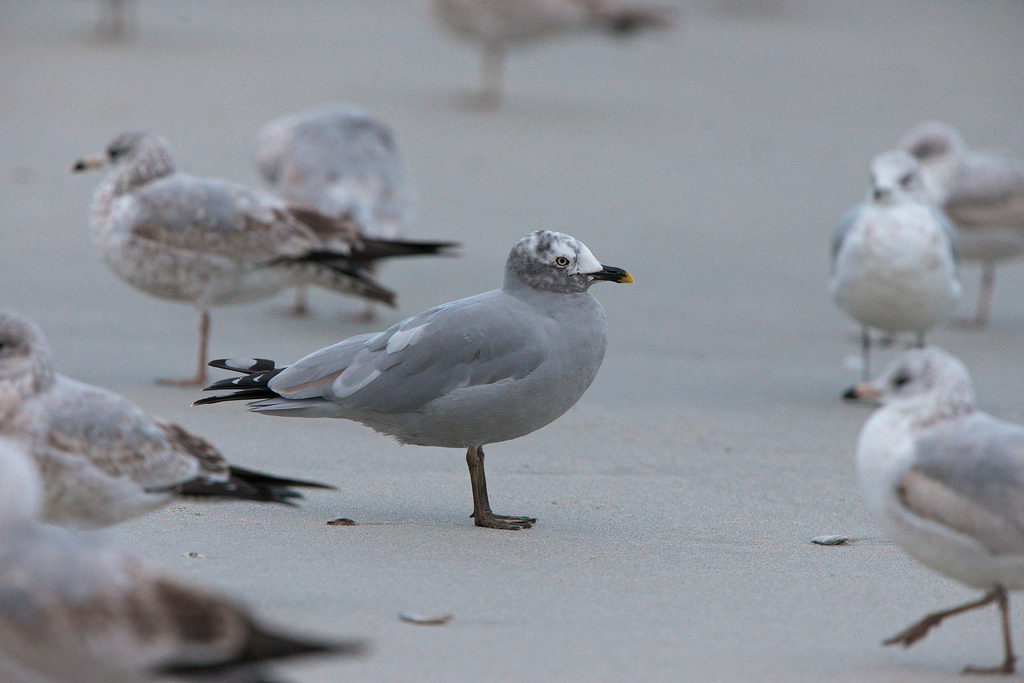
(c) Nodnarb Nedloh, some rights reserved (CC BY-SA) · licence
Family: Laridae · Class: Aves · Order: Charadriiformes
Larus delawarensis (Ring-billed Gull) is a California animal in the Laridae family.
The Ring-billed Gull is a medium-sized gull species measuring 43 to 54 cm (17 to 21 inches) in length with a wingspan of 105 to 125 cm (41 to 49 inches). Adults weigh between 300 to 700 grams. The species displays distinct seasonal plumage variations. Breeding adults exhibit white heads, necks, and underparts, with pale gray backs and wings. The bill is bright yellow with a distinctive black ring near the tip, which gives the species its common name. The legs are yellow-orange. Non-breeding adults develop brown streaking on the head and neck. Juveniles are mottled brown and gray with a dark-tipped pink bill that gradually develops the characteristic ring as they mature. The species reaches adult plumage at approximately three years of age. Ring-billed Gulls breed across a broad range of North America, from southern Canada through the northern United States. In California, they are primarily winter visitors and migrants, occurring along the entire coastline and in interior valleys. The species is common at major inland water bodies including the Salton Sea, San Francisco Bay, and Central Valley reservoirs. Some non-breeding individuals remain in California year-round, particularly in coastal areas and large inland lakes. The species inhabits diverse aquatic environments including beaches, harbors, landfills, agricultural fields, parking lots, and urban areas. Ring-billed Gulls are highly adaptable and frequently associate with human activities. They utilize both marine and freshwater habitats, from sea level to elevations exceeding 1,500 meters in California's mountain lakes. During winter, large flocks congregate at roosting sites near water bodies and feeding areas. Ring-billed Gulls are opportunistic omnivores with a varied diet including fish, invertebrates, earthworms, insects, rodents, eggs, carrion, and human food waste. They employ multiple foraging strategies including surface dipping, shallow diving, scavenging, and following fishing vessels. The species exhibits complex social behaviors, often feeding and roosting in mixed flocks with other gull species. Breeding occurs in colonial nests on islands, typically on bare ground or low vegetation. Females lay 2 to 4 eggs in shallow scrape nests lined with vegetation and debris. Incubation lasts 23 to 28 days, with both parents sharing duties. Chicks fledge after 35 to 38 days but remain dependent on parents for several additional weeks. Ring-billed Gulls are not federally or state-listed in California and maintain stable populations across their range. The species has actually expanded its range and increased in numbers since the early 20th century, recovering from historical hunting pressure and benefiting from human-modified landscapes. According to the North American Breeding Bird Survey, Ring-billed Gull populations have remained relatively stable over the past several decades. In California, the species faces typical urban wildlife challenges including vehicle strikes, entanglement in fishing gear, and ingestion of plastic debris. Climate change may affect the timing of migration and food availability, but current population trends remain stable throughout the species' range.
Classification
Class: Aves · Order: Charadriiformes · Family: Laridae
Frequently asked questions
How is Larus delawarensis classified?
Larus delawarensis belongs to class Aves, order Charadriiformes, family Laridae.
What family does Larus delawarensis belong to?
Larus delawarensis is in the Laridae family.
What is Larus delawarensis?
The Ring-billed Gull is a medium-sized gull species measuring 43 to 54 cm (17 to 21 inches) in length with a wingspan of 105 to 125 cm (41 to 49 inches).
Is Larus delawarensis found in California?
Yes. Larus delawarensis is recorded in California in The California Species Project's catalogue.
Related species
Other California species in the same genus, family, or bioregion.
Data from The California Species Project — 14,000+ California species with verified data from CNPS, CDFW, USFWS, and more.