Larus fuscus
Lesser Black-backed Gull
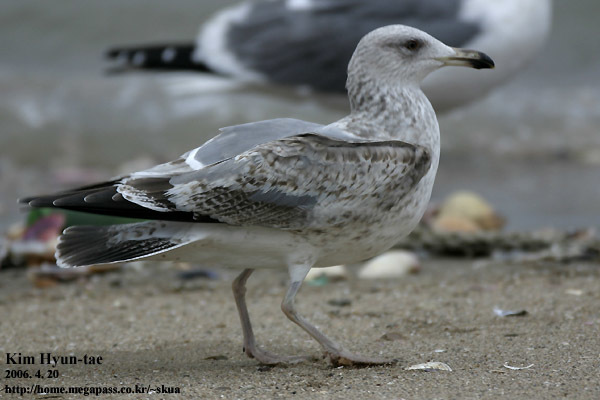
(c) Kim, Hyun-tae, some rights reserved (CC BY) · licence
Family: Laridae · Class: Aves · Order: Charadriiformes
Larus fuscus (Lesser Black-backed Gull) is a California animal in the Laridae family.
The Lesser Black-backed Gull is a medium to large seabird with adults measuring 48 to 67 cm (19 to 26 inches) in length and weighing 452 to 1,100 grams (1.0 to 2.4 pounds). The wingspan ranges from 117 to 148 cm (46 to 58 inches). Adults display distinctive slate-gray to black upperparts on the wings and back, contrasting with white underparts and head during breeding season. The legs are bright yellow, and the bill is yellow with a red spot near the tip of the lower mandible. In winter plumage, adults develop streaked brown markings on the head and neck. Juveniles show mottled brown plumage that gradually transitions to adult coloration over four years. This species breeds primarily across northern and western Europe, with populations extending from Iceland and the British Isles to Scandinavia and Russia. In North America, Lesser Black-backed Gulls are primarily winter visitors and migrants along both Atlantic and Pacific coasts. In California, the species occurs irregularly as a vagrant, with records documented from various coastal locations including San Francisco Bay, Monterey Bay, and southern California beaches. Sightings typically occur from October through April, with occasional summer records. Lesser Black-backed Gulls inhabit coastal waters, estuaries, harbors, and adjacent agricultural lands. During migration and winter, they frequent beaches, mudflats, lagoons, and offshore waters. The species also utilizes urban environments, including landfills, parking lots, and waterfront areas. They are highly adaptable and can exploit both marine and terrestrial food sources. This opportunistic omnivore feeds on fish, marine invertebrates, worms, insects, small mammals, eggs, and carrion. Lesser Black-backed Gulls employ various foraging strategies including surface dipping, shallow diving, scavenging, and kleptoparasitism. They often follow fishing vessels and associate with other seabird species while feeding. The species typically breeds in colonies on coastal cliffs, islands, and moorlands, constructing nests of grass, seaweed, and other vegetation. Females lay 2 to 3 olive-brown eggs with dark markings, with incubation lasting 24 to 27 days. Both parents care for the young, which fledge after 35 to 40 days. The Lesser Black-backed Gull is not federally listed in the United States and has no special conservation status in California due to its vagrant status in the state. Globally, the species is classified as Least Concern by the International Union for Conservation of Nature, with stable to increasing populations in most of its European breeding range. Climate change may be expanding the species' range northward and affecting migration patterns. In California, the species remains an uncommon but regular visitor, with observers noting potential increases in sighting frequency over recent decades, possibly related to expanding North American populations and changing oceanic conditions.
Classification
Class: Aves · Order: Charadriiformes · Family: Laridae
Frequently asked questions
How is Larus fuscus classified?
Larus fuscus belongs to class Aves, order Charadriiformes, family Laridae.
What family does Larus fuscus belong to?
Larus fuscus is in the Laridae family.
What is Larus fuscus?
The Lesser Black-backed Gull is a medium to large seabird with adults measuring 48 to 67 cm (19 to 26 inches) in length and weighing 452 to 1,100 grams (1.0 to 2.4 pounds).
Is Larus fuscus found in California?
Yes. Larus fuscus is recorded in California in The California Species Project's catalogue.
Related species
Other California species in the same genus, family, or bioregion.
Data from The California Species Project — 14,000+ California species with verified data from CNPS, CDFW, USFWS, and more.